On Thursday last week, I went to Springfield, the capital of Illinois to see sites around the life of one of America’s greatest presidents, Abraham Lincoln. I was in company of my host Prof Wilson who was visiting the place himself for the eighth time in company of visiting students and scholars.
(African students and visiting scholars to SIUE have had this 75 year old retired professor to thank for his effort in bridging the knowledge gap between the two sides of the world. For years, he has taken it upon himself to make sure that visiting students/scholars visit sites of historical and cultural significance in the United States, most times out his own pocket. In his company, I have visited the schools in Principia and Carbondale, and now the Lincoln home, Presidential Library, and tomb in Springfield. “Remi Raji was here too,” he mentioned as we were heading out of the Lincoln’s burial crypt, referring to the Nigerian poet and writer whose book Shuttlesongs America was written on his return from the United States in the summer of 1999. “And it was all too emotional for him. Here was where he broke down and cried”, he said, pointing to a spot near the exit out of the president’s burial crypt.)
Here is a short video I made of the visit. I’ll put up some pictures soon when I can.
For me, it was a moving, enlightening experience living through the life of one of the defining figures of modern America. – a complex, fascinating historical figure whose life, death, and legacy made a lasting mark on not just the country, but the world at large. The Presidential Library & Museum itself was a tribute to history, archaeology, and architecture – befitting of an uncommon man and a great president.
As culled (or stolen) from Clarissa’s blog, by Paul C. I wonder why I didn’t think of this since a long time ago. Better late than never, right?
Before
Ingredients:
3 lbs of onions.
½ cup of butter.
½ cup of celery, chopped with leaves.
6 cups of soft breadcrumbs.
1 tablespoon of salt.
½ tablespoon of freshly ground black pepper.
1 tablespoon of dried sage.
1 teaspoon of dried savory.
½ teaspoon of dried marjoram.
¼ teaspoon of ground nutmeg.
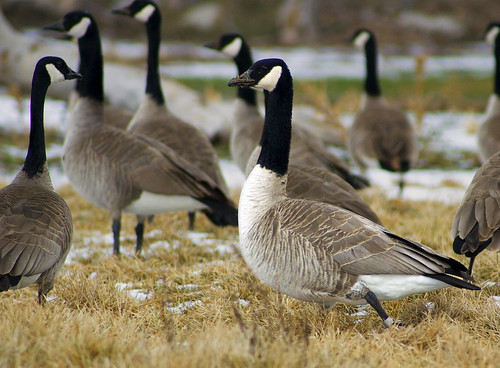
1 goose, about 11 lb.
1 tablespoon of fresh lemon juice.
Salt and pepper.
2 chicken bouillon cubes.
Boiling water.
Directions:
Peel and cut the onions into quarters, then put them in a large saucepan, and add just enough boiling water to cover, and simmer, covered, for about 15 minutes or until just tender.
Drain, cool, and coarsely chop the onions.
In a large heavy skillet, melt the butter.
Add the chopped celery and gently sauté for about 3 minutes, stirring frequently.
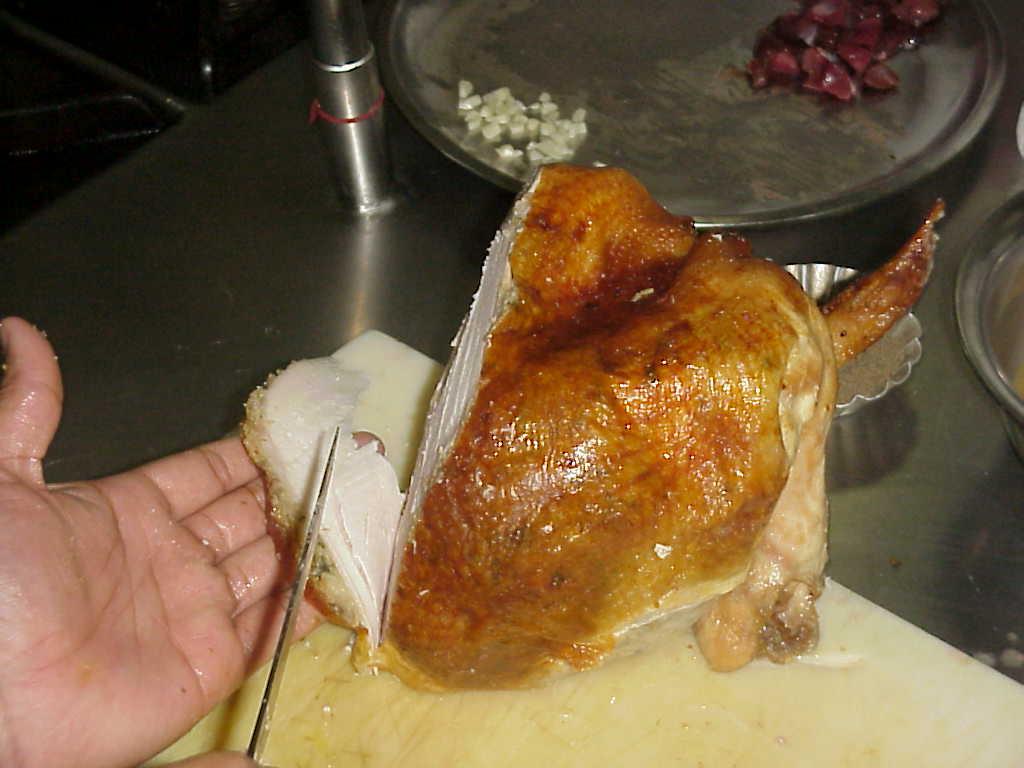
After
Add half the breadcrumbs and cook gently until lightly browned, stirring frequently to combine.
Place the remaining breadcrumbs in a large mixing bowl.
Add the salt, pepper, sage, savory, marjoram and nutmeg. Toss to combine the ingredients.
Add the prepared onions and the sautéed celery and breadcrumb mixture to the bowl and toss again to combine.
Allow to cool before stuffing the goose.
Preheat your oven to 400°F (205°C) degrees.
Rub the goose inside and out with lemon juice.
Generously sprinkle the inside of the goose with salt and pepper.
Stuff the neck cavity with some of the prepared stuffing and fasten the neck skin to the body of the goose with a skewer.
Stuff the body of the goose with the remaining stuffing, skewering and lacing the end closed.
Tie the legs and the wings to the body with butcher’s twine.
Prick the skin of the goose all over, to let the fat escape while roasting.
Place the goose, breast side, down on the rack of a large roasting pan.
Add the chicken bouillon cubes to the two cups boiling water and stir until dissolved, then pour the mixture over the goose.
Roast for 60 minutes, uncovered.
Pour off half the drippings and discard.
Turn the goose over and pour two cups of boiling water over the bird.
Continue roasting for another 60 minutes.
Pour off the drippings from the pan, again.
Prick the skin of the goose all over and continue roasting for about 90 minutes more, or until tender.
To serve, place the goose on a large platter; remove the twine and skewers to carve.
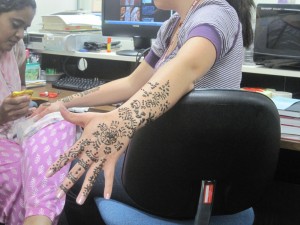
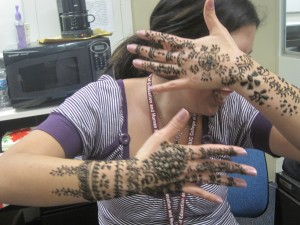
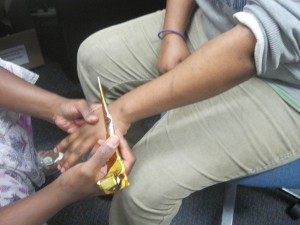
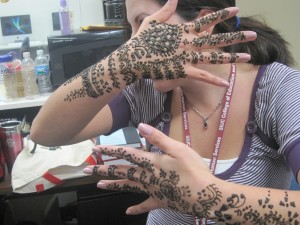
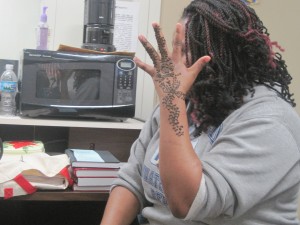
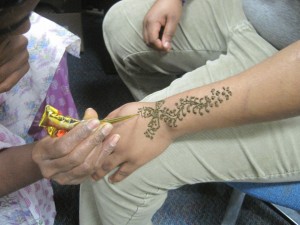
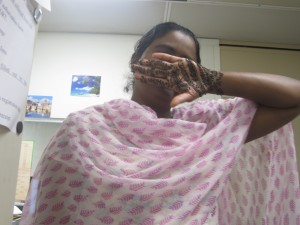
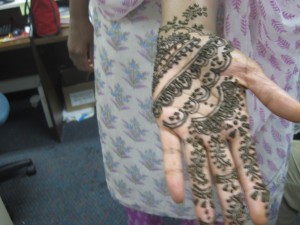
I walked into a body art session in my department on Friday and this was what I witnessed: the process of making temporary tattoos called the henna.
As opposed to permanent tattoos found now on bodies of very many Americans following the hip-hop trend of today, the designs here made from henna – the dye from a particular flowering plant – lasts for a couple of days, maybe even weeks, before going off by itself after constant washing. One thing for sure is that it looks beautiful, especially when well designed like these ones. And it didn’t take long to make.
The artist was none other than Catherine, the Indian Graduate Assistant, and friend, who works at the Foreign Language computer lab. Wouldn’t you want to get something as beautiful as this? I did get her to write my name on my left arm, but it didn’t turn out as beautiful as these, maybe because I didn’t have a fair skin.




 I walked into a body art session in my department on Friday and this was what I witnessed: the process of making temporary tattoos called the henna.