Browsing ktravula – a travelogue! blog archives for February, 2010.

The Yoruba Talking Drum

I made this video during the cultural awareness week on the campus of the University of Ibadan in May 2009. The talking drum is a uniquely Yoruba percussion instrument that is peculiar because of its ability to mimic tonal patterns of actual human speech. In this video, I tried to engage the drummer in a little competition of abilities; he on the skill of drumming, and I on the skill of discerning. Enjoy.

I showed it to students in class today, along with some music videos of Lagbaja, once again to illustrate the blend of tradition and modernity in Nigerian contemporary music. I had a reaction to his appearance almost in a similar form to the one I had the first time I showed him in class. My students are supposedly aware of the concept of the masquerade, but apparently, not in this particular shape and form. Let me get back to you after the Mardi Gras, and I’ll let you know what I learn about how American masquerades really look like. I’m guessing that they are not as elaborate, or as “scary”. We also learnt about the concept of Abiku, how different it is from the scientifically verifiable child mortality, and how many children often used it as a weapon against abusive parents.

Books On My Desk

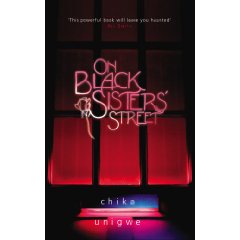
On Black Sisters’ Street by Chika Unigwe. This is a powerful book about the lives of prostitutes from Nigeria in the brothels of Belgium. To write this very moving account of an oft neglected but very crucial social phenomenon, the author had to travel to the red light districts of Belgium and conduct one-on-one interviews with the prostitutes, and record their stories. In a recent interview, she confessed that she was able to earn their trust only because they didn’t believe that she was a writer, but a novice hoping to learn the secrets of the trade by asking around. The author Chika, a Nigerian writer, lives in Beligium with her family. Her first book De Feniks was the first work of fiction to be written by a Flemish author of African origin. Get the books, and read them. As soon as I finish reading it, I hope to come back with a mini-review.

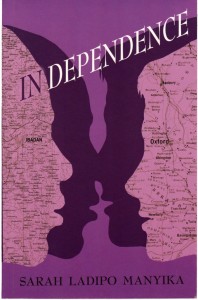
In Dependence by Sarah Ladipo Manyika. In judging this book first by its cover, I give deserved kudos to the artist who placed the map of my home town and the town of Oxford, UK on the two unknown faces that grace the pink cover. The novel itself tells the story of love that spans generations, continents, amidst several obstacles , passion, idealism, courage and betrayal. Of the book, this has been said: “…has the subtle power of a well woven work, nothing is out of place… it is full of surprises” among other nice things by journalists and reviewers.

The first chapter begins thus in a sentence of quite enticing prose: “One could begin with the dust, the heat and the purple bougainvillea. One might eve begin with the smell of rotting mangoes tossed by the side of the road where flies hummed and green-bellied lizards bobbed their orange heads while loitering in the sun.”  So far, it is a very good read.

I can’t explain why I read so many books at once, as I can’t explain why I keep acquiring them. All I know is that some times my mood requires a different kind of literary satisfaction. At some other times, another. I recommend these two good books for their entertainment as well as their literary value.

For my copies of the book, let me thank Tayo who got me an autographed copy from Sarah Manyika, and sent the book to me all the way from Nigeria, and Ikhide who gave me his copy of “On Black Sister’s Street” along with his review notes within its margins. Then Chika Unigwe, the author herself who graciously sent me a copy from Belgium.


All About Valentine

I’m sure that if I as much as asked around, I’d find that I am not the first or the last young man with embarrassing stories about Valentine’s day or first loves. The first Valentine’s day in my childhood memory occurred while I was in JSS3 or so just as I was just becoming a teenager. I had bought a well-designed card with lovely words and taken it to the extra-mural classes we had during evenings hoping to present it to the object of my attention who attended the same evening class. I however made the mistake of first showing it to a friend, who laughed at me, so I figured that the girl to whom it was addressed would hate it even more. Without reason, I tore it off, and sat the whole day wondering what would have happened it I had given it to her. I liked her very much after all. It was one of those moments that never come back, except in adult reminiscences of childhood playfulness.

An earlier moment of embarrassment in childhood love has however occurred a few years before this time. This was way back in primary school when a cute girl in my class suddenly became an object of my intense interest. The problem was, she shared a class bench and desk with some other guy who was not me. Not a good thing, I reckoned, and began to scheme how to take over the spot that I felt rightly belonged to me. So one day while everyone was on break, I moved my books and bag from my designated sitting space and transferred, without the teacher’s permission, into the spot where Tunde – my love’s authentic class partner – always sat, and waited for him to show up so as to show him his new sitting space far away; and for her to show up to be my new class queen. The succeeding events when class eventually reconvened a few minutes later – I must confess – were matters of great laughter to the class, and to me not just embarrassment but an attack, a conspiracy. For I could never fully understood the teacher’s sense of amazement that I had decided to finally move closer to “the love of my life.” I am convinced that variations of this event would have played out within laughters in my mind of my school mates whenever they thought back on those times of our childhood.

There was another one from childhood which I believe some folks might remember. Or not. A few quasi-risqué-romantic-ish prose poems from an eight year old boy have suddenly been discovered within his school books by his siblings. The boy was me, of course, and the girl was the same object from class. The punishment, according to them, was having to read the said “poems” aloud to a giggling audience of siblings within the house, or risk having them reported to parents. Why that threat of showing them to parents was such a big deal then is still not clear to me, but I will bet that it had roots in self-consciousness. I took the first choice, with all requisite boldness for such endeavour, and read my most private pondering on a desired love in public to a group of jesting folks who most likely just wanted to have fun at my expense. Luckily, it did not end up as the last of such expressions of emotions contemplated in solitude. As an undergrad in the University in 2002, I wrote another one and titled it “My Valentine Fantasy.”

St. Valentine’s day is coming again next week, and since the love fairy has already delivered my gift since a while ago, I don’t think that I have much of a request. It is likely that I spend the weekend at the annual Festival of the Mardi Gras in St. Louis anyway – my first time experience of the uniquely American festival of life, fun, colour and fanfare. For Chris’s sake – my American classmate and co-conspirator to the event, I hope it is more than just a day of staring at flashing boobs of random strangers. You bet I’d let you now what I think. Meanwhile, head over to LaurensOnline for those of you in Lagos who may want to impress friends and lovers with Valentine gifts of shoes and bags. You get up to 20% discount if you show proof of donation of any kind to the Red Cross for Jos Relief. It’s a season of giving, after all.

And yes, please tell me about your own childhood crush experiences. I’d love to listen to them, you know.

A Nice Old Pic

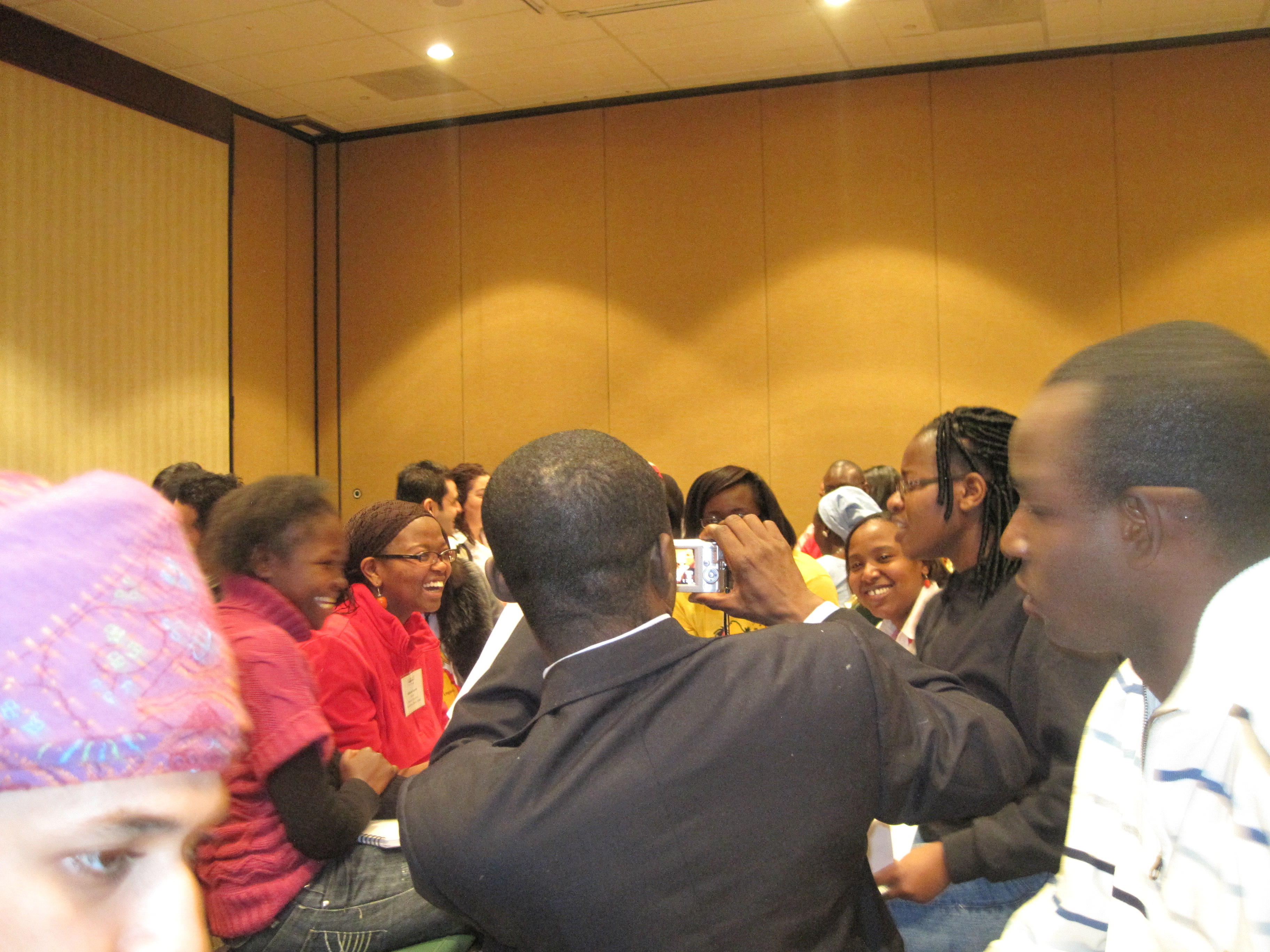
“One day your life will flash before your eyes. Make sure its worth watching.” – Anonymous.

Picture taken during the Fulbright conference at the Hyatt Regency Hotel, Washington DC.

On Chinese Poetry

Professor Tom Lavalle is a great man. He is soft-spoken, he has sparse beards that cover much of his chin, and he smiles a lot. And he speaks Chinese! He is an American Professor in my department and he learnt, speaks and teaches Chinese language and literature. Isn’t that amazing? I met him for the first time on Monday even though we had been communicating a lot through email, and even though his office is just a stone throw from mine. For all I know, we may have gone past or maybe even bumped into each other more than once since August without knowing. For sure, the image of him that I had in my head before meeting him was not of someone of such height and demeanour. Why I had the preconceived image in my head, I have no idea. All I know is that when I met him, I was pleased. He is a pleasant person to talk with.
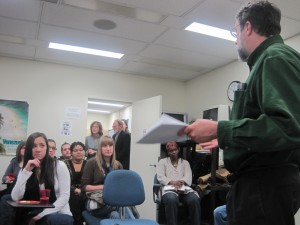
During the first email exchanges we had before we actually met, he had sent me these few translated poems from Chinese which I loved, so on meeting him, conversation inevitably turned to the subject of Chinese poetry and language and how it had influenced Japanese language and literature as well, especially in the form of writing. I learnt so many new things, about him, about China and about writing, language and culture. Why an American would be interested in Chinese poetry is not a question I would always ask, but I did ask for his own motivations, and I found them rooted in a craving for private space in the solace of words. He is a poet himself, writing in English, and his contact with Chinese writings had sparked a different kind of interest in him that has been sustained up to the present day. And because of him, students of this department now have the chance to learn Chinese language and culture at SIUE, and take field trips to a country of so much intriguing history.

Because of meeting him, one day I hope to start learning Chinese. I don’t know where to start from though, whether on a lesson in good calligraphy or on a lesson in Chinese alphabets which I am very sure is larger than the English one. And unlike many of the students who register for the class, my motive will not really be in anticipation of, and preparation for the new world order where Chinese is spoken as a first language by all world citizens, but to access many of the different forms of expression of thought buried within the texts of old and classical Chinese poetry.

Well, maybe I lie when I say that, but how would you know?

“Drinking Wine” #4 of 4

Tao Qian (365-427)

Autumn chrysanthemums have beautiful color,

With dew on my clothes I pluck their flowers.

I float this thing in wine to forget my sorrow,

To leave far behind my thoughts of the world.

Alone, I pour myself a goblet of wine;

When the cup is empty, the pot pours for itself.

As the sun sets, all activities cease;

Homing birds, they hurry to the woods singing.

Haughtily, I whistle below the eastern balcony –

I’ve found again the meaning of life.

(Translated by Wu Chi-liu)