Browsing ktravula – a travelogue! blog archives for October, 2009.

New Lessons

A few minutes ago, I concluded a chat with a French student in this University (on a different but similar international programme) who told me that I had done the abominable by putting my red wine in the refrigerator. “If you were in France,” she said, “you’d be thrown out of the country by now!” Oh, the French!

IMG_0672Checking my post mailbox this morning, I found an envelope postmarked from Pennsylvania. Since I wasn’t expecting anything so soon, I was surprised to discover in it Wole Soyinka’s Collected Plays 2. I had indeed ordered it a few days earlier from Amazon alongside books by George Carlin and William Shatner.  That was fast delivery! The book wasn’t new, but it was in very good condition. Back in Nigeria, Amazon was never my friend since I didn’t have a credit card, and they won’t ship goods to Nigeria anyway. The book contained The Lion and the Jewel, Kongi’s Harvest, The Trials of Brother Jero, Jero’s Metamorphosis and Madmen and Specialists, that last one being an all-time favourite.

Today we saw the Chimamanda Adichie TED video talk in class for the first time. As I remarked to a Nigerian friend afterwards, the video was lovely, but in the end it wasn’t spectacular. I think I must have expected too much a response from the students, although in the end, I’m sure they were able to understand and appreciate Ms Adichie’s valid points in a way that they found interesting, and in a way to which they could relate. My own initial response to the talk, which was pride and exhilaration the first time I saw it, was – as I realize it now – because I’m Nigerian and, seeing her speak to such an international audience filled me with such pride. Why it did so, I can’t explain now. She hasn’t said anything new, but she has used many new ways to illustrate it. And that’s always a good thing.

Later in class, as I was about to receive a usb flash disk from a student who wanted to submit her Yoruba audio recording assignment, I felt an electric spark when I collected the disk. I was alarmed, until the other students told me it’s normal, calling it a “static” current. (Wikipedia calls it “the buildup of electric charge on the surface of objects” which is either bled “off to ground or are quickly neutralized by a discharge”). A few minutes later when I gave the flash disk back to her, it happened again just as our hands made contact, and I “freaked out”, to use American colloquial expression of shock and disbelief. That was one thing I have never experienced before, but I have no doubt that it exists, perhaps even in Nigeria, and all over the world, but I’ve never heard any personal stories. According to a few more people that I’ve asked, this is a rather common phenomenon in America which comes into play when one of the contact persons has spent much time making bodily friction with the floor with their feet or body, they are indeed capable of conducting electricity. I find that strange. I’m surely not touching anyone again soon. Time to go back to receiving assignments through email.

I miss home!

Yesterday

IMG_0613

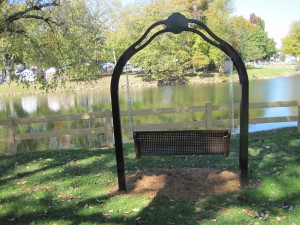
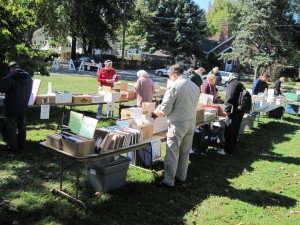
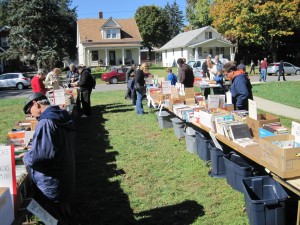
These are a few random pictures from the Le Claire Festival at Edwardsville Park, yesterday, just by the beautiful fountain lake.

If my computer quits misbehaving, I’d put up some more pictures from the event which included a book fair/cheap book sales, live music, outdoor eating and barbecue, popcorn and exhibition of historical materials, photos and artworks.

IMG_0598IMG_0623IMG_0609IMG_0625IMG_0608
IMG_0606

IMG_0621

Tyto Alba

Tyto Alba. (Source: Wikipedia)

Tyto Alba. (Picture Source: Wikipedia)

While living in within the compound of a secondary boarding school in Jos Nigeria in 2005, I had discovered a nest of owls living in the roof of our apartment. The discovery was not really by chance since from the first night spent in the bungalow, we knew that something bigger than a large rat was living in the roof, and they would always make loud noise with their steps especially in the middle of the night. The ladies in the apartment freaked out immediately they found out that what lived there was not a large rat as they had previously thought, but (not one, not two) about three or more large owls. A few days after, we caught one of them by spreading a mosquito net at the opening of the roof through where they had always got in while someone went into the house to hit on the ceiling. After a few knocks that disturbed its sleep, the bird flew out right into the net, and we caught and took him down. Napoleon – a fellow resident of the apartment, and a fellow Youth Corp* member – did most of the job of plucking the most prominent of the bird’s wing feathers, and let him go into the living room. Not being able to fly anymore, he just stood there and stared at everyone suspiciously.

By the next morning, news had spread all around the school and neighbourhood that we had caught an “evil bird” and were keeping it right in our apartment. By evening, it was not the Riyom women alone who were throwing tantrums at our “audacity” and “foolishness”, but the residents of the apartment themselves. The two young women (also in the NYSC programme) who lived in the building with us would not understand nor stand the logic of bringing a scary looking “evil” bird into the house at all where it was bound to become a big physical daylight nightmare. In addition to making sure that their rooms were locked at all times from then on, and they began to whisper “the blood of Jesus” every time they inevitably had to come into the living room, right before they go back into their rooms screaming for us to get the “evil looking thing” out into the woods where it belonged. The bird read the mood of the house and refused to eat any of the rodents we brought for it, or do anything else other than just stare sheepishly. After a few days of immense internal and external pressure, not helped by the bird itself which had started looking weak and tired from non-flying, non-eating and too much daylight, and we had to let it go after a while. It took a few slow steps into the woods behind the apartment and went out of sight as fast as possible. I went online to read about them and found that they were called the African Barn Owl, or TytoAlba – very cool, adorable animals of night. Apparently, not everyone was comfortable with having them near. I confess that at times even I also felt a little chilly when I looked into their large dark eyes. IMG_0569

Yesterday at midnight, while taking a walk back from campus where I’d gone to see a free show of the movie The Ugly Truth, I found an owl perched on a wire mesh around the Cougar Village tennis court. It was a little larger than the tyto alba but not any less adorable. Luckily I was able to take two shots before it flew away into the woods, which was just as well, since it was perched so high and far beyond the reach of my hands anyway, and the lighting was not good enough to give me a better shot of it.

The Nigerian National Youth Service Corps (NYSC) is a community service cum paramilitary service mandatory for every fresh university graduate below the age of thirty. It takes each fresh graduate out of their home environment into somewhere else – mostly a farther town within the country, for the period of a year to learn new things, and to serve the community, while living on stipends from the federal government.

A Food With No Name

Whenever I sit and stare at an empty page like tonight, my mind wanders to the the many things I could be blogging about besides the adventures of class and teaching. Earlier today I tried without luck to write a poem about the foods I eat with names I can’t pronounce. I failed. The reason for that, in my opinion, is that I was hungry. I had the image I wanted to portray in my head, but my stomach hurt a little from not having eating in the morning so I couldn’t get my words out in the particular order of my choice. Feeling deflated, I went out and got myself some really nice microwave-ready food which was ready to eat in less than ten minutes. But by the time I got well fed and satiated, the muse had left. I was left only with desires of different kind so I went into Facebook to stare at pictures instead. When poet Maya Angelou came to SIUe in early October, one of the poems she read was called The Health-Food Diner, a satirical response to a particular occasion when she was stopped from smoking in a public restaurant. In the absence of a own lyrical response to my particular situation at the moment, I will leave you with Maya Angelou’s words. It’s certainly one of her funniest poems.

The Health-Food Diner

No sprouted wheat and soya shootsIMG_0469
And Brussels in a cake,
Carrot straw and spinach raw,
(Today, I need a steak).

Not thick brown rice and rice pilaw
Or mushrooms creamed on toast,
Turnips mashed and parsnips hashed,
(I'm dreaming of a roast).

Health-food folks around the world
Are thinned by anxious zeal,
They look for help in seafood kelp
(I count on breaded veal).

No smoking signs, raw mustard greens,
Zucchini by the ton,
Uncooked kale and bodies frail
Are sure to make me run

to

Loins of pork and chicken thighs
And standing rib, so prime,
Pork chops brown and fresh ground round
(I crave them all the time).

Irish stews and boiled corned beef
and hot dogs by the scores,
or any place that saves a space
For smoking carnivores.

	-- Maya Angelou
Culled from http://www.cs.rice.edu/~ssiyer/minstrels/poems/383.html

On the Mid-Term Test

IMG_0571The test of students’ progress is not always as tricky if one is lucky to have listened to the students beforehand and to have understood what they are used to and what they are not. In most cases, as long as the teacher knows that his purpose in the test is not just to surprise and attack but to monitor his own progress, there would be less tears and heartbreaks when the day is over.

A few days before our mid-term test, I had given the students a list of areas to focus on, as well as how exactly to answer specific type of questions. There should be no one-word answers to questions requiring full sentence responses. There would be extra credit points for those who put the correct tone marks where necessary. There would be questions on personal introduction, identifying objects, numbers and greetings. And lastly, they should go over virtually everything we had learnt in class. After all, it was supposed to be a test of ability as well as hard work.

Beside the thirty questions that covered all we had learnt in class, there were also five extra-credit questions meant to help whomever needed it to get their grades up, and the questions there included “Kíni orúkọ olùkọ rẹ?”, “What is your adopted Yoruba name, and its meaning”, “Who is the author of the class novel ‘A Mouth Sweeter Than Salt’”, “Where was Suzanne Wenger originally from?” and “What’s the word for ‘zero’ in Yoruba?.

I have now finished marking  (or scoring/grading in American English) the tests, and beside an overwhelming joy at how good they performed, I have made a few prominent observations:

  • That none of them remembered my surname. It must have either been too long to remember.
  • That many of them spelt “Good Afternoon” as “kassan” instead of “kaasan”. I’ve now told them that Yoruba does not have consonant clusters. That’s why when the word “brother” enters the language, it is pronounced as bùrọdá.
  • That only a few of them knew the name of the author of the class novel. A few more remembered only the first name and not the surname, while a few knew the surname but couldn’t spell it.
  • That everyone remembered the Yoruba word for “zero”.IMG_0573
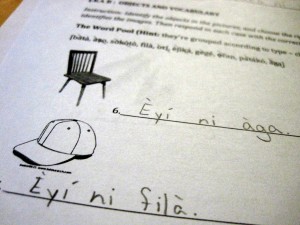
  • That some of the students studied beyond what they were taught in class. A case in point: even though I didn’t ask for plurals, a student responded to a question on identifying pens as “èyí ni awọn gègé.” (trans: here are some pens). I found that very impressive, and she was rewarded extra for it.
  • That almost a quarter of the class didn’t remember their adopted Yoruba names, and half of those who did had forgotten the meaning. It was sure that they were not expecting to be asked about this in the exam.
  • That some students would just NOT read the instructions on the exam question paper no matter how many times they’re told to do so, and notwithstanding the same instruction having been previously stressed again in the exam review materials.
  • That there is always one student in class who would not perform well no matter how much help the teacher gives. S/he is either just lazy, or dull. The problem is, they are the ones who do not speak up when they don’t understand, for fear of being too prominent, when they should ordinarily be the most vocal.

I have my work cut out for me for the next half of the term.