
Browsing ktravula – a travelogue! blog archives for September, 2009.

I’m Being Jazzed

A John Coltrane CD for my birthdayJazz has taken over my life.

It’s definitely not the jazz you’re thinking about in Nigeria right now, but something a little less involving of incantation or some kind of juju charm and hypnotism. Now that I think about it, I wonder why Nigerian music and Nigerian traditional medicine seems to have similar naming systems: juju and jazz don’t just refer to music, do they? Now, in jazz music, the only horn you have is the one that makes music, and not the one for incantations; and the only charming you get from it is the one that mesmerizes you, and not the one that hpynotizes.

On Saturday, I was hosted along with Reham at the home of the Palestinian American family of the Tamaris. The food was nice, the conversation was splendid, and the children were fun. The two kids spent the whole time playing a game called “Life”, and their parents’ response to them when the children invited them to come and play with them was “Why should I play Life when I can live it.”. Splendid.
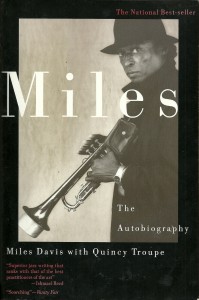
The Autobiography of Miles Davies

The other surprise of the evening came when the host opened up his audio library and gave me a ton of jazz cds to choose from. I’ve never seen so much jazz and blues albums in one place. Well, I have, actually, but that was at Jazzhole in Lagos, Nigeria, where one needs a large amount of money to be able to get a really nice cd, book or picture. I remember spending hours and hours going through Jazzhole looking for something I could buy with my little student stipend, but I was disappointed. Anyway, I digress. I left the Tamari’s house with a bag of songs from Chess, Joe Turner and T-Bone Walker, Mississippi John Hurt, Blind Lemon Jefferson, Blind Willie McTell, Leadbelly, Woody Guthrie, John Lee Hooker, Muddy Waters, Howlin’ Wolf, Elmore James, Buddy Guy, Sonny Boy Williamson, Otis Rush, Etta James, Little Milton, Koko Taylor, Clarence Gatemouth Brown, Miles Davies, Julian Adderley, Paul Chambers, James Cobb, John Coltrane, Bill Evans, Wynton Kelly, Big Bill Broonzy, Bonnie Raitt, and a guy called Taj Mahal. Earlier on Tuesday, I had been given a gift CD of John Coltrane by my artist friend for my birthday, and Ben has complemented it with another gift of the hits of Louis Armstrong and Duke Ellington. All of these songs have now found their way into my iPod, and when I look at it, the little device now looks so surprisingly heavy.

Now, coming back from a visit to my artist friend’s house, I found another library of a different kind: books. The food was good. The movie we went out to see was even better: Love Happens, featuring Jeniffer Aniston, which is really a beautiful, moving story of family and loss than romance. I think I must have shed a tear somewhere towards the end. Now I have in my hands “The Augobiography” of Miles Davies, one of jazz’s musical pioneers from East St. Louis, written by Quincy Troupe. It is 441 pages long, and I won’t finish it soon, because I have a lot to do in class during this week, but it’s enchanting to read. I’ve started, and I’m loving it so far. I am being jazzed, but this is one time when it comes with a total feeling of satisfaction.
Tumbling Down

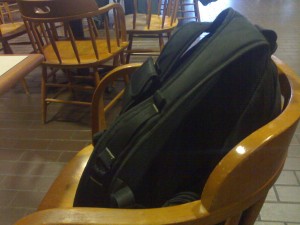
I must have been filled with a little too much adrenaline on Friday when I sped out of my apartment, pedalling with all strength and style as I hurried towards the University. A few blocks away from my building, I began a little display of daredevilry and found myself in the grass, a few feet away from the depth of the lake. I didn’t fall in, and it was a relief – not because I won’t be able to get out (I can swim), but because I had my back-pack and it had my laptop and other important documents. I would be a shame to lose all of them in such moment of playfulness.

23082009928I can only blame adrenaline because there was no reason why I should have been speeding so much at the time, or standing up on the bike while riding, or – as I discovered while laying flat out on the grass – stretching one hand instinctively and without need to touch an overhead tree branch as I rode under it. By the time I brought my hand back on the bike handles, I had lost total control and was doing a 360 degree tumble from the bike track/road onto the nearby grass – luckily. The lake was still a few feet away, and I had a helmet on. There were no cuts or broken bones, but there was a little bruise, and a dirty spot on my cream chino’s trousers. It was some relief to find that there were no passers-by at all –  male or worse female students – who could have had no choice but to laugh or giggle at me as I tried vainly to pretend that all was fine and I didn’t have grass slivers somewhere in my mouth. The supernatural almost always kicks in to save me from undeserved embarrassment. I’m grateful.
I laid there for a while, staring up at the clear sky, then stood up, dusted my shirt, and rode on to the University in style. I did tell you I lead an interesting life, didn’t I?

Ìyeyè

Ìyeyè

Nigerian Ìyeyè

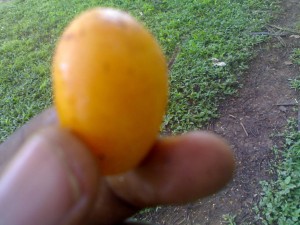
A while ago in Ibadan Nigeria, before I began my Fulbright programme, I’d shared my fascination with the ìyeyè with friends on Facebook, and the response was enlightening. A few of them hadn’t seen it before nor enjoyed it’s delicious taste. I was discovering for the first time that the fruit which looked like a juicy berry that as little children we enjoyed picking up from under its tree as it falls down ripe during the summer was not as popular in all of Yorubaland as I had previously thought. There were some people who grew up in parts of the country without even ever having heard of it.

I’ve now developed a similar fascination in the United States when I discovered the fact that not as many people as I thought know what plantain is or what it tastes like. Interestingly, even Reham the Egyptian has displayed a similar kind of ignorance which is understandable when I put it in mind that Egypt is in Africa’s Sahara region, perhaps not a place conducive to growing such food crops. At the get-together we had at Rudy’s house on Tuesday for my birthday, we inevitably got around to discussing food, and I made another startling discovery that America has no such food as yam. What they called yam here is actually Irish potato, which I’ve had the pleasure of having as a good meal of potato salad.

190920091334

American Red Grapes

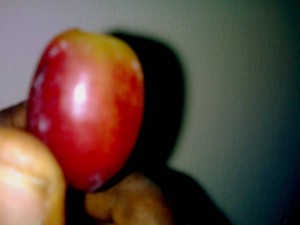
Now grapes. It has been a good pleasure first to discover that one could buy and enjoy a bunch of red table grapes here for a far, far less amount than one pays for it back home. The first (and inevitably last) time that I asked how much a bunch of grapes cost in Lagos Nigeria, I believe it was between $10 and $40, which is only understandable when I know that we neither plant nor “produce” it there. They are imported. And secondly that no matter how hard I try to shake the thought, I can’t but conclude that the American grapes are a sort of distant family to my Nigerian ìyeyè even though they taste a little differently, and the ìyeyè has a seed in its core which the grapes don’t. They look much alike, and they both are berries with a juicy inside and a soft covering. I don’t know much of Agriculture, but I won’t bet against the fact of this similarity. Help anyone?

Yorubaland as Disneyland

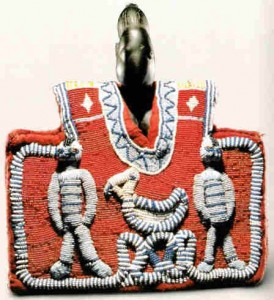
It was mentioned almost in passing in our last Wednesday class by one of the American students that whenever I mentioned Yorubaland, as I always inevitably did while telling them about that part of Nigeria (and Benin Republic), it always sounded to their ears and imagination as some sort of a fairytale kingdom. “Like Disneyland?” I asked, and they all shouted, “Yeah”.

Seriously.

Photo culled from http://academics.smcvt.edu/africanart/“Do you still have kings there?” Another one asked.
“Yea,” I replied, but their function is mostly ceremonial, like that of the British monarchy.”

“Do they have rituals of coming-of-age, like public circumcision dance and festivals, like we’ve seen in some movies?” A different student asked.

“Well,” I replied, thinking, “there are some cultures in Africa that has those festivals for boys when they get to a particular age. But not the Yorubas. They cut their male children’s foreskins immediately after birth, and don’t wait at all.”

They seemed to be very impressed, but I was sure that they still retained some exotic ideas about the famed “Yorubaland” or “Yoruba Kingdom” that reminded them either of a Disney Movie or an animated flick, so I dimmed the lights in class, put on the projector, and logged onto YouTube to look at some Yoruba movies and clips. Luckily, there was Baba Wande and a few other actors there who I could point to as archetypes of Yoruba men and women in dressing and mannerism. I typed in “Lagos” and one of the first results there was a documentary about the Megacity project in which Wole Soyinka and a few others were interviewed for the camera. In the end, I felt I’d given a balanced view of life in Western Nigeria. They saw what a typical Yoruba house and street look like. They saw cars and people going about their daily lives, and I wondered if I’m able to help them reconcile that general city look with the many eccentricities that some of our cultural practices present as evidence of another kind of social life that is not seen on the streets.

For future classes, I have promised them a session of reading short stories of the tortoise from Nigeria. Luckily, I have brought along with me from Nigeria a book of many folk stories that captured our imagination as kids growing up in places in Yorubaland. And from the twinkle in their eyes, I see excitement, and I’m equally thrilled by the prospects of being the storyteller in a class of young students in the Western hemisphere, travelling back into a magical kingdom of animals, and folk wisdom from the Yoruba elders. This too will be an experience of a lifetime.

Class Sessions 6

It was fun to be in class again on Wednesday, and revise the many words, phrases and expressions that we had learnt since the class began five weeks ago. Somehow, we all seemed to have grown on the Yoruba expressions and they don’t sound any strange as they probably did to the ears of the new students when I first walked into the class on that first day.

220920091368Yesterday, we had class practices of oral conversations. The students were paired with each other and they took turns to display their knowledge of conversation techniques by dramatizing the scenario of a chance meeting by two previously unfamiliar strangers meeting on the streets of Osogbo or any other Yoruba town.

Speaker A: Káàro o.

Speaker B: Káàro. Sé àláfíà ni?

Speaker A: Dáadáa ni/Adúpé/Àlàáfíà ni o. Ìwó nko?

Speaker B: A dúpé. Kíni orúko re?

Speaker A: Orúko mi ni Títilayò. Kíni orúko tìre?

Speaker B: Orúko mi ni Babafemi. Níbo lo n gbé?

Speaker A: Mo n gbé ní Collinsville. Kíni orúko àbúrò re?

Speaker B: Orúko àbúrò mi ni _______/Mi ò ní àbúrò. Ìwo nko?

Speaker A: Orúko rè ni _________. Ègbón mélòó lo ní?

Speaker B: Mo ní ègbon méjì. Ó dàbò.

Speaker A: Ó dàárò. Inú mi dùn láti mo é.

…and other short phrases improvised for conversation.

As far as elementary knowledge of the language is concerned, we have not done badly so far. Our areas of improvement include pronunciation. Many students still found the word “GBÉ” hard to pronounce, even though they could pronounce the English word “RUGBY” quite effortlessly. Can someone tell me why? In the next class, we will be in the computer lab to do get these expressions on tape, voiced by the students themselves. It is going to be a fun experience.

PS: According to the result of the web poll on the right side of this blog, I need to spend more time talking about my class sessions more than I talk about myself. I will keep that in mind as I go on, but I will occasionally have to share my personal experiences as they relate to my appreciation of the programme as a whole. Thank you for voting. I will appreciate as many more votes as possible. This is a chance for me to know what thrills you and what doesn’t. If you haven’t voted, you can still do so. The poll is on the right side of the blog homepage.