There is a place on one of the major islands in Lagos called “Sandfill”, a place that most likely has never always been called that (since it might not even have existed before it was created out of the Lagos Lagoon). It was most likely called Sandfill because a large part of it was reclaimed from the waters through the process of sand-filling. Many parts of the Lagos islands are currently undergoing that kind of creative enlargement through reclamation from the water. However, take any public transport in Lagos today (especially ones run by the largely uneducated bus drivers and conductors), and what you would hear as they call passengers going to this direction is not “Sandfill” at all, but “San’ field” (or “Sand-filled”, or “Sandfield”).
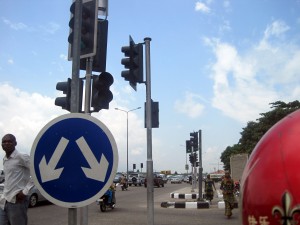 I have long wondered about this process of organic nomenclative (if the word exists) behaviour. In my many walks around the world of visiting places of significance, the process of naming – and the etymology of words over time – has always held a tremendous fascination. A place in Southern Illinois, a few miles from where I lived for a few years, was called “Effingham“, a name that meant nothing much to many of my friends until I asked whether it was a purified version of something more risque from an earlier time. Then it made sense. When I moved to Lagos, I heard about another place also a few miles from where I now live, called “Olókó nla”. Like Effingham, I broke into a giggle the first time I heard it, half thinking it was a mistake, and that no one would dare name their place “The Owner of a Big Penis”. The case for ambiguity is plenty. After all, one of the mischiefs we indulged in in primary school was forcing our classmates to repeat “My Father Has a Big Farm” in Yoruba, with a view to leading them into the wrong pronunciation of “Oko” (farm) so that it sounded like “Okó” (penis), and get a big laugh from the class. The only way “Olókó nla” would make sense is if it were originally “Olóko nlá” (The Owner of a Big Farm) before mispronunciations (perhaps due to the multi-ethnic mix of the Lagos metropolis), mischief, perhaps illiteracy, and/or the convenience of colloquialism, dispensed with the old, original pronunciation, and left the world with the latter. I have been in public transportation many times in which young or old women tried to tell the driver where to let them out by yelling “Olókó nla”. It has always been hard to suppress a giggle.
The transformation of “Sandfill” into “San’field” or a variation of it is a problem mostly of illiteracy (and an interesting phonological phenomenon). The bus transport workers most likely are unaware of the reason for the name. A similar problem of contact between people of different languages gave us “Oke Sapati” and “Oke Paadi” in Ibadan, where “Sapati” is a bastardized form of “Shepherd Hills” as the colonial officers once called it, and “Padi” is the Yorubized form of “Padre”. A similar simplification has changed people originally called “Mohammed” to Momodu, “Abubakar” to Bakare, “Isaac” to Isiaka, “Badmos” to Badamosi and a number of many names that have now become decidedly Yoruba as a result of appropriation, and inadvertent imposition of the Yoruba phonological pattern on the imported word. Yoruba does not take consonant clusters, so any imported word must decidedly take on a new vowel whereever a cluster once existed. So “bread” becomes buredi, “brush” becomes buroshi, “brother” becomes buroda, and an easy one “handset”, when imported, becomes han’seti, among many others.
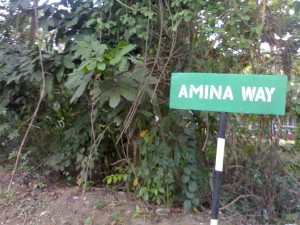
The pleasure of names and nomenclature are open to those interested in their exploration, as I have found. To many to whom names are just pointers to direction and nothing more however, it won’t matter one bit if Alausa was originally “The place for Hausas”, or “The place for walnuts”. Yet as history shows us, the etymology of a word/place plays a significant role in the historical understanding of that place. A few years ago, the Oba of Benin wrote a book in which he claimed that rather than the other way around, it was actually a man from Benin who migrated to found Ife and become their king long after the successful expansion of the Benin kingdom. To support his point, a number of linguist friends pointed to the cognate possibilities of Ooni (the name of the Ife king’s title) being descended from Ogene, and not the other way around. Language, after all, always tended towards simplification, and a word once called Ogene (high chief) is more likely to have simplified to become Ooni over time. The Ife history tells a different story however, claiming that Ooni is a simplified form of Owoni.
There is not much to end this with as lesson other than submit to the dynamism of the process of naming. In cases like Olókó nla, it might lead to legitimately fun anecdotes. By some luck, when signposts spring up in Lagos in the future that point to that place as “San’Field”, or maybe even “Sanfeld”, some people would still be alive who would remember how the original name first came about. Like Nigeria from “the Niger Area” as Lord Lugard’s wife first thought it, it would have been worth the birth of just another word in the language.
 Along with a few researchers (and with anticipated support from a few institutions), we are proposing to build a multimedia dictionary of Yoruba names. It is a project that has been dear to my heart for a while now, and a continuation of an earlier project from university days. As the name suggests, it will be a dictionary. And being a dictionary, it will have a number of important linguistic, cultural, and artistic resources attached to each entry. We envision a cross between a wiki and a dictionary.