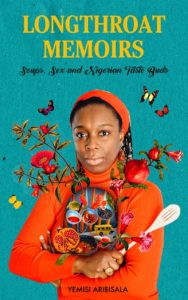
By Kọ́lá Túbọ̀sún
Book: Longthroat Memoirs: Soups, Sex, and the Nigerian Taste Buds
Publisher: Cassava Republic Press
Publication Date: October 31, 2016
Pages: 357
The Great Nigerian Food Memoir
“Nigerian food is the most endearing, enduring, topic in the world, especially since we have gone so long without talking about it.” – Yẹ́misí Aríbisálà
The allure of Yẹ́misí Aríbisálà’s debut book of nonfiction, titled Longthroat Memoirs: Soups, Sex, and the Nigerian Taste Buds, is, surprisingly, not the food, nor the promised “sex” in the title.Published by Cassava Republic Press, this book of essays comes with a more satisfying delight of well-crafted sentences, stories, and attention to detail, style, and ambition. An unapologetically Nigerian book of such brilliance, scope, and purpose has been needed for such a long time that it is hard to believe, going through its pages, that it has indeed arrived. The author it was who wrote a food column, for a few years, in the now defunct Nigerian paper 234Next as “Yẹ́misí Ogbe”. For those familiar with the understated brilliance of her style and approach, this all makes sense, and is timely.
Longthroat begins with an introduction fourteen and a half pages long, which coyly attempts to manage expectations of what is to come, through caveats about the author’s unlikely role as the bearer of the country’s food biographer, among other “confessions”. This part could, arguably, serve as a review of the book, except that it takes too much away from what follows. So, it whets the appetite of the new reader instead, and sets the table. In that introductory treatise, we are gently eased into the kitchen of the author’s mind where both the idea and the steps of implementation of this culinary journey take place first before they meet the page. I would return to the introduction again and again.
The first chapter is a review of the reputation of Nigerian food (and names) in the imagination of the foreigner. The first culprit here is Michael Barry, a half-Welsh, half Indian man whose “Nigerian River Province soup”, listed in his 1996 book Exotic Book the Crafty Way as an authentic Nigerian food, left the author scratching her head trying to identify its parts. She gave up eventually disappointed with both the writer’s imagination and the accessibility of Nigerian food to the outsider. Our ẹ̀bà, it turns out, was what was being described as “cassava bread” in Michael Barry’s book. A disappointing find! We never find out what the “River Province soup” is because it doesn’t exist. It is, also, the creation of a foreigner as an idea of what a random Nigerian food looks or behaves like. Yẹ́misí did not hold back: “I would hate for Michael Barry to get away with… suggesting that our food can be simplified and reformulated into something else, something it is not.” Her idea of the Nigerian soup as a person, more than just a passing item on a plate, takes off from here. It “may seem aloof at first,” Yẹ́misí writes, “but once given its due, it will immediately make itself friendly at the very least.”
The book proceeds smoothly along these lines, paving way to other encounters, hilarious personal stories, told through the keyhole of a writer obsessed with the dimension of food in everything, from sex to dreams. The chapters move in different ways. In one, which came early in the book, the author describes a typical Ìbàdàn boy in a marketplace arguing with his mother about eating àmàlà (or ọkà, as she put it), to illustrate the mischief of adults, and the eternal devotion of Ìbàdàn indigenes to their carbohydrate meal made from “desiccated yam ground into a dense white flour, and then made into a grey mound using boiling water”. In another narrative in the same chapter (listen to audio excerpt here), a ram goes for a ride on a motorbike and ends up on jollof rice: quite a common scenario in many Nigerian cities during festive seasons. The description lures in the oblivious reader with gentle words until the macabre nature of that ill-fated ride becomes suddenly obvious. To the Nigerian already familiar with it, the passage plays out like dark humour gently hovering above the conscience of the meat-eater. Another chapter which further elevates the book into canon of essential Nigerian literature is the story of the author’s father-in-law and his travails in the Nigerian Civil War; how the pursuit of the next meal drove the conversation of survival. It was, aptly titled, Dead Man’s Helmet.
Reading the book, deceptively called a “memoir” (it is, to be clear, but the character of the book both defies and enriches the genre) takes the reader back decades into a happy place where food and observations of food carried some reward of discovery. Here, I speak for myself. What is the difference between irú wooro and irú pẹ̀tẹ̀, for instance? What are they anyway? Why did they smell so much and why did my grandmother like them so? Why are they wrapped so tightly in those small leaves? Why are the ones my grandfather’s youngest wife bring from the farm better than the ones we bought in the neighbourhood? How come I sometimes saw them in food (as in okro) but not in some (ewédú)? How is irú different from ògìrì? How does Dadawa, the cubed variant that debuted in the 90s, improve on what was a local condiment that supposedly added character to our local meals?
Sometimes a chapter is a journey into a forgotten part of one’s culinary past left unappreciated through the passage of time. One word or a sentence here stirs it up, smell, aroma and all, into new awakening. At other times, it is the wonder of a shared experience which in one’s memory had previously amounted to nothing more than a mundane occurrence, but which in literature transmutes now into a notable cultural event, properly highlighted and intensified through the writer’s power of observation and documentation. This is where the work shines out the most: elevating the most common experiences—what defines Nigerian culture: our cooking and eating habits, among ourselves and on the world stage—through beautiful sentences that delight and titillate.
Who remembers, for instance, breaking open ẹ̀gúsí shells with their fingers, usually while seated with mothers or grandmothers to whom that kind of chore is a perfectly productive use of afternoon time? In a world now defined by “finesse”—a type of accepted snobbery against deliberateness, patience, commonality—that image of simpler times spent sitting with grandparents and helping out with cooking over several hours, along with stories, songs, and admonition, brings the reader as close to emotional time travel as one can get. Yẹ́misí calls this particular food preparation act: “hand-shelling” ẹ̀gúsí. We who are familiar know that she meant “hand de-shelling” or “de-husking” if we’re being technical, but one could see why the former appeals more. In Yorùbá, we say “wọ́n ń ṣẹ́ ẹ̀gúsí”. That act of “ṣẹ́-ing” the ẹ̀gúsi, breaking the shell in half and removing the content, is what gets the white pointed seeds out to where it can be useful. But that attempted homage to the phonetics of ṣẹ́-ing the seed, instead of the mechanically-sounding “de-shelling”, warms my linguist heart (though that English translation wasn’t the only relevant pull to the vivid sense of nostalgia that the chapter beautifully evokes).
Of Sex, Subtlety, and More
“What I ate last night is as significant and as tangible as my dreams. My dreams are as tangible as what I’m eating. Neither of them can safely be taken for granted. Life seen through the prism of food has more colours, not fewer.” – YA
The “sex” in the subtitle of Longthroat Memoirs does not materialize in the way readers conditioned to the treatment of the subject in Nigerian writing might expect it. But it does materialize in different other ways, sometimes gentle, and sometimes hot and vivid, usually around food and cultural attitudes. I, for instance, will not be able to look at a the velvety black covering of the African snail the same way again. Through word association and the writer’s imagination of their role in our sexual myths, vividly and mischievously imagined in the chapter called The Snail Tree, a Nigerian foodie’s insistence on a snail diet will now always task the mind in the direction of more intimate parts. The treatment of sex here however, as one would realize, is deliberate. Check out, for instance, this sentence from the second paragraph from that same chapter:
“There are places in a woman that a penis will never reach.”
The sentence that follows this gives too much away so I will not quote that here. But the chapter itself, one of the most directly polemic in the book, tackles the author’s discomfort with the ubiquitous fascination with sex in contemporary literature. Here, she opines directly on the Nigerian/African writing and literary culture in a way that is fresh and unflinching, using food as a contact point. Chimamanda Adichie and Binyavanga Wainaina make appearances and not in a flattering way. The chapter also explores the way in which food can be used to sublimate other human impulses. But because of the understated way in which sex appears and disappears throughout the work, I expect some mild reader rebellion. Pointing out the irony of using “sex” to sell a book in which the use of sex as a selling point in modern writing is so directly challenged will be too good to pass up.
In a yet unpublished interview with me, Yẹ́misí clarifies her purpose:
“Our manifestations of sexuality seem mostly dysfunctional. In writing, in the media, it is mostly titillation and misunderstandings. Are there some things that the application of words disfigures? Obscures? We all seem to be grasping at straws in private lives bragging about our involvement on public platforms. So if we are going to be real and honest, “liberality” should be prima facie the admission of incompetence and fumblings and disastrous encounters. The chapter was me saying, look I’m not going to pretend I’m good at this, that I apprenticed with Cirque du soleil. If I’m going to be truthful and free in my writing about sex, I’ll have to talk about my confusion and incompetence. Everyone else can write titillation if they want.
I wanted to point out obvious and not so obvious parallels between appetites… I wanted to offer the perspective of seeing something better by not looking directly at it.”
That chapter alone, The Snail Tree, capable of winning any prize for nonfiction anywhere, makes the whole book worth reading.
But the book does (and packs) much more. It challenges assumptions (Will a Maiguard in Lagos prefer carefully made white soup or his Agege bread and fried eggs, if given a chance?), attacks hubris (Yorùbá people, with your pride of “sophistication”, come to Calabar and experience food cooked with some imagination and creativity), and examines contradictions (How are Yorùbá the oily-food-eaters—ndi ofe mmanu—when Easterners add oil to their garri at every instance? And how are Igbos the eaters of solid-as-stone food—aj’òkuta má mun’mi—when their invention of garry-with-oil has rescued ẹ̀bà from the tyranny of turgidity?). Longthroat Memoirs successfully situates itself in a prominent space for not just the sensual narratives around food but of cultural attitudes, defining the country and its people in our own taste and words. A cookbook, a narrative of one culinary pilgrim’s journey through Nigeria’s cultural environments (from Ìbàdàn to Calabar), an exposition on prejudices and pretensions of some of our cooking myths, a personal and historical diary, all at once, Longthroat Memoirsmanages to fulfill more than gastronomic desires.
How to Cook a Sentence
“Writing about food in the way I do involves noting the influence of food on life and life on food, and attempting to weave an accurate cultural landscape.” – YA
Something that Aríbisálà has, and exhibits in abundance in this work, is patience. (That, along with the discipline to remember the names of all the food items she encountered while living in Calabar, and the diligence to verify the English—and sometimes Botanical—names of the local vegetables and fruits we are used to under different local names.) Reading any book is a race against time and the writers intentions. But the style in Longthroat Memoirs is deliberately contemplative of each individual reference, attentive to the moment enough to satiate an impatient reader and possessive of the right depth to reward a patient one. We know now that the book came about from a number of essays written first for a weekly newspaper column. But in setting each word to the page, the writer has deployed a rare skill that draws the reader in with an inviting aroma and keeps them satisfied after each course. In Peppered Snails, Aríbisálà introduces new Nigerian concepts (“toaster”, “yíláta”, etc) to the unfamiliar reader and spent considerable time weaving these into a tale about the cooking or endurance of hot peppered snail, all without taking the focus off the important direction of the narration. The style reminds of the best offerings of greats like Sóyínká in a work like Aké or Ìbàdàn, the Penkelemes Years, for instance. This is no idle comparison.
How does Yẹ́misí do it? How does one person deftly convey a vivid sense of smell and presence through words? We have read countless fiction and nonfiction by African writers, but not many of them have handled the treatment of food or any intimate contact with this much dexterity. I have an idea, but it is an inadequate one. Growing up in South-Western Nigeria isn’t enough motivation to care about its food, nor is having been transposed—through marriage—out of that environment into a contrasting one in the South-South a sufficient excuse either. There are many coincidences along the way, one of which is discovering, a while ago, that her health, as well as her children’s, was being affected by what they were consuming. She wrote about how she found out, in her trademark style of patient literary exploration of ordinary facts, combining personal history with a collective journey around food, in the piece for Medium in 2015 titled Mother Hunger.
Though that piece, along with many others of hers scattered around the web, are not included in this collection, they offer some clues as to the motivation for her craft, but not the germination of her skill. The writer’s obligation to memory and her diligent recollection seems to have been wrought through plodding hard work of deliberate crafting over many years.
Eventually reaching the end of such a book feels satisfying as equally as it feels deeply dissatisfying: it is not a book that should be read from cover to cover in one stretch. Each chapter, like slivers of mọinmọin under the leaves after a wrap is finished, should be returned to for extra flavours and spice. It is a shame that the book is not universally available on Kindle. Those equally likely to enjoy the literary delight of its letters juggling the taste buds of memory are Nigerians abroad or people everywhere with interest in Nigerian food culture. This book is for them. And for non-Nigerians, I suspect that its successful grounding of Nigerian recipes, ideas, misconceptions, myths, and stories through a personal lens will also be a brilliant introduction to both our cuisine and a different kind of nonfiction narrative. Listen to Yẹ́misí describe Lagos through the eyes of a drive to Yaba:
“Lagos knows how to primp and sashay on bridges, new skyscrapers, tall swanky things. It has $1,200-a-night hotel rooms; overestimated real estate on anxious hairlines of land arbitrarily reclaimed from the sea; fragile, sand-filled peninsulas anchored on the Grace of God…”
***
What are the knocks? A few. Olúbàdàn, the king of Ìbàdàn, was once referred to as Aláàfin of Ìbàdàn – an unintended slight that would have caused a warring of tribes in a different time. There’s also the perennial issue in Nigerian literature of having Yorùbá names/words written without appropriate diacritics. This should change in 2017, please!
In the chapter called Peppered Snails, the description of “toasting” on the campus of University of Ifẹ̀ spoke about taking a girl to “a new buka” to eat dodgy Chinese food instead of “an old buka” to eat pounded yam and soup. Those who have lived on that campus would know that the passage referred, instead, to New Buka and Old Buka respectively. These are not generic eating places, but known brands and locations.
So, What is This Book?
“(Nigerian Soup) is a multifaceted cultural treasure trove full of intriguing stories. It might not be gastronomically illustrious, but it is energetic and good-hearted. It belongs to one of the most fascinating personalities in the world: the Nigerian.” – YA
Is it a cultural resource, an encyclopedia of relevant memories, a cookbook, a dialogue with nostalgia, a thorough work in the documentation of the Nigerian food and cultural experience, a hard-wrought piece of literary exploration? All would be right and all would be insufficient. Yẹ́misí has, simply put, written a Nigerian book of stunning brilliance. Until now, when I am asked to provide a book from which to appreciate and understand Nigerian culture, I have usually had very few to mention. Peter Enahoro’s How to be a Nigerian comes quickly to mind, as does Chimamanda Adichie’s Half of a Yellow Sun. But the latter is fiction and political while the former is mostly cultural and humorous. Yẹ́misí Aríbisálà’s book is both and more.
Memoirs are fun usually because we know that they tell us something interesting about an author, a situation they were in, or a certain time or a subject. When terribly done, they are too self-assured, too boastful and thus inauthentic, unsatisfying and unrepresentative of expected situations. Others are doomed by self-censorship to be of any real value for the genre, or by too much focus on the self to offer us more. But, depending on our initial expectation, it is usually easy to be satisfied with a personal account, which is by definition subjective. Being stimulated, engaged, or elevated by such work is another thing. That requires a different experience found in very rare instances in the hands of a skilled writer. Longthroat Memoirs falls into the latter category: a book that carries the weight of so much cultural and literary burden, and manages to discharge it with grace and style.
_____________
This essay was first published on Village Factor on January 21, 2017