I was once a radio presenter, and it was one of the best times of my life.
I had just left secondary (high) school, and I had come across this advertisement on radio asking for interested young person for a radio programme aimed at the youth. I didn’t have so much to do after high school so I jumped at the opportunity, and also because I had so much energy that I just desperately wanted to channel in a creative direction. I was sixteen.
I was also very smallish, but already showing signs of growing. I surely wasn’t as tall as I am now so the first fear was that I would be turned down because of my young looks and voice. It was an unfounded fear because when I got to the broadcasting studio on the day of the oral and practical interview that had us making impromptu broadcasts on radio and television in front of all the judges and other contestants, I found that I was the tallest and one of the oldest of the applicants, and all of a sudden, I had another sudden fear of being turned back because of my height. Eventually, that turned out to be unfounded too. I went into the air conditioned cubicle that I had seen for many years on television (It was where their presenters announced the beginning of each television programme) and read the prepared script. For effect, I even added a few words of mine, and smiled. Time up, next person. After a while, the interview was done, and the over thirty of us young boys and girls were asked to go home and wait for a phone call that will confirm our acceptance.
I got mine a few days later from the producer of the show, a beautiful woman and a veteran broadcaster of the radio station who had trained in England and was married to a famous Nigerian football goalkeeper (now late). She told me that I’d been accepted, and that I should show up on Wednesday to meet with my co-host to prepare a jingle that will be used to promote the show, and get familiar with the broadcasting house. There was a snag though: we would not be paid for our work like normal staff, but we would sometimes be given stipends to cover our transportation. Was I still interested? Yes, I said, and hung up. It was going to be fun to be a radio presenter of a thirty minutes weekly radio show (which was later extended to one hour) on Saturdays.
There were a few other snags along the way, one of which was the lack of a functional record library in the Broadcasting House. The good records have either been lost or stolen and the library had only a few old albums. For contemporary music, we depended on commercial Deejays who demanded that we mentioned their names at the end of every show as their only compensation. For a while, I also stole and borrowed some of my father’s records from his library and returned them afterwards (if I remembered to). It really was fun. My co-host was a young beautiful girl who was then still in secondary school at the time. (The last time I checked on her, she was working in a famous bank in Ibadan). We would meet on Wednesday at the big broadcasting house to rehearse and get our lines right, then later an hour before the show at the FM station to get comfortable and cue CDs and record tracks, then when it was 1.30pm, after the introductory signature tune that was the chorus of We Are The World, our voice would come on: “Hello to you folks out there. You are welcome to Children’s Delight. I am Sola, and with me is Kola…” They later changed the name of the show as well.
Till date, I sometimes get the impression of being considered too old, or sometimes being too young. At the coffee lunch on Monday a few weeks ago with Prof. McClinton, I had told her my age since she thought I was still twenty-five, and she couldn’t believe when I told her that I was a few years older than that. I almost couldn’t believe her either. “Your mannerisms don’t show you as that old,” she said, and I laughed. I agreed too, while also adding, “It could be because I don’t have much of a beard.” Or maybe I am an old man in a young man’s body. Till date, I still also get questions from friends who knew me in those days on the radio. They always wondered why I walked away from it when I entered the University a year after. The fact was that I was actually bored after a while. After up to a year presenting and giving all of myself to it sometimes for free, I was ready to move on. However, I enjoyed every moment of it even though it was becoming too stressful to manage and to combine with a new experience of University life. I also began to consider myself grown up for the themes of the weekly shows. I was moving away from the realm of questions and polemics for the reality of answers and actions. University called. In any case, Sola had a few more months on the show before she adapted it for older youths, and eventually walked away when she went into the University a few years later as well. They were fun times.
Today, I co-hosted a radio show on Blogtalk with Nigerian blogger Vera Ezimora along with two other Nigerian bloggers. It is a two hour weekly web-radio show discussing a general lifestyle topics. This week’s topic was a subject of good fiction: When do you object to someone else’s relationship in light of what secret you know about one of them? Never? Immediately you know? Or, right before “I do”? You can listen to the show here. I enjoyed the discussions and the phone-in contributions, and it reminded me of some of those pleasant days in the cool padded rooms of the FM radio studios in the late 90s. On one of the office boards today in the Broadcasting Corporation in Ibadan is still a copy of a picture of the young me in suit with large headphones on my head, of Sola my co-host and our beautiful brilliant producer in the studio all of us staring at the camera. Good times.
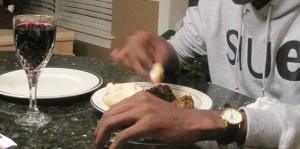 This is the first part of the tale of my visit to the State of Maryland, where food engaged me in a contest of wills and I almost ran for cover.
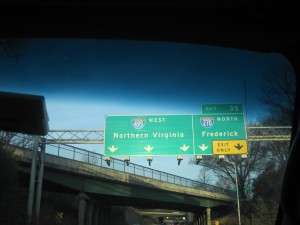 But we made it to his house in one piece, Vera Ezimora and I, with the aid of a talking GPS device. I have never been so humbled by the power of technology, where a little device as small as a mobile phone can lead a car driver to a location of more than an hour away, and where we had both never been before. We were coming from her University where we had gone to participate in one of her class tutorial sessions. (Needless to say, after that almost boring hour of listening to different accents of her classmates discussing the varying definitions and types of empathy, I am now convinced that I am never going to see that word in the same way ever again. Ever. And this is not a good thing!) No matter where anyone lives in the United States, a GPS device can lead anyone else there, without fail. It’s takes just a little imagination to conceive of how much of a leap we would achieve in Nigeria and Africa in general (in criminal investigation, business or even social relations) if we could just get adequate electronic mapping of the landscape.
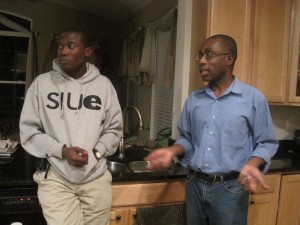 The man Ikhide Ikheloa who met us at the door turned out to be a simple, likeable man just like I had assumed from a distance. He was warm, and down to earth. He is a simple man with a very good taste, and humour; a family man in his middle age. A photo of Barack Obama rests beneath the television in the living room. He ushered us in with his still authentic Nigerian Pidgin English, and I felt immediately at home. His last visit to the country of his birth was just last September, and our first conversations dwelt on the impact that had on him. They were enormous, it seemed, and we listened to his tale of bad roads, generator fumes, LASTMA harassments, malaria, roadside vendors, friendships and many other highlights of his trip. Born and raised by a military policeman, he is no stranger to discipline. The tales he told during the few road trips he and I later made around town were of the memories of his childhood in the old Midwestern Nigeria, especially before, during and after the civil war where he had to survive alone with his brother as a young boy without any parent in sight. He is an avid reader. He also considers himself a compulsive writer, who just can’t help himself. On his critical reviews he says: “I’m a consumer of literature,” and I consider my critical opinion on the work I read as being within my rights of response to what I have spent my money and my time to consume.
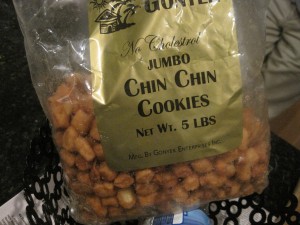
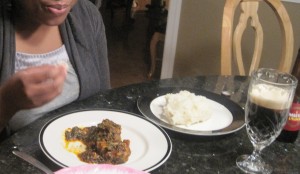 Again, I should say that he did make the pounded yam himself, and it was very good, but Vera and I have never agreed on whether the accompanying vegetable soup and sauce (which included snails, cow legs, and different delicious meats and fish) were also similar results of his culinary skills. I don’t doubt it. He is not a typical Nigerian man by many standards, and he’s surely not a lazy man. However, the voices of opposition and skepticism abound to drown mine of hope and solidarity. The loudest of them ironically belongs to his own first daughter who, having overheard our confused wonder at the dinner table about who made such a delicious soup, had asked aloud without providing a corresponding answer to clear the air of any further speculation: “Is that what he told you, that he made the soup by himself? Ha!” And just as soon as I completed one plate of food, it was replaced by another with the words. “K, here. Have and eat these too. They’re very good, and there’s more where they came from.” By the time I updated my Facebook status some minute later, it read: “KT is not drunk, but this drink of bottle will not wine itself…“. I however survived it by some miracle, but almost couldn’t get up on time the next morning to catch my flight. But in all, it was a memorable experience of a visit for many reasons. Not only because it was a day that I engaged food in a battle of wills, and I was almost roundly defeated.