Whenever I’ve told people that my thesis is on L2 tonal acquisition, except for folks with sufficient familiarity with the field, the first question usually is – “what is tone?” or “what is a tone language?”, followed by “so what exactly are you trying to find?” I therefore spend the first five minutes explaining to them what tone languages are (and that about 70% of all world languages are tone languages), and then tell them a few more details of the direction of my work. I found myself in this direction by chance – though I don’t tell them that – but after taking the patience to explain why in the absence of sufficient research materials on the process of L2 tonal acquisition I find it fascinating to be involved in discovering all that can be found there, they usually look enlightened suddenly, and then give me a look of “well done.” I feel better, although I know that a good number of them are just happy to be done with the conversation.
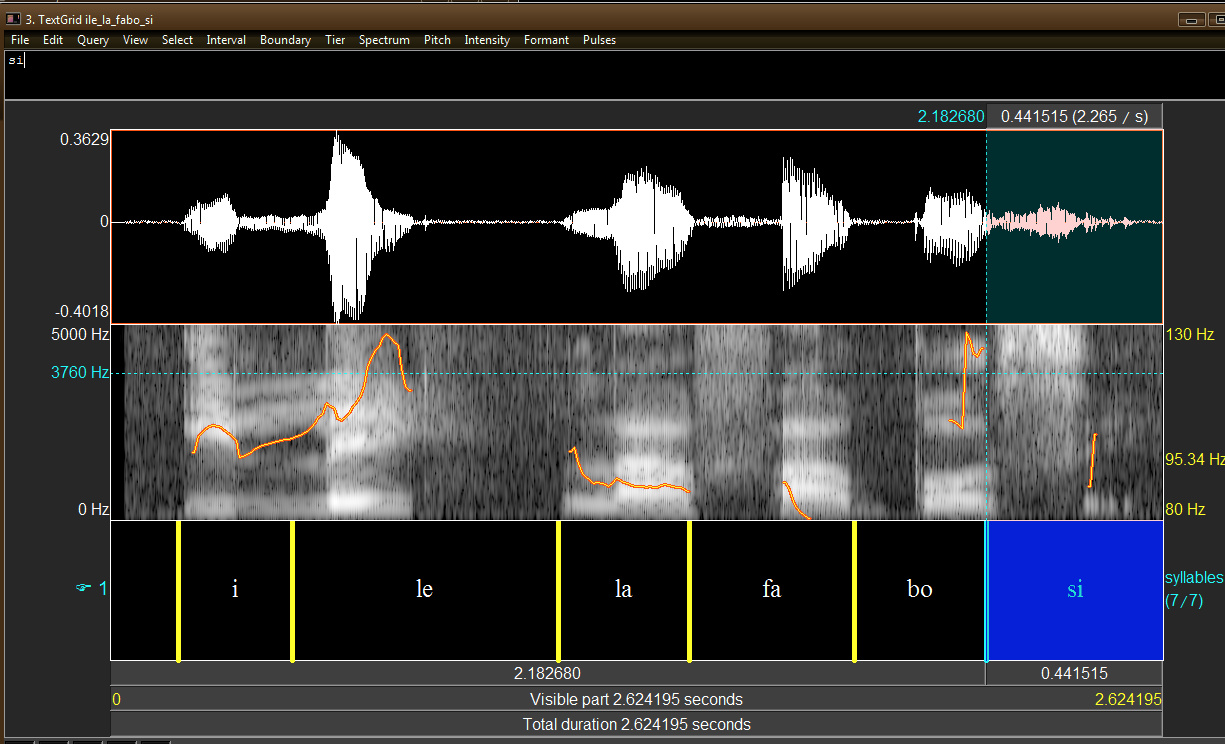 Having taught Yoruba at the university level for a while here in the States, it was natural to be interested in phonological and pedagogical dimensions of the language acquisition. Then I took a course on Second Language Acquisition with all its arguments on the critical period hypothesis that implies that language learning becomes difficult or impossible after a certain age. It all coalesced at some point in my head, and here I am. The data gathering part of the work itself is almost done, and the writing is halfway done already. I have discovered very many fascinating things, and encountered enough data to advance into a few more research directions in the future. One of the main things, of course, is that nothing at all prevents anyone from learning and acquiring tone or any language at any age whatsoever. There are influences of first language, to be sure, but they don’t pose enough challenge to prevent a subject (even those above the so-called critical period) from acquiring the form.
Just last week, I helped another colleague conduct a shorter research than mine on the questions of tonal perception among American English speakers. The results were equally interesting regarding which tones were easier to learn in isolation and in context, and whether tones are generally easier to learn in context or in isolation. I have been busy. In a few weeks, all of this should be over, and I should have some time off to myself. What to do with that time is another matter. There seems to always be something. What I will take away from this research (and the whole Masters experience) would be the fascinating unpredictability of results, along with a few frustrations of disobedient subjects and other constraints of time, space, and materials. Somewhere in there will also be an appreciation for the Graduate School here – along with my ever patient supervisors – for the small research grant that has made the whole exercise worthwhile and less exacting, and my supportive family and friends.
The commencement is on May the 5th. I shall have become a master in something (else).