by Tèmítáyọ̀ Ọlọ́finlúà
Mango, Christmas and avocado trees; old houses, some refurbished, others abandoned; line the street that slopes downwards.
“Tayo, please wait for me at the gate with 4A,” she had said on the phone, her English laced with a tinge of Ondo/Ekiti accent and spiced with some Yoruba words. Tola Adénlé—or Mama Tọ́lá Adénlé, as her name is saved on my phone—came to me first in an online article that filled me with the desire to meet her. After some Facebook messages and phone calls, I am waiting to meet her.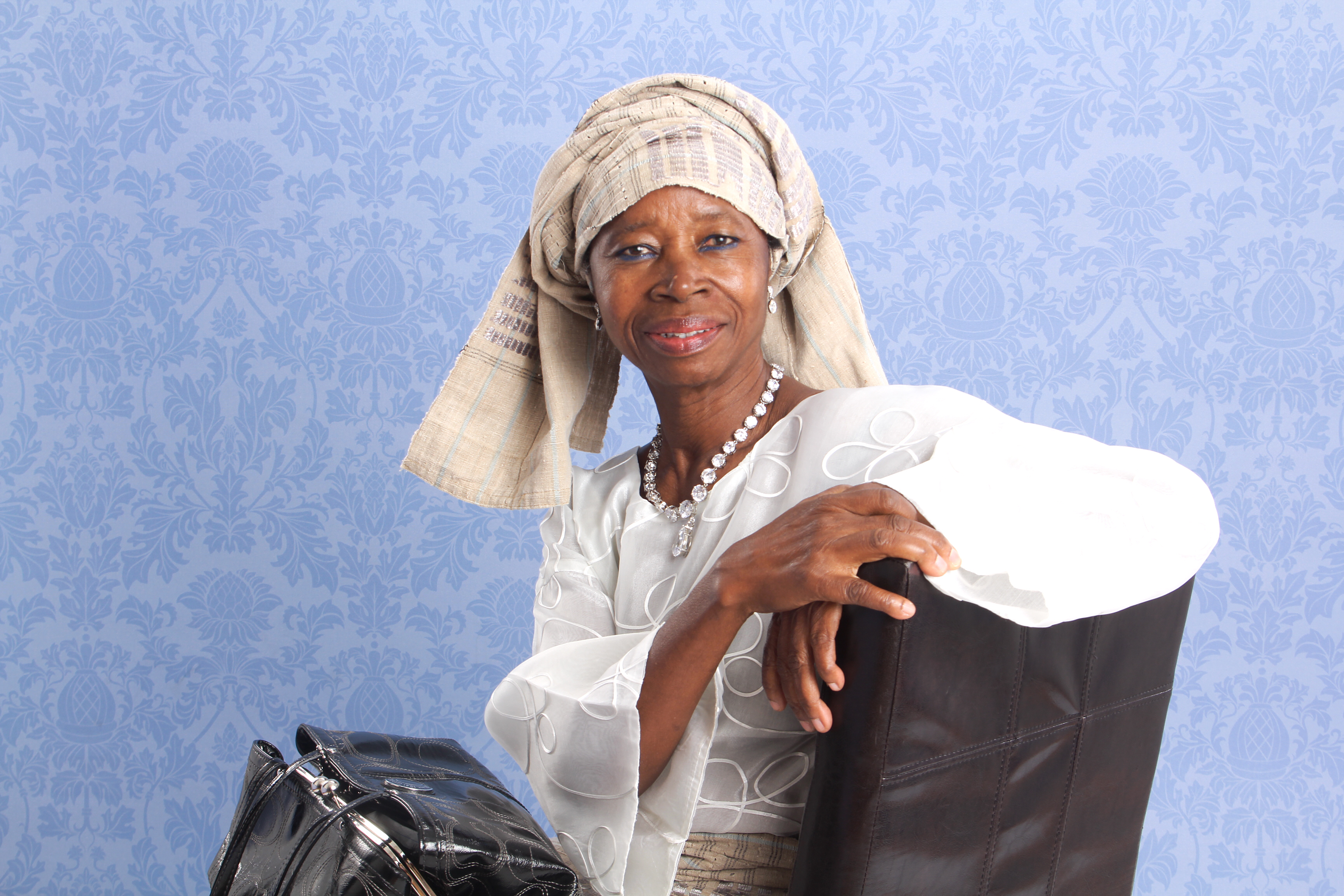
At the gate, my mind wandered: what will she look like? Will she bounce around like her cheery voice jumped on the phone? When she opened the gate, she had a warm smile, a green top and a pair of cream pants on. I knew she was the one. She needed no introduction—the face matched the pictures. The texture of her real voice similar to the texture of her “phone” voice. She welcomed me into the house.
“Feel free to look around.” And there was a lot to see. Almost every corner of the room was lined with pictures—largely family; hers, her husband, her children, her children and their husbands, and their own children. She calls them the Adénlé clan.
“Life is about memories. Keeping memories, that is all life is about,” she says.
I get a tray with tea and snacks; then, we settle outside on two chairs. “That’s Dr. Adénlé’s chair,” she says, referring to her husband—hydrogeologist, Dr. Adénlé. It is a good view: trees and houses, in competition. The house on the other side of the fence used to be theirs.
“Either it got too big for us or we got too small for it,” she says.
Then, we settled into the chat, not an interview. She had insisted that it should be as informal as possible. She would email me pictures, so no need for a photographer. I was reluctant to record. It would be just nice to drink from her deep wells of knowledge.
“This will not just be about you asking me questions. I would also ask you questions,” I agreed. She wanted to know why I chose the freelancing route; how I survive; my background. I told her.
It was my turn to know more about her. But not so fast.
“I should give you an autographed copy of Emotan Magazine,” she said “In fact, let me do it right now.” She gets up immediately and returns with the copy. Emotan was the third woman’s magazine published in Nigeria. This edition was published in September, 1977. So, yes, it is a collector’s item.
When she returns, I ask about her urge to get things done “right away”. Is it out of fear that she may leave it undone or that she may forget—a result of old age?
“It is not fear. It is just that I hate to be reminded to do something that I promised to do,” she says. Neither is it a fear of age, as age is a fact of life.
Dr. Adénlé soon arrives, but before he left us, she does introductions. Tells me a little bit about them—how they like things small, even though they are both from large families. He is the son of a late Ata-oja of Osogbo; she is a daughter of a prominent family in Iju, Ondo state, the Adámọlẹ́kuns. Their wedding had under 30 people in attendance at a Cathedral Church in January 1970. Other things, I find out myself: a soft whistle is one of them calling the other; that she is particular about everything—the chair she sits on; the plate she eats from; her daily carbs intake; the number of steps she takes daily; the turquoise of her earrings matches the nail paint on her toes. He does not care much about such particularities. That when she tries to remember something, he assists—like the name of her Editor at Daily Sketch: Sola Oyègbèmí. The Adénlé couple cannot stand chaotic Lagos—they both resigned from jobs there at different times before they met in the 60s. They fit well into each other, ball and socket.
We talk about other things: writing, publishing and Nigeria. Writing is her gift that she must continue giving. She did not know this initially. She had written a letter to the editor of West Africa Weekly, an old magazine from Florida in 1971. She quotes some lines from the letter. Writer, Kọ́lé Ọmọtọ́sọ́, a PhD student back then at the University of Edinburgh, read the letter and told her that she seemed to have the gift of writing.
“But you will need to read a lot,” she said he had told her.
And that was how she kept honing the skills—from a letter to a magazine; she served at Daily Sketch, Ibadan as a corper; then, she became the Woman Editor at Daily Sketch. She reels off names of her colleagues at the Daily Sketch. She shared a table with Tunde Thompson, who would face Buhari/Ìdíàgbọn’s harsh military rule judgement with the infamous Decree 4. It is interesting that Thompson supported Buhari for president in the last election. It was after the Sketch experience that she started Emotan as a Woman’s Bimonthly. The magazine which was published out of Bodija, Ibadan, had a readership of about 15, 000. It soon became a monthly. It attracted writers, readers and adverts from every part of the country, even from West African countries. Its articles remain relevant even decades after. One subscription page of the magazine reads: when you miss a copy of Emotan, you miss good company. True then, true now. In 1985, after several editions, it was time to rest Emotan.
For someone who moved to Ibadan for the first time in 1966, and has lived there on and off, since then, I ask her what she thinks of the city now.
“Like Nigeria, Ibadan is chaotic. And it is not because the people are not skilled enough to transform the city. S’e b’oye kilu ma improve ni?” She asks rhetorically. She says that this “lack of progress” is connected with the maniac rush for wealth rather than ideas that can transform the society. “It is only here that you ask people what they want to become and they say: millionaire, as if it is an aspiration. Many have fallen into the default mode of most Nigerians—not caring about what they leave behind, only rushing after money.” She laments that this is the reason many do not create things that will transform the nation. Warts and all, Ibadan remains her favourite city.
She does not understand the Nigerian craze to keep acquiring things they will never use. Neither does she understand the reason why parties seem like drugs for people to get excited; take a fix today and wait for the next one to feel high again.
“True happiness should come from within. From doing things that make you happy. Not from organising big parties for people—half of whom you do not know. “Every wedding is now a society wedding; every burial is a state burial,” she quotes an older Nigerian industrialist’s words from a 1985 speech to the Ibadan Chamber of Commerce. She speaks of her long-held belief in Buhari as the one who can sanitise Nigeria of corruption, a belief that accelerated the birth of her blog, in 2011 as stated in the early posts.
In 1988 during Babangida’s presidency, her family joined Nigeria’s [then] mythical “Andrew” and moved back to the States. Since then, it has been between the United States and Nigeria. She also maintained a column with The Comet on Sunday, and later, The Nation on Sunday until 2011 when she started her blog.
Her love for aso-oke, the traditional Yoruba textile which she fell in love with after wearing it for the first time as a bridesmaid in 1965, led to her developing some categories of the textile on her blog. The different categories became so popular that a book, AṢỌ ÒKÈ YORUBA: A Tapestry of Love & Color, A Journey of Personal Discovery, was published in January, 2016. It chronicles her journey of discovery of Aso-Oke, the textile’s history, Yoruba’s sericulture past, occasions that call for aso oke, modern uses of the textiles and many interesting details of this contribution by the Yorubas to world’s textile technology. The book is laced with several pictures, many of them taken by her husband. It takes one on a journey into the past of the textile and whets one’s appetite about its future. The book will be available on amazon.com, through her website, and on her 70th birthday on April 2.
Having spent seven decades on earth, written two biographies, mothered four amazing daughters, held down a magazine for almost a decade, written a collection of short stories, Adénlé still has expectations for the future.
“One must always have expectations. Or else one dies. May not be physical. There is always a mountain to climb.” One thing is certain, Adénlé will be busy giving her gift of writing to her world.
There is no slowing down for Tọ́lá Adénlé. She might have been born in the age of the dinosaur, to quote her words, but she uses today’s tools. She whips out her tablet and begins to type. “Let me do it right away.” She had promised to send me an invitation card for her 70th birthday and her picture that accompanies this piece. I wonder about this woman who is from the past yet grounded in the realities and intricacies of today—how many 70-year-olds maintain websites where they curate their work? You can read Adénlé’s work on hers.
She autographs my copy of the first edition of Emotan. I will keep it and show my children. I will tell them the story of a woman who dreamed up a world for other women; of how she came to me in an online article and how her story inspires me to run my own race.
“Do what you like, that is how you make progress. Follow your passion, that’s where your success will be.” Her words will not leave me even as I now advance upwards on a street lined with mango, Christmas and avocado trees; old houses, some refurbished, some abandoned.
_____
 Tèmítáyọ̀ Ọlọ́finlúà is an award-winning essayist who has completed writing and communications assignments for various organisations such as Global Press Institute, Mania Magazine, Saraba Mag and Facebook, to mention a few. Her work featured in various publications, online and in print.
Some of her writing awards include Finalist, African Story Challenge, Technology and Business Cycle (2014); Second Prize, Peter Drucker Challenge (Manager’s Category), 2014; First Prize Winner, NEPAD Essay Contest, 2013, among others.
She currently curates content for lifestyle website, www.liveinibadan.com that focuses on the city of Ibadan. You can read some of her works here, here, here and here