Baby Showers

Some day before I leave here, I’ll be attending a baby shower of a friend and former student of this institution. A baby shower is an event where people gather to celebrate the life of a baby that has not yet been born. Alright. Forget all that naming ceremonies we do in Nigeria eight days after the child is born. Here, the baby shower takes place before the child is born. Isn’t it amazing? The said baby by the time of the shower would have already gotten a name. All that will be left is delivery.

There are many reasons pregnant women in Nigeria and much of Africa don’t celebrate their babies before they are born, and much of them are based on superstition. The most concrete of reasons will have to do with the maternal and infant mortality. Because of lack of adequate healthcare for much of the poor pregnant women in the villages who also lack access to education, good food and good shelter, many children are lost at childbirth, or to debilitating diseases afterwards. In cities, due to lack of good state or private hospitals, this happens to middle class people in the cities as well, except they are rich enough to go abroad to have their babies. I guess in cases like that, it would be futile to celebrate life when even its beginning is in doubt. The rest is cultural. From history, and from a tradition that probably predates the migration of Yoruba people to the west of the Niger river from wherever the came from initially, children are celebrated at birth, and named on the eighth day. End of story.

Among many other differences in pregnancy attitudes in America and Nigeria is disclosure. Unlike what I am more familiar with, here, people would tell you that they are pregnant even before the protrusion shows itself. For a reason perhaps close to superstition as well, you won’t find African women doing that. And you can’t ask them why. So,as it has happened to me several time while I was growing up, I would find myself unable to discuss the existence of someone’s pregnancy – even when it stared me in the face – until they gave birth. I wonder how much of that has changed with modernization.

With access to stable electricity, much of the problems (especially in Nigeria’s healthcare) would be solved. Sometimes, it is that simple. Hospitals will be able to offer better healthcare services if there is stable power. That is one of the biggest challenges before the Acting President Goodluck Jonathan who is now in the United States on a state visit to meet with the US President. He has about a year to set in motion plans to put the nation back on the track of development. A huge but worthwile task. There is a longer article about maternal mortality here by Eyinade Adedotun.

Check out other solutions for improving maternal health or to participate in the global call to solutions, please visit Healthy Mothers, Strong World: The Next Generation of Ideas for Maternal Health. www.changemakers.com/maternalhealth

Tyto Alba

Tyto Alba. (Source: Wikipedia)

Tyto Alba. (Picture Source: Wikipedia)

While living in within the compound of a secondary boarding school in Jos Nigeria in 2005, I had discovered a nest of owls living in the roof of our apartment. The discovery was not really by chance since from the first night spent in the bungalow, we knew that something bigger than a large rat was living in the roof, and they would always make loud noise with their steps especially in the middle of the night. The ladies in the apartment freaked out immediately they found out that what lived there was not a large rat as they had previously thought, but (not one, not two) about three or more large owls. A few days after, we caught one of them by spreading a mosquito net at the opening of the roof through where they had always got in while someone went into the house to hit on the ceiling. After a few knocks that disturbed its sleep, the bird flew out right into the net, and we caught and took him down. Napoleon – a fellow resident of the apartment, and a fellow Youth Corp* member – did most of the job of plucking the most prominent of the bird’s wing feathers, and let him go into the living room. Not being able to fly anymore, he just stood there and stared at everyone suspiciously.

By the next morning, news had spread all around the school and neighbourhood that we had caught an “evil bird” and were keeping it right in our apartment. By evening, it was not the Riyom women alone who were throwing tantrums at our “audacity” and “foolishness”, but the residents of the apartment themselves. The two young women (also in the NYSC programme) who lived in the building with us would not understand nor stand the logic of bringing a scary looking “evil” bird into the house at all where it was bound to become a big physical daylight nightmare. In addition to making sure that their rooms were locked at all times from then on, and they began to whisper “the blood of Jesus” every time they inevitably had to come into the living room, right before they go back into their rooms screaming for us to get the “evil looking thing” out into the woods where it belonged. The bird read the mood of the house and refused to eat any of the rodents we brought for it, or do anything else other than just stare sheepishly. After a few days of immense internal and external pressure, not helped by the bird itself which had started looking weak and tired from non-flying, non-eating and too much daylight, and we had to let it go after a while. It took a few slow steps into the woods behind the apartment and went out of sight as fast as possible. I went online to read about them and found that they were called the African Barn Owl, or TytoAlba – very cool, adorable animals of night. Apparently, not everyone was comfortable with having them near. I confess that at times even I also felt a little chilly when I looked into their large dark eyes. IMG_0569

Yesterday at midnight, while taking a walk back from campus where I’d gone to see a free show of the movie The Ugly Truth, I found an owl perched on a wire mesh around the Cougar Village tennis court. It was a little larger than the tyto alba but not any less adorable. Luckily I was able to take two shots before it flew away into the woods, which was just as well, since it was perched so high and far beyond the reach of my hands anyway, and the lighting was not good enough to give me a better shot of it.

The Nigerian National Youth Service Corps (NYSC) is a community service cum paramilitary service mandatory for every fresh university graduate below the age of thirty. It takes each fresh graduate out of their home environment into somewhere else – mostly a farther town within the country, for the period of a year to learn new things, and to serve the community, while living on stipends from the federal government.

The Fourth Class

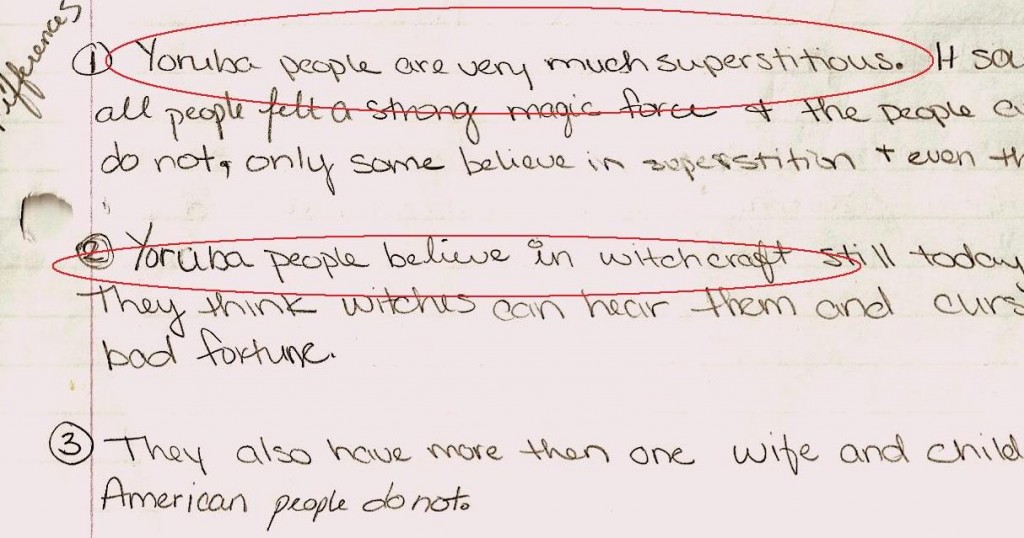
When I was in Kenya in 2005, I remember that one of the most recurrent observations I received from Kenyans was that Nigeria is a place filled with people who believe in witchcraft and practice it in their daily lives. We all believed in juju, they said, and none of the women I spoke to would dare to marry a Yoruba person for fear of one day having to deal with a mother-in-law that could turn them into a piece of metal at the slightest provocation. I have since discovered that this is a very prevalent perception of Nigeria, mostly obtained through our home videos that have been ranked third in the world in terms of output. Is there practice of witchcraft and a prevalent belief in it in Yoruba land today. The answer is yes. Does everyone believe in it. Erm, I would say yes to this as well, but with very few exceptions of the skeptics.

Cut to my fourth class, where I had asked my students to read a short story titled “Why Atide Is Taking To A Coin”, written by a German friend, student of Yoruba and a current PhD student at SOAS. I first read the short story in 2004 while it was still being written, and I got to contribute a few ideas to its storyline. So last week, when I asked my students to list ten things they found strange, new or memorable about the Yoruba culture from the story, and five things that they found similar to their own culture, I was trying to get them more interested in reading and discovering new things. It was also a way for me to get into their minds and see what they see when they look at me through the prism of Yoruba culture. The result amazed me. Of all the answers given to the first question, one was common to all the ten students in the class: They were surprised that a belief in witchcraft still exists/persists in some cultures of the world, particularly mine. They couldn’t understand why people ascribed occurences they couldn’t explain to the evil forces in their family, and they couldn’t understand why somebody who is Christian/Moslem would go to a Babalawo to get help with something that was bothering them.A Class homework

Now, I could have easily said that it was the fault of the writer of the story for painting the Yoruba people in such a light, but when I look around Yorubaland today, I find not one but many leaders and public figures who would take their supporters or followers to shrines so as to get them to swear and take oaths of allegiance. Recently there was a case of a prominent state governor, and a lawmaker whose naked picture was taken at a shrine where he had gone to perform rituals. The fact is, belief in rituals are still as strong today in Yorubaland as it was before the British came. Whether this is a good or a bad thing is beyond my scope to say, but it took me some time of readjustment to deal with the truth, being a little lost to the effect such disclosures might have on the impressionable minds of my brilliant students, and their ability to see this somehow as a positive attribute of such a people with a complex culture and outlook on life.

Are we a modern society in Yorubaland, or are we still attached to the deep vestiges of the past? If the texts of our literature, the lines of our poems and the plots of our dramas are anything to go by, the answer might be far from what we always like to believe.