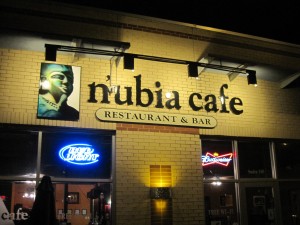
 And so tonight after a drought of three months and more, I arrived home, and in heaven, with all but the seventy welcoming virgins, of course. It started as a jest and mild daring that we would drive down to St. Louis to check out the “African” restaurants. I had had a few apples and was just hoping to go to bed but the trip proved a little too tempting to pass, so we – Mafoya the Beninoise, Ben the American and I the traveller hopped in the car and drove to St. Louis, seeking a place called “Nubia Cafe.” The name did not suggest anything other than African so believed that I was going to at least find something to my taste, just like I did in the Indian restaurant in Chicago. At least it was peppery (read spicy) enough to my African tongue.
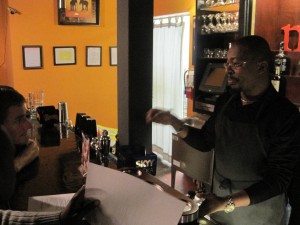
It was the smile of the woman who welcomed us in that gave a first hint. And then the smell from the kitchen, and then the ambiance. Then finally, as we stood staring at the host – a tall and handsome black man with a goatee standing behind the counter, whose smile and sense of mischief led us on a false trail of his true identity – I heard the concluding part of the song Lele by a Nigerian Igbo musical group Resonance seeping in from the surround speakers in the room, and knew at once that I was home. “You’re Nigerian?” I asked, and he nodded, extending his hands. “My name is Henry Iwenofu. Nice to meet you.” And he indeed was a nice personality, well read, smart and articulate.
From then on, things went smoothly, from the overdrive hyperactivity of finally landing on home soil so far away from home to the mellowness of deep conversations that you’d always find among Africans meeting on a distant land.
 HOW LONG HAVE YOU BEEN HERE?
“Over twenty-five years”
He should be like forty years himself.
WHEN WERE YOU LAST IN NIGERIA?
“In 1995, briefly.”
I doubt that he remembered much of the June 12 crises, but he has some Youtube videos of the Biafra soldiers’ songs on his phone.
WHERE ARE YOUR PARENTS?
“They were here since a few weeks. They stay with me.”
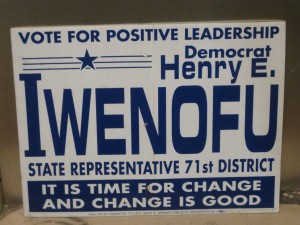
 There is a little board sign beside the counter bearing his name. “I contested in the last election for a council seat.” He said. “I didn’t win, but I got some votes.”
DO YOU STILL SPEAK IGBO?
“But of course!”
He also happened to speak a bit of Hausa and Yoruba, and he’s an American graduate of a Political Science equivalent course, with a Master in Law. “I’m a barrister” he jokes, “and that’s why I’m now working in a bar.”
HOW LONG HAS NUBIA CAFE BEEN HERE?
“About eighteen months.”
 DO YOU SERVE PALM WINE?
“We used to do so, but since demand slipped, we have discontinued it as well as Edi-kang-i-kong and Star Lager Beer.”
Still unable to believe my ears, the music changed to Asa’s eponymous album and the songs filtered in one after the other while we enjoyed the meals that came in succession after a few minutes of banter.
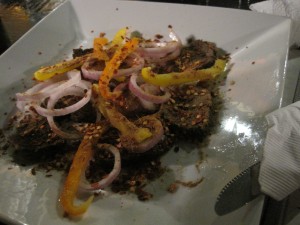
Appetizer: Suya/peppersoup (Comments: Very very good, but not the best I’ve had. Ben however loved the soup, even though he had to quickly ask for plenty water so that his tongue/throat doesn’t bleed.)
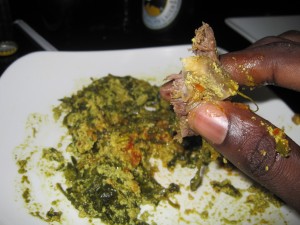
Main course: Pounded yam and egúsí soup. (Comments: OMG! The Nigerian host even had the audacity to provide forks and knives to eat it with. What? Are you kidding?)
 Drinks: Tusker beer from Kenya (Comments: none)
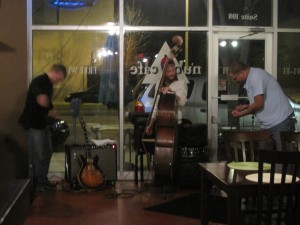
After the meal, which was accompanied later by a live band in the corner of the room, we got down to the real African past-time: arguing. It took the whole hour and even though we agreed on little, we shared much, and Ben just looked on, sometimes bored, and sometimes animated. It was his first time in an African restaurant, and it could as well have been his first time seeing two Africans argue, on such an unimportant topic as whether or not we were different, or the same even though we come from different places… This argument must have arisen from a question as to whether he would be going back home. No, he says, but not for reasons I expected (political instability, poverty etc), but because, according to him, “I don’t have the money. I can’t afford to make such trips regularly.”
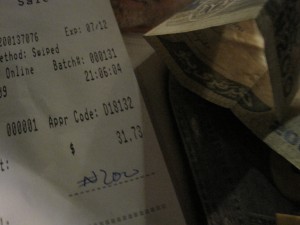 The other woman who had welcomed us in with a smile turned out to be from Tennessee, and she found the whole show we had put up to be very amusing. She was going to find it a lot more amusing when, as it was time for us to pay and head back to Edwardsville, I looked at the bill and had a very bright idea. Since I’ve been in the US, I’ve been gradually initiated into the tipping culture and found a certain joy in leaving little change for the people who had made effort (don’t tell me it’s their job) to provide good quality service. So to show my appreciation tonight, I looked into my purse and brought out the crispiest – well, not necessarily the crispiest – of my Nigerian currency notes. It was a two hundred. I had brought the Nigerian currency notes along to the States only to show my students (and some of them have actually “won” a few of them for keeps while answering questions in class), and for other unexplainable reasons, but as I looked at the space for tips on the bill, I could think of nothing more appropriate to give back to this long range traveller like me than a small piece of home.
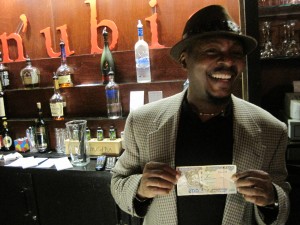
In American currency, it is less than $2, but from one traveller to another – albeit one more temporarily resident than him – I was handing him a touch from his distant past.
“I’ll frame this,” he said, as he posed for a photograph, and the Tennessee woman who sat beside him kept grinning from ear to ear, looking at me with a mixture of thrill and quirky interest. She definitely didn’t see this one coming, and much as she tried to find out from me how much the note was worth in American currency, she failed, to my delight. It was my first experience of home away from home. And from this heaviness of my tummy now as I return from the eating and all the merrying, I feel the warmth of home. Hello Nigeria.
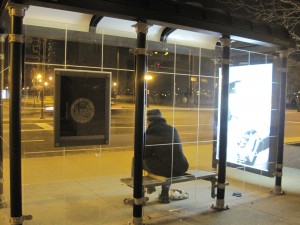 I will leave Chicago with this feeling: thrill; this impression: awe. Here’s a city that runs on order and a certain edge. Walking the length and breath to where my feet could reach, I found an open eyed town that never stops demanding. Either going upward on an elevator onto the Skydeck of the Sears Towers, taking pictures there on the glass ledge, requesting for branded gift items at the Institute of Arts, getting a guided tour, getting a 4D Fantasea tour of the Shedd Acquarium, or getting onto the Ferris Wheel at the Navy Pier, Chicago never stops demanding. Here’s where a padlock costs up to $10. (A little riddle on that: Q: Which is safer, a padlock with number combinations or a regular one with jam and lock? A: If they both cost the same, they stand equal chance of being broken), and a bottle of soda could cost almost $3. It’s a shopaholic’s heaven, a traveller’s escape and a photographer’s playground. There’s hardly ever a place to turn without something memorable to see. The one advantage of this set of travellers was our preference for our feet as means of transportation all through the large city. There probably was no other way we could have seen so much.
 New York has the Subway. London has the Underground system. Chicago has the “L”. “No, not the ‘El’. Only Boston folks spell it like that,” our guide says. “It’s the ‘L'”. It hardly matters that there are places where the train moves at ground level. It’s still the “L” which stands for “Elevated Train.”
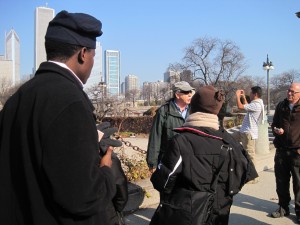 Lying at Union Station with a computer on the lap and an earphone plugging the ears, a stranger stops by, hooded and jittery. He needs a smoke and was ready to pay for it. Walking across the street, a woman with a scarf on her head is throwing up on the curb with no one taking notice. A policeman on small motorped warns squatting travellers to watch out for their bus or stand a risk of being ejected from the Amtrak station as soon as it is midnight. Coming in a cab for the first time during this trip, conversing with a Romanian taxi cab driver, sharing the words of exile. He will one day go back home, but not to become a politician. He’s now a Chicago citizen.
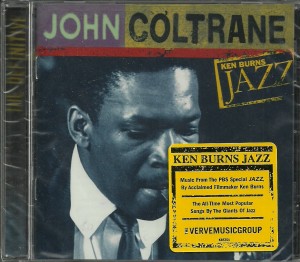 Jazz has taken over my life.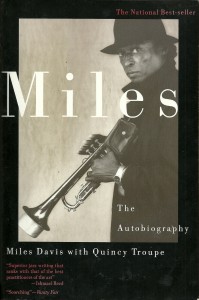
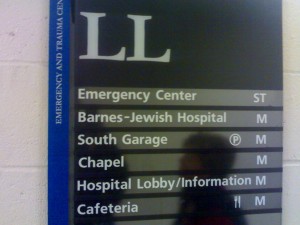 Healthcare is important to everyone, and no one, no one should have to die because they’re poor,, and no one should have to go broke because they fall sick. A society with as many rich citizens like America should be able to take care of it’s poor. This is not Obama’s policy. It is only common sense. The same goes for Nigeria. As I sat in the lobby waiting for Holly to emerge from the emergency room where she was being attended to, I began to think about the number of people who were rushed into the emergency room while I was there. I thought about all the sick people I know, and how much they already suffer, without worrying about having money to pay for it. I have a close family member diagnosed with cancer, and my heart goes out to her. A close friend of mine that I last saw in about 2008 in good health has now been diagnosed with a bone disease. He’s also sickle celler. One of the families here that has been very nice to me has a cancer patient in it. Patrick Swayze, the actor famous for his role in Point Break and Ghost has been announced dead after a long struggle with cancer. Just a few days ago, we had mourned the passing of Senator Edward Kennedy of the USA, and Gani Fawehinmi of Nigeria, both favourite public figures whose lives were cut short by old age, and a terminal disease. It is a world filled with sickness that we live in. We should not make it worse by restricting care and support to only the ones that can pay for it. Helping the weak and taking care of the sick may just be the most noblest act we could perform as conscious human beings, or the sanest reason of our existence.