Over the last couple of years, I’ve received mails from young people who have gained admission into Southern Illinois University Edwardsville, are about to travel, and are interested in tips that can help them survive in the institution. I’ve often had to write them long emails answering particular aspects of their requests. Today, I want to put much of my thoughts on the matter here, in order to help many more that might stumble on the blog while looking for information about the school and the city. (I wrote something similar, earlier, for Fulbright FLTAs heading to the US, if this is your category).
____
First off, congrats on your admission into SIUE. You should be proud of that. If you are also lucky to have got one of the many tuition waivers available for exceptional students, even better. Congratulations. What this means is that all you’ll have to worry about is feeding, housing, and transportation. To have the tuition burden taken off is a big relief. If you’re also extremely lucky enough to already have a Graduate Assistant (GA) position that also pays you a stipend of about $8.50 per hour for 20hr work per week, along with the tuition waiver, then even better. You are one of the luckiest students. All we have to do now is talk about the school, the environment, the people, and other interesting details. If you don’t have any of these grants and you still have admission to SIUE, let me address you first, below.
As a student, one of the things that could help take your mind of the stress of studying is a tuition waiver and/or scholarship. Most schools have this for exceptional students who apply for it. SIUE is no exception. I know a couple of friends who have applied and received this scholarship/waiver/grant without knowing anyone in the University. They merely applied on the website, followed up, and were selected because of their record. If you still have the time, go here and see if there’s one you can apply for. GA positions are usually advertised on the school website as well. With those, you get to work for the school in different capacities (either as a research assistant to a professor or a food attendant at the school food court. There are many others in-between), and get a stipend of up to $850 per month. Ask about these before you travel.
About the School: Much of what you need to know about SIUE can be found on the school website or on Wikipedia. Located in a conservative part of Illinois (at the bottom left end), most of the students in the school are from Illinois and neighbouring areas. Some of them have actually never travelled out of the Southern Illinois region before, which once surprised me. According to Wikipedia, 9.68% of enrolment comes from other foreign students. Out of this, there are Indians, Chinese, Taiwanese, Korean, African and European students. However, notwithstanding the seeming insularity, the presence of SIUE brings a multicultural presence to the area, and you will be surprised at how knowledgeable a number of the people you meet are about the world.
About Classes: I studied Linguistics/Teaching English as a Second Language in the Department of English, so my knowledge of class and studying is limited to that and the Department of Foreign Languages where I taught for one year as a Fulbrighter. If you’re familiar with this blog, you probably have an idea of my experience both as a student and as a teacher. The summary is that the classes are thorough, the teachers are patient and knowledgeable, and the master’s program is usually a combination of stressful and interesting times, as you’d expect from anything worthwhile. It helps a lot to talk to teachers about whatever is bothering you, ask questions rather than assume, and always turn in your assignments as at when due. Avoid plagiarism in all cases. This can cost you grades and your reputation.
Social and Care: SIUE has something called the International Hospitality Program. You should read about it. They’re also on FB. What it is is a group of (usually retired) family men and women interested in social good who volunteer themselves to be host families for international students. They do not really “host” you in their houses for the duration of your stay, but they invite you out, send you birthday cards, give you occasional rides to town, among other small conveniences. You’d be surprised at how much of a relief that usually is for a student living far away from home. One of the things that made my first night on campus one of my most memorable was the package left for me in my apartment by members of the IHP. My host family was a couple with an Indian father and a white mother, both Americans. They eventually became like real family inviting me out on occasions, sending me Christmas cards, etc. I am still good friends with their children, even across the distance.
Accommodation: For university housing, I’ve always expressed my preference for Cougar Village. I like it because it is a “village” in the true sense of it, but it’s also a small town, depending on what indices are used. It has a post office, a beautiful lake, a police presence, a regular bus schedule, fast (and complementary) internet and cable, heating and air conditioning, and a number of interesting features. I have many fond memories living there. However, I should say that the fact that I had a scholarship (for at least one year of my study) made it easy to stay at Cougar Village. The cost might be too prohibitive for many. In that case, having accommodation in town is advisable. You should ask around, preferably from international students associations. They will be able to tell you where you can get decent housing at affordable rates off campus. As most students also realise, sharing an apartment with a colleague/fellow student/friend is also a smart way to save money since both of you can share the costs of the amenities you consume.
Outdoor Social: Being a small town has not robbed Edwardsville (and the greater St. Louis area) of its fun. There is (or used to be) a small bar downtown called Stagger Inn where you can get very good toasted raviolis (my favourite snack) for under $10. The beer is good and you have a range to choose from. It also usually has a live band at least once a week. Close to it is Erato Bar where you can get the best mojito in town. If you crave Asian food, there is a Wasabi Sushi bar at 100 South Buchanan Street. There is also (was, at least, when I was there) a Chinese buffet in the same complex where you can eat-all-you-can for about $10. My favourite place for wine is an old winery about five minutes drive from downtown where you can taste the different types of wine before buying. I hope it’s still there. I think it is. Just found the homepage. You’ll find many more by going online for reviews, or talking to people. If you don’t go to town a lot, the Skywalk Cafe on campus located above the space between Founders Hall and Alumni Hall has one of the best wraps I’ve ever had. The food there is not bad for a student who has to shuttle between one class and another.
Transportation: In Edwardsville, as in most parts of the United States, it helps to have a means of transportation. Mine for about a year was a bicycle given to me by my adoptive father. I looked a lot awkward riding it around campus, particularly with a Nigerian cap on my head everywhere I went, but I loved it because it freed me from having to always wait for the bus. It also helped me discover Edwardsville by myself, depending on no one but a city map. In the winter, it may be a little tricky to remain on a bike, but thankfully the buses that go from campus to Cougar Village also made allowance for the bicycles in front of the bus. In any case, the situation of the roads will determine when is best to ride. The best alternative, of course, is to have a car. But since this is not an option open to every student, many of who have to pinch pennies to survive, I’d say go with the bus. It cost about a dollar to move from one place to another. The buses also go to almost everywhere, so you won’t get lost. The best thing about the bus is that it is usually air conditioned and is a good place to read or do people-watching, if that’s your thing.
Food: Like I said earlier, there are a number of good restaurants to visit if you can. Otherwise, cook at home. It’s cheaper and you have control. For my Nigerian/African brothers, some American foods can take getting used to, but it’s not big enough a deal to turn you off totally. Try things out and you’ll discover what you like and what you don’t.
Academic/Intellectual Resources: The Best Small Library in America for 2010 is located in Glen Carbon, about twenty minutes drive from campus. If you ever have the chance, pay it a visit. It’s a beautiful and resourceful place. I wrote about it once too, for the now defunct 234Next newspaper. I reprinted it here. You can find the pictures here. Otherwise, the Elijah Lovejoy Library on campus is a good enough place for research, studying, and any other intellectual enterprise. But if you live downtown Edwardsville and you want a place to use, the Edwardsville Library is also very good, and accessible. If what you want are non-academic intellectual clubs, ask around. I know of the Eugene Redmond Book Club in St. Louis. Google it. There are also a few open mic poetry readings around town that might interest you if you’re into poetry and such.
Other Dos/Don’ts: I can’t think of much. It’s a beautiful and lovely town, with nice and lovely people. Make friends, don’t be afraid to ask questions, and have fun. Before you know it, two years (or whatever number of years you need to spend) will be over, and you’ll be sad to leave. You’ll miss the deer and the ducks, the walkways and the lake. There are probably many more things you need to know that I can’t remember here. Don’t worry. Whenever you need to know it, you will. Most importantly, have lots of fun. And oh, don’t forget to keep plenty quarters on you at all times ;).
Good luck!
 When Àlàbí first arrived in the U.S. two years ago to begin his master’s of science degree in chemistry at SIUE, he saw first-hand how relatively affordable university-level textbooks are to acquire in the U.S. compared to Nigeria. He also saw stacks of still-relevant textbooks in good condition that were being discarded.
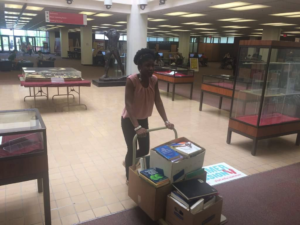 “We thought maybe we’d receive a couple hundred donated textbooks at our initial book drop-off sites on campus at SIUE,” said Àlàbí, who will pursue a doctoral degree in chemistry from Brown University in August. “That initial donation topped 1,000 textbooks in only a few months. We also raised funds to pay for the cost of transporting the books by ship to my home university, Tai Solarin University of Education in Nigeria. We are absolutely confident that we can continue the momentum and tap into the generosity of teachers and learners in the U.S.”
 “We encourage individuals and student associations at community colleges, technical colleges and universities across the Midwestern states who are willing to designate a location on their campus as an Efiwe textbook drop-off site,” Àlàbí said.