Notes on Obscurity

by Benson Eluma
.
1.
Sister Mustard died someplace
Mount Ebola, I think, in Africa.
They planted a mine on the headstone
For a curious little boy to play with.
Kaboom! and his lost limbs made
A weeklong presence on international news.
Sister Mustard turned
And smiled in her death…
.
2.
The ants worked hard in the sun
Following the ancient wisdom.
But this year the rains did not fall; they waxed
Lyrical, Hard Rock melting sand-home and barn.
Afterwards, camera crews rushed
To scoop water; their
Precision instruments detailing
The wreckage to the last microscopic fractal…
.
3.
The poetaster wrote his dying song
After so many years of ruing the ignominy
Of his verse, the evil recalcitrance of his stylus.
He sent it out, a warning to others trying the impossible.
But the critics, hard up for new conundrums,
Overturned every stone;
They scoured every cave
To lay laurels at his unmarked grave…
.
4.
And Daodu, born on the first day
In the Year of Jubilee, a complete set of teeth
Fortifying his infant gums,
Died a plenipotentiary with 300 monuments.
And the worms went to work on the annals.
And floods ravaged the city year after year.
And finally a generation arose in whose memory
Daodu’s name, undecipherable, was a dead talisman…
.
Used by permission.
The Lake Isle of Innisfree

I WILL arise and go now, and go to Innisfree,
And a small cabin build there, of clay and wattles made:
Nine bean-rows will I have there, a hive for the honey-bee,
And live alone in the bee-loud glade.

And I shall have some peace there, for peace comes dropping slow,
Dropping from the veils of the mourning to where the cricket sings;
There midnight’s all a glimmer, and noon a purple glow,
And evening full of the linnet’s wings.

I will arise and go now, for always night and day
I hear lake water lapping with low sounds by the shore;
While I stand on the roadway, or on the pavements grey,
I hear it in the deep heart’s core.

-WB Yeats

Nostalgia – A Not So Old Poem

Do men really feel or just believe? In wandering afterthoughts from your sonic alter-ego,
Love, my belly tickles to a distant bell in childhood paces around our childish lusts.
See me there on the streets of dustland, with heels on the playground of luckless rants.
.
Am I supposed to feel this way again, muse? Your voice spins me to a thousand memories.
I do not stir, nor do the droplets in my eye move beyond their range of steam. No. Muse,
I do not control this softness that drives me across a beaten path towards your taken arms.
.
It is the voice of the night, or else a green-eyed beacon that pushes these fingers to work, and
To stalk: “Traveller, your love has not always been without the crawl of blunt senseless drive.”
It is the delirious dope of distance then, or caprice, or a flighty strong wind of love’s nostalgia.

Two Poems for Wenger

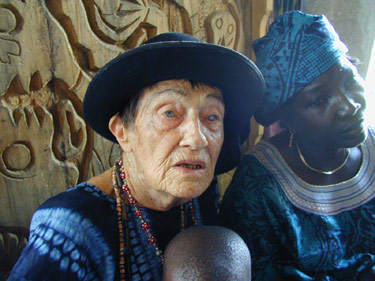
I wrote this poem last January for Susanne Wenger when news broke that she had passed, and sent it to a couple of friends and a few listservs. Friend Benson Eluma was one of the people who wrote a response in poetry to my offering back then. Click here to read his poem, now published in Nigeria’s NEXT newspaper. The poetic meeting of Benson and I on the campus of the Ibadan University is a long story for another day.

Here below is the final version of what I wrote back then, thanks to a few suggestions from Lola Shoneyin.

Like Chalk in the River

For Susanne, Olorisha!

They said it rained when Suzanne was buried.
It poured.
They spoke of a rumble of the heavens
as the Orisha Osun swam back, again, to her pristine source.

They talked of art.
They spoke of beauty.
They mentioned hands
That sculpted spirits.

But now when the forests have stopped dancing with the rain,
See the wind escape from that storied grove.
Look, amid the hallowed haze,
at a turning twirl of her spirit gaze.

Gone is the eye that looked out for the standing stems
When greed called for arms, and men scorned sense, and all she wove.

Today, the Spirit it was that left, again,
To return. To return: a time-bound god, or else a travelling dove.

NOTE: Susanne Wenger was the Austrian artist who lived most of her life in Osogbo Nigeria as a priestess of the river Osun. Born in Austria, she met and married the German artist Professor Ulli Beier who brought her to Nigeria in the 1949. The couple quickly assimilated in Nigeria, he as a teacher and she as an artist, but they moved from Ibadan to the nearby town of Ede in 1950 to escape what Wenger called the “artificial university compound”. In Ede, she met one of the last priests of the rapidly disappearing, ancestral-based Olorisha religion. She quickly became engrossed in his life and rituals, even though at that time she spoke no Yoruba. “Our only intercourse was the language of the trees,” she said later.

Her work in Osogbo for the many parts of her life included an enormous effort to protect the sacred grove of Osun, a forest along the banks of the Oshun river just outside Osogbo, which she turned into a sculpture garden filled with art made by her and others. The sacred groves of Osun are now UNESCO World Heritage Sites thanks in most part to her efforts. (Read more about her life here).

She died last January in Osogbo, her adopted home, at the age of 92.

Re-Reading Myself

Re-reading oneself can be such a boring chore that I’ve always tried to avoid because of the emotions it inevitably brings back. Most times, one is just too glad to be rid of the overwhelming feelings that make one write in the first place to go back at will. I’ve just finished looking through all the poems that make up my first collection of poetry and all of a sudden I’m back with the overwhelming nostalgia of pre-University and University life. Maybe this year would be a good time to re-issue the collection into the public after five years of hibernating fermentation.

I am now officially looking for publishers for the electronic and print reissue in America, Europe and in Nigeria. Here, below were the lines I penned for the year 2000, written a few hours into that year while I sat in church on that December evening, bored to my bones.

The Year of the bug

It’s a new dawn because a year is born,
But are hours years for zero to mark one?
Men have flown to realms of high imagination
with anxiety and snippets of loose contrite illusions.
Of human clock, a stroke of the thin long second hand,
Or the gradual droop till the final grain of sand
Marks a whole new start – a thunderous landmark.
And new time commences, yes it remains dark.
Here begins a new dull span of restless days
Of ends unseen, unsure even when one strongly prays.
Called it a new phase, named it a new rolling life –
new day into pay; new life into more human strife.
And yet remains too cryptic and strange remnants
of words, thoughts, fears and imagination parts,
And of pregnant signs, sights and sighs unblown –
of things not yet seen and yet all unknown.

(c) All rights reserved.