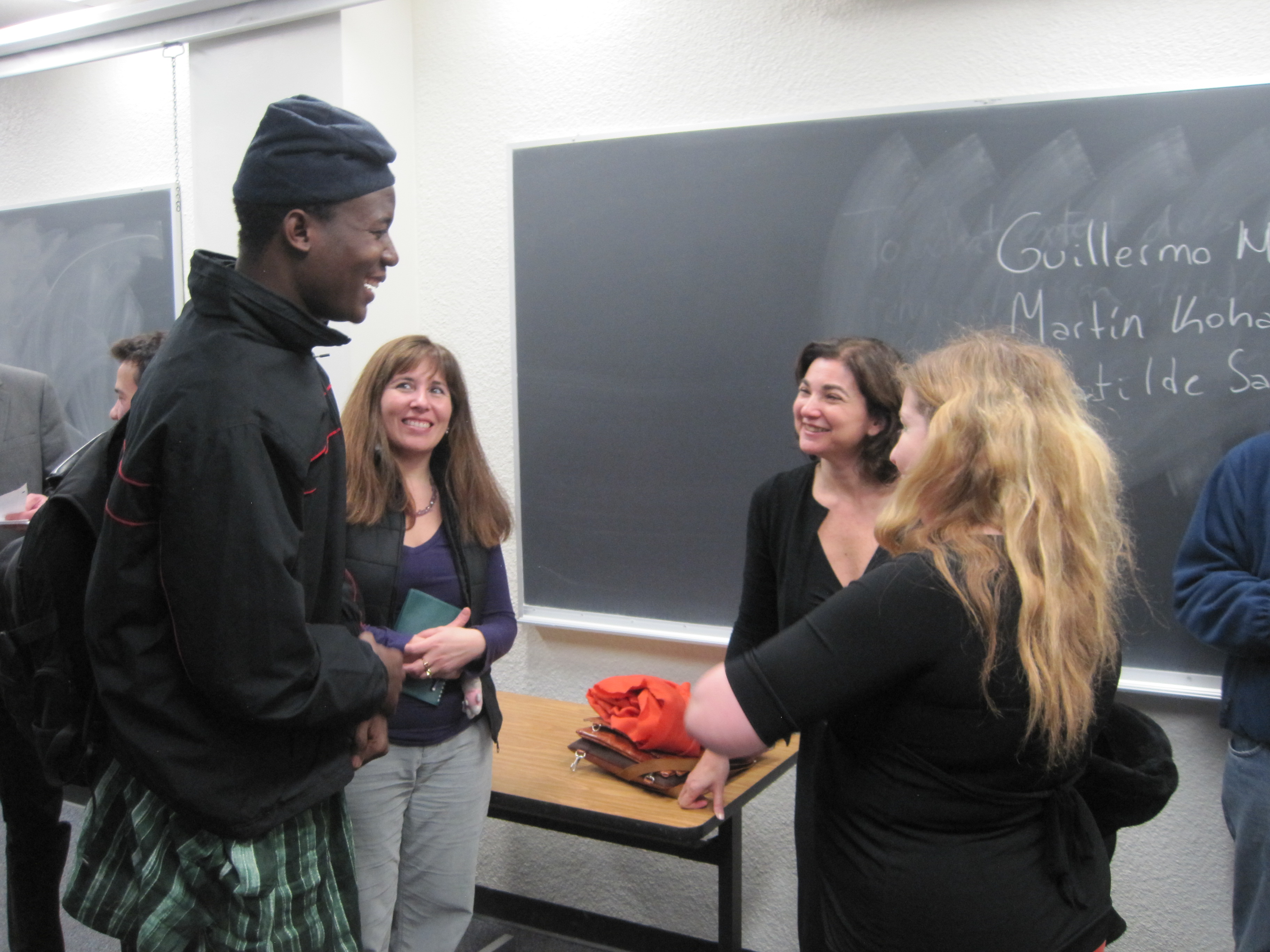
 I came late to this talk by the Argentinean writer Paula Varsavsky who had come to our University at the behest of the the tenacious Professor Bezhanova. The professor of Spanish had brought the brilliant writer to enlighten students of Spanish language and literature here on campus, as well as other interested listeners, in spite of financial straits in the University that made it impossible to financially compensate the writer in any way. Paula the writer writes mainly in Spanish and grew up in Argentina and the United States. She works now as a journalist, translator, short story writer and novelist.
 Notwithstanding my late coming, I found a choice spot to sit, and I listened to much of the talk from a distance. The beautiful and soft spoken writer spoke of the repression of women writers in Argentina, the person of Evita Peron and her polarizing figure, writing in Spanish and its challenges, her life story and progress up to date, the politics of women writing, and military dictatorship (The wealthy people in Argentina were the ones who instigated and sustained the military for their own selfish reasons. The military didn’t strike of their own accord). At the end, she read a chapter from her first novel No One Said A Word (I have the video of her reading it on camera.) The chapter was descriptive of a very tender moment between a father and daughter some time before the general election in the country.
Here are a few things I learnt from the talk: Women writers are unknown in Argentina, she said. Even in cases when women writers wrote far better or were more prolific than the male writers, the male writers’ names still dominated the literary landscape. She gave an example of the woman writer and poet Silivina Ocampo who even though was a better writer than many of the contemporary male writers was not given the required recognition in the country because women are not supposed to be heard out of the home. The public voice effectively belonged to the man, and becoming a writer in such a country is like trying to usurp a position reserved for the men. Argentina, even till date, is still a repressive society for women. Another thing I learnt was the relationship between the class of wealthy Argentineans and the military. Apparently since 1930, the military that took over the government had done so at the behest of a small group of wealthy landowners who wanted to gain total control of all the resources of state. So to achieve this, they instigated the military to take over – much like what happened in many parts of Africa after independence as well. Some people, a cabal, to retain their hold on the land resources, backed military people to keep the people in check and control the land. As soon as the country went back into poverty, democracy took over. According to Paula, they are not totally gone yet and may return if the country gets back to prosperity.
The best part of the day was at a get-together that took place later at Starbucks. Present was the writer and a few members of staff who had attended the talk earlier in the day, along with plenty coffee. Earlier in the day, I had read a translated short story of her titled El Retrato or “The Portrait” and found it very refreshing. Another one of her story, The Golden Dome, is online for reading and downloading. The informal get-together helped get to know her better, her influences, her interests, and her challenges. Meeting writers is always an exciting opportunity. I’m guessing that the only thing more interesting would be being a writer oneself.