A Nigerian Tragedy

There comes a time when talking about the same kind of tragedy, or idiocy, over and over again becomes a futile act. Once is an aberration, twice is a trend. When it happens a third time, it has definitely settled into a most horrific pattern. I speak, of course, of the terrorist acts in Nigeria committed by a small radical Islamist group*, as well as the inability of the government to respond in a satisfactory way. It has almost become an annual Christmas idiocy.

In 2009, just around Christmas, the idiot from Katsina Abdul Mutallab got on a plane from London headed for Detroit, and almost took all the lives on an airplane. He put the country’s name on the world map for terrorism, and the outrage from citizens was unprecedented. “He doesn’t represent us”, we shouted, as the United States placed the country on a terror watch list. In December 2010, a bomb blast in Jos killed about 32 people and wounded dozens more (along with another one in October sponsored by the Movement of the Emancipation of Niger Delta, to mark the October independent celebrations). This year, bombs placed strategically in churches where faithfuls were celebrating the Christmas holiday has now claimed another number of innocent people.

However, beyond the deserved rage against the deranged people to whom violence is an acceptable way of making a point, and the gross ineptitude of a government unable to provide adequate security for the citizenry when they need it the most, I have realized that what should be most deplored is also the lack of fast and competent emergency response. A common sentence to all the news about the recent attacks is a variation of this: “Nigeria’s Emergency services acknowledged they didn’t have enough ambulances immediately on hand to cope with the wounded.” If the government entrusted with the security of the country could not provide that security, it should at least provide emergency help whenever crises happens. This one did not, and thus the tragedy. I am outraged.

NEMA should either be made efficient, or be disbanded and its funding money given to non-governmental organisations that will provide real emergency response whenever citizens need help. It is anyone’s guess how many lives would have been saved if there was prompt emergency response by capable people on the ground rather than finger-pointing and vain tough-talking rhetoric by an incompetent government. When I’m in an accident and dying on the street, I do not want my government on television saying “(this is) a dastardly act that must attract the rebuke of all peace-loving Nigerians… These acts of violence against innocent citizens are an unwarranted affront on our collective safety and freedom” as Mr. Jonathan did last week. I want a president that directs all emergency vans to my help as soon as possible. I don’t know about you, but I would appreciate that a whole lot more.

* The crises in the country are not caused only by radical Islamists. Other radical minorities like the said Movement of the Emancipation of the Niger Delta (MEND) have also been credited with many acts of violence on innocent public structures, and killed countless innocent people. Then there are vehicular accidents, maternal mortality, and armed robbery. An undeniable fact is the decline of that country into chaos. A more heartbreaking one is the ineptitude of government response either in prevention, and in crises management.

PS: There is a new KTravula poll on the right sidebar. Please tell me what you think. —->>

A World In Intolerance

Saturday evening found me in a bar downtown Edwardsville for a quick drink. One particular conversation with a mere acquaintance present there with a few other friends eventually turned to discussion about careers, mine, and about what I would like to be doing as soon as I’m done with a Master’s degree. It then returned to him and what he was doing at the moment. He’s studying to be a health scientist and he would one day love to work on the African continent. “I would have gone to Ghana in the summer,” he said, “but I didn’t have the money”. “Great,” I replied. “I know a program called the Global Health Corps which sponsors interested health workers/scholars from the United States to parts of Africa in order to make a difference doing what they love. It’s fully funded, and it’s perhaps precisely what you need. As a matter of fact, my fiance lives in Uganda at the moment because of this program.” He was immediately enthusiastic for one second, and then stopped. “I can’t go to Uganda, Kola. They’d hang me there.”

It took me about two seconds, and then I got it. He is gay. This was my first time of hearing this admission directly from him. He was apparently already familiar with the laws in many states on the continent today demonizing that kind of difference. I recovered from my double-take and tried to assure him. “You’re a foreigner. Foreigners are usually more protected especially when they’re volunteering… Maybe your presence in local communities saving lives will be enough to help change minds… Or maybe you don’t have to wear the tag on your forehead…” No, he said. He doesn’t have anything to hide and would never live where he is forced to deny who he is. The conversation went on for a little while more with me asking a few more questions I’d always wanted to know from a self-declared homosexual: How long has he known? Has he ever kissed a girl and loved it? Has he ever had sex with a girl? etc It was surprisingly an open conversation without any awkward moments where the young man opened up with his fears, hope, dreams and pain at the kind of society that demonizes difference. I expressed my empathy to him, just a few seconds before I informed him that he wouldn’t be able to live in Nigeria either.

A few days ago, last week, a  new law was passed by Nigeria’s Senators penalizing “homosexual activity” for up to 14 years in jail, and up to 10 years for those who support, conduct or witness homosexual marriages and association. Many things make this law stupid, but this makes it curiously draconian: there has never been a clamour for homosexual union/marriage in Nigeria. If anything, the derisive societal attitude has been previously enough to keep those with same-sex attraction in the closet. Societal acceptance – if it ever happened – would have been a very big leap forward. Many pundits have already written about this, and the conversation about the scourge of this state-sanctioned intolerance has already taken centre stage in the media, which is good. Looking through the various arguments put forward by citizen for the support of this legislative measure has however convinced me of the long way that society still need to go to overcome intolerance.

Back to America, at around the same day, Congresswoman Michelle Bachman of the United States House of Representatives was telling a group of voters that she has no problems with homosexuals or lesbians getting married, as long as they get married to people of the opposite sex. Read it here. Here is the summary then: If you live in Nigeria or in the US as a gay person, you risk being criminalized except you get married – to the people you are not attracted to. If you live in Uganda, there’s one step further, you may be brutally murdered by a mob of intolerant activists (as was the case of the human right activist David Kato). There is much more to say about the hypocrisy of these expressions of sadistic intolerance, but I will end this post here – a minor contribution to the dialogue. There are a lot more we can do to bring peace to the world than spending time demonizing other people because they are different from us. A lot more things we can do with our conscientious energy.

The Nigerian Prince

I have finally settled with the reality that international email scam will always have a Nigeria name tagged to it, whether or not it has a Nigerian face notwithstanding. My skin has finally got thick enough. I don’t know how it happened, and it did take a long while, but yesterday while Jon Stewart was making fun of Sarah Palin’s decision to take all the money from donors through her SarahPAC for as long as possible all the while knowing that she wasn’t going to to run for office, and then compared her to “the Nigerian Prince” scam category, I strangely found myself laughing. So, that’s it folks, scam jokes with “Nigeria” in its punchline have come to stay. Git with it!

A crush once told me that her mother warned her to beware of Nigerian men, before politely qualifying it with more information about how the warning wasn’t different from the warning the woman also gave regarding other men from her own country. Don’t worry, she’s not American, but that hardly changes a fact: there is a perception out there that makes for good comedy, or malice, that whenever there is an international scam involving emails, there is a Nigerian somewhere close to it. This, to be fair, is rooted in some fact. Between 1985 and 1999, Nigeria was ruled by some of the most corrupt, most morally bankrupt, must brutal military dictators who rendered extinct a thriving middle class. Along with their looting of the country’s coffers, they also rendered to waste the hitherto reputable social conscience, and ethics. A nation that thrived on hard work and equal opportunity turned to one of vanity and hopelessness, and a futile chase of wealth by all means at the expense of dignity replaced the ethics that once made the country the hope of the continent.

By the late 90s, majority of young (and at the beginning, mostly educated) citizens embraced the new opportunities that the internet brought, and to put it to the use best suited for the loneliness and hopelessness that the situation provided on the ground in the country: for crime. Thinking about it now, I doubt that crime was the real intention of the first people to take advantage of the powers of internet communication. I imagine someone mistakenly discovering that from his apartment building in Lagos, he can have a real romantic relationship with someone as far away in the world as Chicago, or Adelaide, or Brisbane. And then, another one discovered an idea that e-relationship could become a profitable venture. I do not claim to know how this began. I can only guess. I was nineteen years old in 2000 when I entered the University of Ibadan as an undergraduate and I had used email for the first time only one year earlier.

So naive was I of this scamming phenomenon that had, by then, become quite lucrative (that every internet cafe had at least one person using the computers there to send scam mails to unsuspecting people around the world) that when I first came into contact with a sender, I thought that my life was at risk. I worked for a few months between January and September of that year in an internet cafe where emails were still first written on paper, then typed onto the computer, and then sent massively. It was like fax, or telegrams. Only a few people had personal email addresses, and those who did still had to have their emails typed out on the computer in the cafe before they logged on to the internet to send them. My job was to get those typing done, and help customers trying to reach their loved ones. One of the customers we had however was a hairy man of around 33, well built, tall and spoke Hausa, English, and pidgin English. All the emails he had me type always began with “I am the nephew of the late General Sani Abacha, the recently demised Nigerian Head of State”. It went on to say how many millions the late General had stashed somewhere and pleaded to the reader of the email to contact him so that they could transfer the money together to some other account, and share it.

For those familiar with Advance Fee Fraud, this is usually the catch. There is a bogus amount of money somewhere, usually very large and tantalizing. All the reader had to do is to show interest in being an accomplice so that the sender can share some of the loot with them. It usually never works out like that in the end, of course. The unsuspecting responder would be asked to send his/her account number, and then some advance fee to “process” the withdrawal of the loot, and then the criminals go for the kill. By the time the responder discovers that there was no loot in the first place, he/she has already committed a large amount of his/her personal funds and will not be getting it back. There are other variants, of course. A man pretends to be in love with a woman he meets in a chat room. He makes her fall in love with him and then he feigns poverty and the woman starts sending money and gifts to him until he decides that he’s had enough. Sometimes he gets her to loan him a large sum of money, and then disappears. The woman then shows up in Nigeria and makes the front page of a newspaper. She’s looking for so-and-so person who she fell in love with. In many cases, the man had used a fake name as well…

Back to the story. At the moment of typing the said emails, the only thing in my mind was that I had finally met my nemesis. Relatives and family members of Sani Abacha were known to be brutal. People had disappeared and many had been shot for opposing his reign as a military dictator. So here I was talking with his nephew and helping him send emails that detail a series of large financial transactions with foreign correspondents. I was knowing too much and my life was about to change for the worse. I would not know until very much later that my fears were unjustified, and that there was no need for me to have immediately started avoiding the man for fear that he would soon want me dead for knowing his secrets. He was most likely not related to anyone relating to Abacha. All he was doing was trying to swindle whoever was stupid (and greedy) enough to respond to the email.

Of course, in the intervening years, I have also realized the very fine line between romantic scams and real love that transcends distance. I met and dated for a few years someone that I met online who has remained my friend and colleague ever since. I have also discovered the very many scams that dot the internet landscape, including ones that trick you into signing up for “free trial” products only to charge you a month later, or ones that tell you that you’re their “50,000th visitor” and try to get you to sign up for offers that you don’t need and that might either cost you, or clog your email bandwidth. There are thousands. Telemarketers call you with polite requests that you provide your address and then sign you up for magazines you didn’t want who send you the check in the mail a few weeks later. Credit card companies put hidden fees in fine prints and surprise customers across the country every day (with a sustained backing by the conservative political right who insist that banking regulations that look out for consumers are “job killing”.). In short, access to the internet and its many possibilities brought about as many negatives as positives.

Today, as it has been even before the internet came, fraud, by very many political names, have taken over the world – from a criminally-minded Nigerian (and non-Nigerian) youths aiming to swindle greedy western businessmen, or thieving marketing gimmicks aimed at the unsuspecting internet user. The “Nigerian Prince” variety however takes the cake, of course, because everyone at one point or the other has received such a mail claiming to be the relative of a recently dead corrupt politician, be it Saddam Hussein or a recently removed one, like Hosni Mubarak. Not all of those emails are Nigerian nowadays, of course. I know for a fact that regulatory efforts by the Economic and Financial Crimes Commission (EFCC) has made it hard to commit internet fraud in the country and go free. The “product” has been exported to other parts of Africa and the world. That doesn’t mean that the jokes will go away, but that Nigerians will – and should – begin to laugh with it as it goes on. According to Jon Stewart, they now also have Sarah Palin on their side.
News from Home

The following conversation – or something very close to this – took place on the way from Lambert airport a few days ago. In the car were three of us: An American professor/director of international programs, a Nigerian professor of technology visiting our campus (and the United States) for the first time on a MacArthur Foundations scholarship, and me. What united us was our interest in Nigeria. All of us had lived there at one point in our lives and are connected strongly to her in some way or another.

“When was the last time you went home, K?” the new Nigerian asked.

“I was just there in the summer,” I replied. “That was just a few months ago.”

“Nice. Do you plan to come home sometime?”

“Yes, of course. As soon as I’m done with whatever I have to do here. But it is also important that I have something concrete to do over there. I wasn’t very impressed with the situation before I left.”

“Oh no,” He said. “Things have really improved. The new president is really doing things.”

“He is? That’s interesting, because all I’ve heard these days are very unflattering things. Bombs, do-or-die politics, and campaigning with convicts.”

“No. He is really doing things. Electricity has really improved. Even education. He is bringing professors from here (the US) back home to help shore things up. We will need all hands on deck when you are done. You should come back home.”

Here the American professor contributes. He is impressed by the news of progress. I remained skeptical.

“I’m surprised that all you hear are the good news,” I said. “I’ve followed the situation in Nigeria closely and I do not think that Goodluck stands any chance in the next election except for the power of incumbency. I have not seen or heard any thing about progress. I do know that last week when one convicted member of his party was released from prison, his presence was conspicuously felt – along with the ex-president – at a church service thrown to welcome him back. It was a celebration of corruption if you ask me.”

“Oh no. He is a smart man.” The guest replies again. “All those corrupt people are close to him now because they are afraid of what he will do to them when he wins the election.  He is a strategist. Don’t believe all you read.”

“I don’t really care for smart men but smart institutions, or things would never change.”

The conversation went on for the stretch of the forty-five minutes it took to drive from the airport back to school. I was lost in contemplation of what could be the cause of a stark difference between what I read from ordinary commentators, citizen journalist, academics like this new Nigerian, and real pundits online about the state of my country. I have not been impressed with the Goodluck charm as I probably should have been, and have been known to show a certain interst in the prospects of ex-Military ruler Buhari and his vice Bakare, for some strange reason. For one more reason, some of my otherwise smart friends have taken to volunteering for his campaign organization. How could this have been?

Being stuck here means that even if I want to, I can’t cast a vote. All I have is an opinion, and a chance to scoff at faux optimisms. It is very possible that our guest was saying all he could to paint the country in the best of lights, especially because of the presence of an American.  It is highly unlikely, I thought, for things to be all good and rosy without there being a way for outsiders to see it from this distance. From where I stand, the current president is just as much a savvy politician with love for his hold on the position as everyone else. How that translates to progress for the country, I have not yet seen. But then, we still get to have elections.

In then end, I return to my couch skepticism. It is not like changing our leaders will make our lives miraculously better. It at least provides a way to spend otherwise idle time, and a chance to have a say in how the process turns out.

Something Short But Crucial

Immigration is a fact of life and humans have been doing it for centuries. We made it complex by building embassies and consulates around the world so that before we move to any other place we get a chance to feel at home through an annexe of our government in that new place where we’ve moved to. We going through several processes of documenting ourselves so as to confirm our good behaviours. We also pay money so that those consulates and foreign missions keep running and providing the services we need. Usually, we do this in expectation of a kind of courtesy in return from the consulates. After all, they are set up to help citizens far away from home.

Some things had been bothering me for a long time. I work in a language lab affiliated with a foreign language department. Occasionally, I get to handle the employment papers of foreign students from France, Germany, Spain and Mexico who are in the department to help with conversation hours and language tutoring of our students. Something that has amazed me over time is the amount of time given for their passports to expire. German and French passports give ten years. This means that if you obtain the passport in 2002, you would not need to renew it again until 2012. I first thought that this was a fluke until I looked at several students’ passport and confirmed that indeed, it is the trend. It’s the same for American passports, and very many others.

You know where I’m going with this: Nigerian passports don’t enjoy the same privilege. Before getting the passport, I remember a couple of gruelling days spent at the immigration office in Ibadan first to hear that due to some strange reason, I will not be issued a passport in the particular branch because they were all sold out; I should go to Abeokuta instead. I didn’t buy it, went back to my university, got an official letter stating that I didn’t have that much time to travel around and it was important that I got it as soon as possible, and returned there to speak with someone who looked like a higher officer. Many days later, and after paying money a little more money than necessary, I got it, only to find that after five years, I would need to renew it again going with a chance of going through an even harder process when the time comes. And one could see their point, right? Make the process of obtaining something as simple as a passport so hard that people will think twice before leaving the country – even if it is to progress in their careers or escape a hard condition of living.

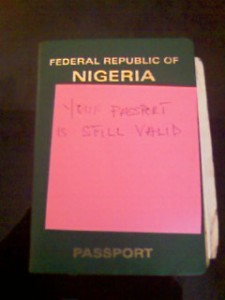
And so last week, I discovered that not only has that certain inefficiency in my country’s immigration department followed them from local Immigration Offices into foreign consular offices, the same attitude to citizens which resembles nothing else but contempt seems to determine the way they conduct their businesses. I don’t know about Nigerian embassies in other countries but what I have seen of their behaviour in Washington leaves much to be desired. A Nigerian – not me – and a Fulbright scholar studying here in this state had sent her passport for renewal. Along with the required fees and forms completed, she also sent a self-addressed envelope. A few weeks later, the passport returned along with the forms and the fees. There were no letters addressed to this citizen who had done all that is necessary in formal situations to apply for a passport renewal. There were no letter heads. All that came with this travel document was a post-it note written by hand and stuck to the back of the passport, which simply read: “Your passport hasn’t expired yet.”

Welcome to Nigerian diplomacy.