I’ve always been fascinated by names, and I can’t say since when. I’ve also always been fascinated with technology. It was no coincidence then when, while researching topics for my undergraduate project at the University of Ibadan, I settled on creating A Multimedia Dictionary of Yoruba Names. It was the first undergraduate project in the department (and, I hear, in the university) which made use of only electronic materials. There was no hard bound copy of any written material. Everything was hypertext and audio, burnt onto a compact disk. For audio I had the help of friends and colleagues to obtain fluent Yoruba speakers willing to help pronounce these names that formed the bulk of the audio database. Then, with my little knowledge of html, I designed an reference interface to access the sounds. Users could click to hear a name pronounced, or they could merely look up a name to discover the meaning.
 I found the project stimulating to work on, hard as the challenge of audio recording was, sometimes across two continents, but it gave me great pleasure, and something worthwhile to work on at that time when academic endeavour as a student looked like a chore with no silver linings. It helped to have had a couple of published materials to use, but researching the meaning of names proved interesting enough to mitigate the boredom of the final years of school. I got my degree, and left the university, with a niggling desire at the back of my mind to one day return to the project in a larger form. The choice was either to find money, call up some of the original collaborators and do it again, this time without the constraints of a university environment, or to simply pursue it as a solo side project. The reality turned out to be that because of other commitments, I would never be able to individually pursue it as a solo project anymore.
Time and chance has kept me in the orbit of project and vocations that relate to African (Yoruba particularly) languages and culture, and my masters thesis focused on the problems and peculiarities of learning Yoruba tone as a second language learner/speaker. Growing up as a monolingual speaker of English in Europe or America, how easy is it to learn Yoruba (or any other tone language for that matter? Mandarin, Vietnamese, Igbo etc). The result of my research yielded fascinating insights to second language learning and acquisition and I have sworn to return to that research as well at a later date. Scholars who have dismissed the possibility of monolingual English speakers to learn and master tone at a second language level will be disappointed by the challenge posed to their premature conclusion.
The reason I have been interested and involved in these things (beside the obvious one of it being in the orbit of my profession as a linguist) is my consternation at the absence of enough cultural materials online from this (Yoruba) and many other African cultures. In this century when most of what is knowable (particularly about Western culture and civilisation) is online and accessible to everyone, it is appalling that Africa seems to be left out. True, most of our cultural information are oral and thus based in the memory of griots and other living libraries scattered around our hamlets. This however can’t be an excuse to shy away from the tools of new technology to document them for future generations. Foreign media who need to pronounce names of African celebrities resort to Anglicizing them without consequences. If a Nigerian can pronounce “Krauthammer” or “Schwarzenegger” or “Spielberg” or “Reagan”, why would folks like Chiwetalu Ejiofor (as the Igbo will spell and pronounce the name) need to change their names to “Chiwetel” in order to get by in Hollywood? In this video from The Tonight’s Show, British actor of Nigerian origin, David Oyelowo tries to teach Jimmy Fallon how to correctly pronounce his Yoruba name.
In a world where linguists and cultural practitioners from Africa do their jobs well, Jimmy Fallon would have had to consult a dictionary of African names online and learnt the correct pronunciation before his guest comes on the show. He would do that for a Swedish guest, after all, no?
My life’s work then, it seems day after day (as I’ve found myself gradually gravitating towards) is to find all the ways possible to make the African experience part of the world experience, using tools provided by information technology. But not just that, it will also include making technology friendly and accessible to Africans who would otherwise have been put off by its alien language and lack of enough user-friendliness. Between 2012 and 2014, we successfully petitioned Twitter to allow the platform be translated into Yoruba. This was a huge victory for language survival and a testament to the open-mindedness of the folks at Twitter, recognizing the ability of the platform to be even more efficient in the hands of more people, and in more languages.
 My current project is to document ALL Yoruba names, by crowdsourcing, along with their etymology, meaning, phonetic/morphological properties, and all other stories and cultural dimensions to them. This time, we’re trying to make not just a dictionary, but a resource centre with dictionary, encyclopedic, and linguistic/multimedia information. I am raising funds on Indiegogo to meet the goal of creating the software backbone of the project and we have got a number of volunteers and goodwill. The larger aim is to kickstart a process that will lead to an awakening, and an eventual movement by all concerned, to put more effort in the documentation of our cultural experience in spite of the onslaught of a type of monolcultural globalisation that only leaves us bereft of any signpost of our identity and place in the world. Not just for Yoruba, however, but for all African languages. But we have to start somewhere.
If you believe in this dream, please go to the project page on Indiegogo to donate whatever you can. Every dollar counts.
 I have long wondered about this process of organic nomenclative (if the word exists) behaviour. In my many walks around the world of visiting places of significance, the process of naming – and the etymology of words over time – has always held a tremendous fascination. A place in Southern Illinois, a few miles from where I lived for a few years, was called “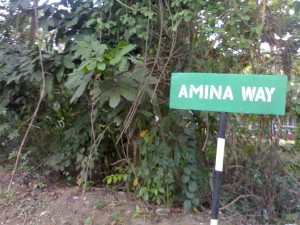
 The problem began when she started calling the names. I – a sometimes overconfident believer in my own ability to pronounce and spell any name as long as it is pronounced correctly – stared however into the screen confused each time I wrote out what I heard of a name, and my colleague told me that I’d written a totally different thing from what is correct. First there was Shawn which I thought was “Sean”, then Tiffannie which in my mind could only have been “Tiffany”. When she called “Lindsi”, I thought she meant Lindsay, and I wrote it, only to be corrected once again that the name is written just as it pronounced, and not Lindsay. And there came the others: Kathryn, Catherine, Kathrine, Brittney, Brittany, Lindsey, Devan, Devon, Kaitlyn, Cathlyn, Caitlin, Katelynn, Elisabeth, Elizabeth, Ashlee, Ashley, Megan, Meagan, Staci, Stacy, Alexandre, Alexander, Kelli, Kelly, Halle, Haley, Jasmyne, and Jasmin. Of course, before we finished typing in all the names, I’d simply given up on trying to type them from sounds. I would listen, and then peep into the student register myself in order to see how the names are spelt.