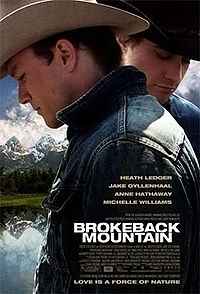
 I find it interesting that the historic “Proposition 8” ban on gay marriages in the American State of California was struck down on the same day that I’d plan to blog about this movie that I was seeing for the first time. Brokeback Mountain (2005) is a very moving (but to me a little discomforting) story of two men whose friendship evolved into something more and lasted for a lifetime, withstanding even the challenge of their individual marriages and separate heterosexual lives. I doubt that bisexual love has been depicted on the screen with this level of boldness before or since Brokeback. Wikipedia compares it to the great romance stories like Romeo and Juliet and Titanic.
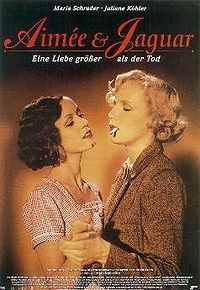 I had also recently seen a German movie called Aimee & Jaguar (1999) set in the Second World War, a true life story of an “abominable” (by standards of the time) relationship between a German woman, wife of a German officer, and a Jewish woman. Adapted from a book which contained photos of the many letters shared between the two, and official correspondences post WWII, the movie was remarkable not only because of the same sex nature of the relationship but because of the way the story depicts the love within the dangerous power relations and politics of the time. I know I could have enjoyed it better if my German was as good as that of the actors. Translations didn’t help much.
Both films – given to me by the same person who felt that I needed to update my tolerance credibility by exposing myself to the two prominent sides of the controversial coin – were refreshing in their own way. They both ended up very sad, yet moving, with very affecting moments, good acting and nice picture. Brokeback Mountain features Heath Ledger and Jake Gyllenhaal and it was nominated for the most Oscars at the 78th Academy Awards. It won three but lost “Best Picture” to Crash.