A Different Kind of Hoe

This is my post #400.

I have now lost count of how many times I used a perfectly clean English expression only to later discover that it meant something totally different in American English. Once upon a time, the “black book” was a place to write names of people you don’t like. But while telling a story of my first really brutal treatment in the hands of a woman bus driver in Edwardsville, I mentioned in passing that she had now entered my black book, and my students’ eyebrows went up. A black book, I was later informed, is a book where men wrote the name of their objects of desire. Surely that was new to me, and I immediately corrected myself. If I had a black book, the woman bus driver won’t be in it, definitely. Nine months ago, the only time you’d ever have heard me use the word “flashing” would be while remarking that someone had been calling my mobile phone without allowing me to pick it up before hanging up. In Nigeria, as in many other countries, that is “flashing”. I’m now aware – as I have actually been for a while even before coming here, from watching American movies – that flashing doesn’t have much to do with phones at all as with body parts. No, I don’t want to be saying that anyone has been flashing now. No sir, that’s why I have a voicemail. 😀
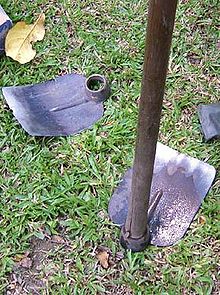
“This is a hoe.” Picture from Wikipedia

The influence of the mass media and their obsession with sex may have done irreparable damage to the innocence of words today. It is nows harder than ever to communicate without the risk of saying something totally different. Growing up in Nigeria in the eighties and nineties, I remember vividly that soda (soft drink) covers used to be called “crown corks” and that on radio during promotion, the jingles always were something like “Look under your corks and you might win a gift of…” (Hint: Nigerians typically don’t pronounce the ‘r’ in these kinds of words). Even to me today, that doesn’t sound to the ears as innocent as used to before, as neither is the use of pussies or doggys to refer to pets. Whatever happened to the language?

I am thinking of these things today only because during yesterday’s class, I was asked to tell the students the meaning of Ìwé kíkọ́ láìsí ọkọ́ àti àdá kò ì pé o and other lyrics of the song that they had learnt for the past three weeks from the class tutor. I painstakingly wrote out the translation on the blackboard (“learning from books without hoes and cutlasses is not a complete education”) and then suddenly realized that I could be wrong to assume that they all knew what kind of farm implements used in rural areas in Nigeria. The song itself came out an old culture of farming, and the grown folks who composed it had hoped to remind the young ones that farming is just as important as schooling. And so I asked, pointing to the writings on the wall. “You know what a cutlass is, right?” They didn’t. “What about a machete?” They did. “Alright, the cutlass is almost like a machete, and it’s used to cut down trees and to farm.”

And then it came. “What about a hoe?” Silence. Giggles. Laughter. Stares of horror.

He mentioned a hoe!

Then someone said, “yes” he knew what it was. I was at first relieved, until a few seconds later when I discovered that he actually didn’t, and it was my turn to be shocked. He definitely knew what he knew. And what he knew is neither used on the farm nor is supposed to be used in decent speech. Sigh. This is what has happened to my beloved English language. Oh, but how exactly did we get here? I’m going back to speaking only Yorùbá from now on, except that when written without sub-dots, the word for hoe in my language doesn’t fare better either on the scale of cleanliness.
Literally Disengaging

Whoever has lived in America for up to a year would have acquired a new kind of identity whether they like it or not. It could be the one they themselves realize, or those that is bestowed upon them from those who occupy a different clime. In the case of someone like me, he might have learnt to spell the word learnt as “learned” and mum as “mom”, to write dates with the month first, to eat pizzas, to shake hands firmly, smile everytime his eyes make contact with a stranger’s, use expressions like “I was like…” and wash clothes with washing machines rather than with hands. If he’s also from Nigeria, like me, he would also have learnt to stay up all night making most use of the internet, or leaving the lamps on in his bedroom for as long as possible. And eating grapes. And getting home deliveries of food whenever one is too tired to cook or to go out. In any case, all those are about to change, along with new disengagements in language.

I do not yet know the extent of my enslavement or adaptation to the American English speech patterns, and I might not know until I get back home. But this I know for sure, somebody is going to point out to me soon enough when I get to Lagos that “going to the bathroom” could only mean one thing: going to take a shower. If I want to go to the toilet, I will have to say so. I will leave medication in the United States and return to drugs in Nigeria and not feel ashamed to call it that. Old people will return to being old people and not senior citizens, and when I say I’d like to eat yam, I will have yam, I will be sure that impostor potatoes won’t surprise me in the most unexpected part of the plate. Potato chips will return to being potato chips, and the fries will remain the America.

Let the disengagement begin.

For All You Pandorans

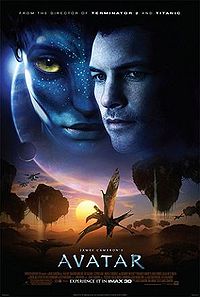
What impressed me most about the blockbuster movie Avatar is, surprisingly, not the amazing 3D animation, which nevertheless blew my mind as it did everyone else. After a while though, my eyes got used to the 3D effect; the novelty didn’t last long. It was not even the utterly patronizing storyline featuring a White Messiah coming from an advanced civilization to save a tribe of nature-oriented locals by undergoing a change and becoming one of them. How could that have impressed anyone? The storyline was predictable after a while as just another typical action movie with love thrown in, except with the twist of a White Messiah which we have seen in a few other movies like “A Man Called Horse,” (which is said to have started the pattern), and “At Play in the Fields of the Lord.” What about “Dances With Wolves” or “The Last Samurai”, “Pocahontas” and “FernGully.”?

No, what I was most impressed with was the Na’vi language of the movie, which I’ve now discovered was totally made up. Now that’s creativity. Of course, from the time I saw the movie last week, I knew that I was watching a totally made up language, and this is not a slight on the movie but common sense. It would be foolhardy to expect a White director to put a real world language in the mouth of a made up tribe of “primitive” aliens, especially in the age of political correctness. But I wasn’t reallysure until I confirmed today on Wikipedia. Here’s what it had to say:

From January to April 2006, Cameron worked on the script and developed a culture for the Na’vi. Their language was created by Dr. Paul Frommer, a linguist at USC. The Na’vi language has a vocabulary of about 1000 words, with some 30 added by Cameron. The tongue’s phonemes include ejective consonants (such as the “kx” in “skxawng”) that are found in the Amharic language of Ethiopia, and the initial “ng” that Cameron may have taken from New Zealand Māori.

As a linguist, this fact tickled me to no end, and it should tickle you too. Click on the Na’vi language link on Wikipedia to see the form and phonology of the Na’vi language, developed solely for a movie. This is how to make a movie. This is one of the qualities of great artworks – the attention to detail, and the lengths to which artists go to make their work authentic. All the actors in the movie had to spend quality time learning to speak this totally made-up language, and master its nuances of speech – at least, its accepted speech patterns. The last time I was this impressed with movie language was after seeing Mel Gibson’s Passion of the Christ in which the actors spoke old Aramaic and Latin, two altogether dead languages that are no longer spoken by any group of living people (except the Catholic church, and scientists, for Latin, and a very small group of people, for Aramaic). So this is what makes Avatar great, and not the patronizing earth-saving story of the renegade crippled-White-Marine-who-falls-in-love-with-native sentimental crap. And the movie is darn too long!

On The Origin of Names

What do the word “simian” and the name “Simeon” have in common, aside from a similar pronunciation? You guessed it – nothing at all, unless Simeon lives in the cage in a zoo or on a display plinth in a museum of extinct apes. If I were named Simeon, I would be very sad indeed if anyone were to laugh out loud every time they mentioned my name, especially if the person is a native speaker of English.

I remember my Kenya days, reclining under the mango trees on the grass lawns around the Margaret Thatcher Library on the campus of Moi University, Eldoret, discussing words and languages. All of us were guys, men, so the topic inevitably led to the risquĂ©. All I wanted really was a chance to gather knowledge about the Kiswahili language to add to my vocabulary, and until then, everything was going smoothly. I would come out in the morning, lay on the grass while my informant, Ng’ash, a photographer (whose name also rhymed with nyash) did his work and dealt with my endless list of questions at the same time. After going through a list of over four hundred words in Kiswahili with him and his other equally fascinating and mischievous co-photographers in that spot of the campus, I found that ngozi meant “skin”, pole pole meant the same as pele pele (go gently), kiboko meant “buffalo” whose skin is used to make what we called koboko (the whip), Mungu meant “God” and jana meant the same as Ă nĂĄ (Yoruba for “yesterday”), among many other amazing similarities. I also found out that kuma meant “vagina”, and that moto meant “hot”. The joke Ng’ash liked to make was that the first time a Kenyan found himself in Japan, he could not get his mind off the fact that the institution he was enrolled in was called the Kumamoto University. Kuma in Japanese is a popular name for children, meaning “bear”.

And so in Washington DC in December, I found myself on a dinner table with half a dozen Tanzanians who dared me to prove to them how much of Swahili I spoke. I did, starting with the everyday ordinary words. But they kept egging me on and I told them that I had actually learnt the private words first while I was in Kenya, and that I still remembered them even though I found a dinner table the least appropriate place to discuss such things. They would have none of it so I said, “I know that mbooro is for penis. Do you believe me now? I know that one for females but the point is proven, no?” The boys looked surprised, and the girls kept giggling mischievously, now resolved not to let me off until I gave voice to their body parts as well. It was an embarrassing almost awkward moment. But I did, and then shared the joke about the Japanese University. What else I found out afterwards was how easier to mention the word for privates in another person’s language. When asked to tell them what they were in my language, I could only tell them the word for penis. For vagina, I referred them to the Nigerian women in the hall, and as I correctly guessed, none of them took up the challenge to ask.

What I also learnt at the table was that the Nigerian name “Uche” in Tanzanian Swahili also meant the same as kuma, and that every time they heard the Nigerian name while watching a soccer game, they were giggling aloud not for the style of his dribble or the grace of his feet. Since I found out in Kenya in 2005 that Titi means breasts (as in matiti in Swahili), and “titties” in American English, I’ve always wondered what my name means in all the languages of the world if there was a way I could go on and find out. In American English, it means “a dark carbonated drink with a secret formula bottled in cans and bottles.” Not bad. What does it mean in Chinese, Malay, Emai, Nepali, Farsi, Akan, Ikaan, Uwu or Arabic? Maybe I should ask Reham about the Arabic part. I hope the meaning would not be too x-rated for her to tell me. I also remember one of my class sessions last semester when we were discussing colours. I had written the Yoruba ways of expressing colour on the board, and it included pupa for “red”, bulu for “blue”, funfun for “white” and dudu for “black” among many others.  By the end of the class, I was told by the students why of all the colours we learnt that day, they would most likely remember dudu for a longer time to come. In American English (slangs), the word doo-doo refers to excreta, they said. Talking with my Swahili friend recently about these, she told me that dudu in Swahili also means “a large insect”, in addition to being the word now used to refer to the HIV/AIDS virus. Very nice. So now, although eniyan means “person” in Yoruba, all of a sudden, I am never going to refer to myself as an eniyan dudu ever again! Not in America, and definitely not in Kenya.

10 Reasons To Not Speak Your Native Language in America

This post is a flipside part of my monthly “10 Reasons” blog argument. The first part of the argument is HERE, and you should probably read it first.


IMG_269310. People feel uncomfortable when you speak a “strange” language around them.

9. If you don’t already know how to speak it, or speak it correctly, how would you speak it?

8. English already has enough speakers? Perhaps not enough. And in any case, how many people understand your “African” language?

7. You could be mistaken for a terrorist.

6. If you’re gonna be in America for a long time, you may as well put the language in a safe cooler.

5. It brings you close to those who share your background and cultural similarity? Yes, but do they want to be close to you on the basis of language? Not really.

4. According to a new research finding, the new generation will rebel against your language use anyway, so what’s the point.

3. The American diversity includes only basically one other language. And it’s Spanish.

2. It’s not always easy to speak, if one thinks in English most of the time.

1. Nobody cares.


Bye bye November