Today is World Aids Day. For that, let me share with you an excerpt from my short story “Behind the Door”, published in the African Roar short story collection. The story was initially called “The First Test.” Enjoy.
______________
I followed her to the lab table and was going to ask her whether she had done the test on herself before, but I decided against it, convinced that she must have, at some point.
“What happens when one tests positive? Do you know?”
The words came out of me by themselves, but her response confirmed that she had heard it many times before. “Well, mostly we will just ask you first to do a few more tests to confirm that it is really the virus, before we know what to do next.”
“So you are telling me that it’s possible that this test shows positive and the other test shows negative?”
Her “yes”came in a firm tone that now got me uneasy. “It has happened before, you know. Sometimes there are some other infections that may manifest themselves on this test, and may not in fact be the virus.”
I was surprised, but more than that I was now scared. I thought back on my life and my confidence wavered. Her latest disclosure was now leading me to consider the possibility and consequences of being wrongly diagnosed. I did not like where my riotous thoughts quickly went.
“Let me ask you a last question,” I said, after a short pause.
“Alright.”
“What is the rate of infection in this part of the country?”
“Well, it depends on the organization that did the statistics.”
“No. I mean in your hospital. You do this every day, right?”
“Yes.”
“Like how many people, on the average, come here for testing every day?”
“About twelve.”
“Okay. Now about how many of them turn positive?”
“I would say about two.”
“Really?”
“Yes.” She said firmly.
Oh my God!
“Don’t be surprised, good sir. The infection is actually prevalent. With every ten tests I perform, there’s usually one positive person, at least. That is why we encourage people to come out and test themselves. There are actually more infected people roaming the streets than we know.”
I did not smile.
“So how many tests have you conducted today?” I asked.
She was busy writing on the notebook, so she gave no response. The statistics are not in my favour if all the people she had tested today were already negative, I thought. I could be the scapegoat. Oh wait, mathematics doesn’t work that way. Today may be the exception. Or in any case, the day is still too young for despair. The real unfortunate fella may be walking in very soon to receive his news. It is not for me. But even if this woman had already registered three positive people in her inglorious notebook today, is there anything in the world of random figures says that I can’t be another one. Damn, I should have spent more time in the arithmetic classes…
She gave me a wad of cotton wool on one hand, and in a quick movement of a professional punctured my right thumb with the little pin before I could scream for her to stop. She smiled assuredly, and proceeded to transfer the drop of my blood onto the little testing strip of cardboard resting on the table.
“Why don’t you go wait outside?”
“For how long?”
“Well, for just for a few minutes until the result shows on the strip.”
________________
The story is one of the twelve short stories in the anthology which you can buy here, here and here.
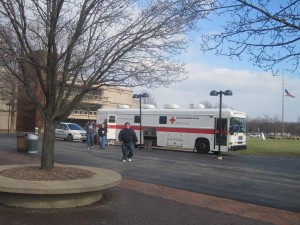
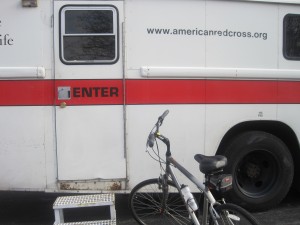 As soon as we passed by the Red Cross blood donation point at the SIUe quadrangle today, Chris and I, and managed to steer our conversation to donation of blood, I knew that I had come to another ktravula moment in the life of this journey. You see, I am conscious of all the dimensions of my Nigerianness, and about a year ago, just after I published my short story
  There was a sign-in sheet on the table. It had the name of those who are on the waiting list. On the examination table is a young woman whose blood was being taken. She had a pump in her right hand.
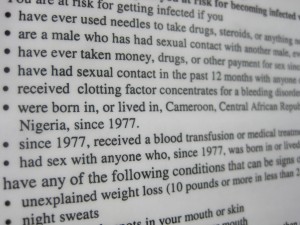 And read I did, carefully, until I got to where I am mentioned. Indeed, it’s written there in clear black ink of the excluded list. If you’re from Nigeria, If you have been to Nigeria, or had “sexual contact” with a Nigerian. Or if you have had malaria in the last three years, you CANNOT donate blood. I called her back and asked her why.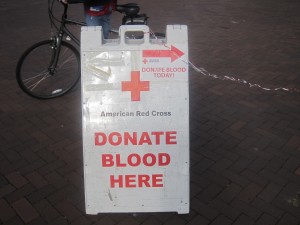
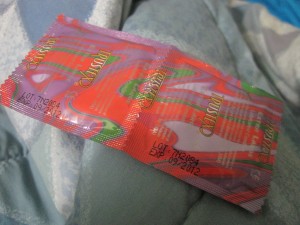 It was World Aids Day on the 1st of December, which was memorable for me because it reminded me of the first time I had to take an HIV test. It was just a year ago, in Nigeria, while preparing for this travel experience. Somehow, even though it was not a mandatory test, I took it, and it resulted in