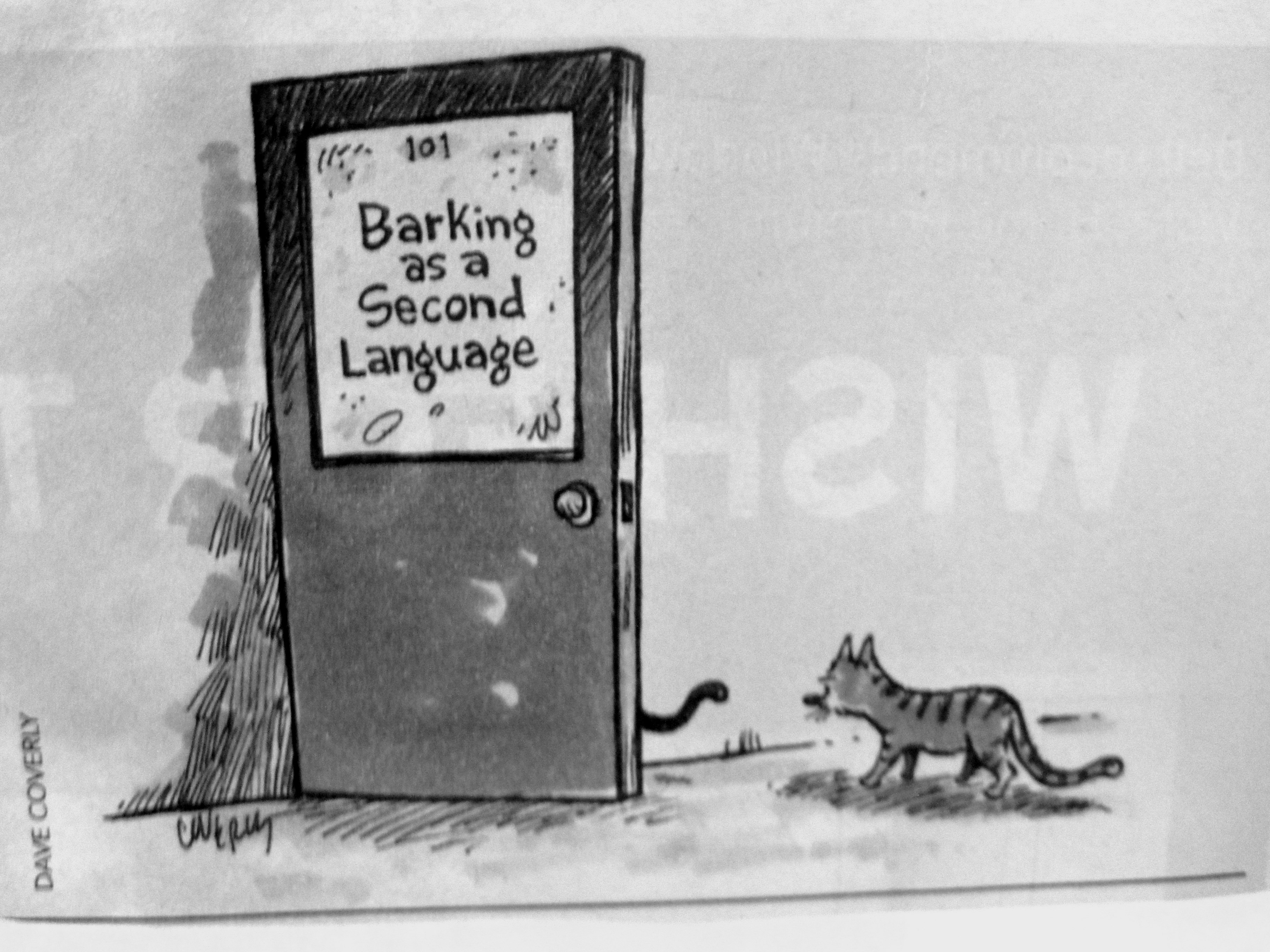
 “Barking as a Second Language”
Seen on the door into the Department of Foreign Languages where I work. I found it funny.
“Barking as a Second Language”
Seen on the door into the Department of Foreign Languages where I work. I found it funny.
 This is my 200th blog post!
Now that I have spent the whole of Thursday holed up in the hotel attending one workshop to the other, I am beginning to think that these photos from my solo walk around the little town yesterday might be the only ones that I have of its interesting sites. Or not. Let me check. Yes, I’m right. This conference is all I have come here to do.
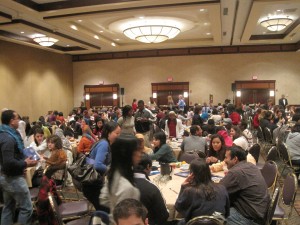 Meanwhile, the conference itself is very warm gathering of 409 Fulbrighters from 49 countries teaching hundreds of languages all over the country. I have met old friends who remember me, and those who don’t. I have also met new ones who had heard about me and those who hadn’t. There will be more conference sessions tomorrow, and more feeding sessions too, until Saturday when the conference officially ends. We have learnt about Social Networking for the Foreign Language Classroom, Writing for Publication in Foreign Language Journals, and Scenarios & Strageties: Addressing Individual Student Concerns. Tomorrow, there will be more… Before this conference ends, we will meet with some representatives from the State Department. No, I don’t think that there is a chance to see the Secretary of State, so that’s that, already crossed out.
But this was my lethargic Thursday put into good and productive use of my time, although now, the only thing that hasn’t changed is the tiredness I feel at the end of the day. I however learnt many things in the conference sessions today. One that stuck with me was a fact that forty Fulbrighters from eleven countries have been awarded the Nobel Prize since 1952. They include Jean-Marie Le Clézio (France, and Nobel Laureate for Literature in 2008), Henry Kissinger (USA, and Nobel Peace Prize 1973) and two time winner Linus Pauling (USA, and Nobel Laureate in Chemistry 1954).
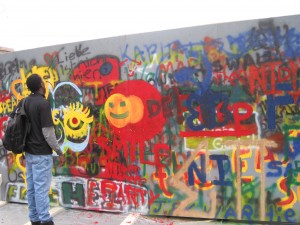 And so today marks the twentieth year of the demolition of the Berlin Wall in Germany. To commemorate it on campus, the German arm of the Foreign Languages Department in which I work have unveiled a public art exhibition featuring texts, artworks, pictures, history, (German) music, and most notably a miniature replica of the old Wall. Constructed with wood, and strategically placed at a publicly accessible spot on campus, the “wall” already randomly graffitied stands today both as a reminder of the historic day, as well as the ingenuity of the Department of Foreign Languages, especially of Belinda Carstens – the head of the department who is also a professor of German. Along with the chance to take pictures with the “wall”, students have been encouraged to spray-paint the wall and decorate it with their own graffitis as they see fit, just like was done with the real Wall in those days by angry Berliners and rebels who wanted it torn down. Needless to say, the over twenty feet long wall is already a notable piece of attraction on campus, and will be till the end of the week.
Here are a few of the pictures I took today, along with Catherine Xavier, an Indian member of the department. The exhibition will be open every day for the rest of this week, and there will be paint brushes and paints for each visitor to use to their artistic advantage on the symbolic representation of the old wall.
 But amidst my excitement to be here at this moment in time, here’s a dilemma I face: I can’t yet figure what I want to write on this wall. Prof Doug Simms of the deparment had taken his time today to draw on it a sickle and a hammer (the old symbol of communism) turned upside down, like it was on the old wall, according to him. A few of the other graffitis on this “wall” reflect each painter’s own sensibilities, and not always related to the politics of the Wall itself. So here I am, thinking (or asking YOU, as the case may be) that when I go back there tomorrow with a brush and paint in hand, what other creative texts or symbols (in any language) should I be writing on this remade wall from twenty years ago beside the obvious personal statement in my mind at this moment which simply reads, in German: “ktravula war hier“?
A mother mouse and a baby mouse are walking along, when all of a sudden, a cat attacks them.
The mother mouse goes, “BARK!” and the cat runs away.
“See?” says the mother mouse to her baby. “Now do you see why it’s important to learn a foreign language?”
A recurring question in my mind every day I go to class to teach my students Yoruba is “What exactly can they do with this knowledge?” Surely, like Ralph Waldo Emerson said, “there is no knowledge that is not power,” but when I look at these young students – the youngest of them being nineteen years – and look at the Yoruba language, I can’t help but wonder if there is anything particularly useful that they can do with their knowledge of it. The last few classes have featured questions and answers mainly about the people and cultural practices, as well as about language. So assuming that by the end of this semester, I am able to give them a basic knowledge, as well as give them sufficient motivation to learn more about the language, culture and people, then what?
Language is a medium of thought, but it’s also an abstract wealth, mostly without tangible value. An African language might be viewed with even more skepticism, especially from an American perspective. Besides the possibility of ending up like Austrian Suzanne Wenger in a Yoruba town with enormous artistic influence on a people’s belief, or as British Karin Barber in a University as a European authority on the language and grammar, what else is there to do with these little snippets of knowledge that we share every week in class? I cannot answer the question, and I would not be asking the students to do so.Yet.
We have learnt about Suzanne Wenger, Wole Soyinka, Karin Barber, Toyin Falola, and a few other literary figures. In the last class, I tried to dispel some more common genralizations about the people and perceptions. Students seem always to have new questions each time, and I love it. Had I seen that video of Chimamanda speaking at a Ted.com event, I might brought it along to class. I definitely will consider doing so in the next class, just after our test on Monday. I hope that in the long run, there is something of value being exchanged between us every time we gather in class to discuss.