The following conversation took place a few minutes after my flight landed at the Reagan Airport in Washington DC this afternoon. The conversation had been waiting to happen since my first five minutes into the plane. I had taken my seat close to the window, and suddenly noticed a short but pretty white girl walking down the aisle. She walked past my row and took her seat on the other side of the plane, about two rows behind me. We exchanged glances, and she smiled. I wanted to say more but I kept quiet. The reason why was that the man who took the middle seat beside me didn’t look friendly and I didn’t want to look like an ass, especially since the lady was a little far away. It would be hard to make a conversation without making some noise. So I kept quiet. But every time I looked back, our eyes met and we repeated the same short smiles. On her part, it must be because she didn’t want to be rude. On my part, it was because I desperately wanted her to acknowledge that we had indeed met somewhere before even though I couldn’t immediately remember where.
Two hours later, the plane was at a stand-still and a queue had formed in the aisle for those who wanted to disembark, so I reached over the unfriendly looking man and broke the ice.
“Hi, how are you.”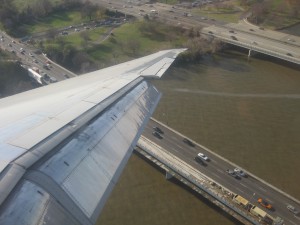
“Fine,” she replied. “And you?”
“I’m fine. I’m sorry, but do you attend SIUE?”
“No,” she said.
Oops.
“Oh, ok. Really? You look really familiar. Is it Principia University then?”
“No.”
“Carbondale?”
“No, I attend Webster University.”
I’d never heard that name before in my life. And then I think I saw the man beside me giggle.
“I’m really sorry then,” I said. “You look really really familiar. I know that I’ve seen you somewhere before. That university that you attend – Webster – is it in Illinois?”
“No, it’s in Missouri.”
“Oh, alright.”
Damn! Right then, I could have just disappeared under the seat because I had successfully made an ass of myself not once or twice, but many times in the presence of about a dozen people within earshot of the curious conversation. All of them were white, and grown up, except the object of my tenacious attention. Not that it mattered much that they were white, but with their silence, I began to wonder what they must think of me. And then it hit me.
“Are you a Fulbrighter?”
“Yes.”
“Oh my God. Of course you are! What a relief. You were in Providence, Rhode Island in August with me?”
“Oh yes.”
“Oh whew! That explains it then. Of course that was where I first saw you. I still have you in my photo albums. I know that I’d seen you somewhere before. I don’t usually forget faces. How silly of me to have forgotten to mention Fulbright.”
“Yea. I’m so sorry I couldn’t remember you.”
“No problem. I know I am not crazy!”
Now the man beside me, who was still on his seat because the airplane’s door hadn’t been opened and nobody had left the plane even though everyone else was on their feet, began to smile and looked at me with a look that finally seemed forgiving. It was such a relief.
“So how is the experience so far?” I asked.
We went on and on right there in the aisle talking about what we had done, and how stressful, fun, enjoyable, interesting, etc the experience had been for us. She’s from Germany, and she is the only Fulbright FLTA in her university. She teaches seven students and takes a tutorial for about forty more, she said. At some point, our hitherto unfriendly passenger joined in and shared his love for the museums in Cahokia and the Gateway Arch as well. It turned out that we were both heading to the same Conference, and we were both looking forward to meeting over four hundred others.
It was my first memorable welcoming into the nation’s capital, and when I left the plane, I couldn’t tell whether it was meeting someone familiar, or being absolved of that suspicion of stalking that made me happiest. But it was a happy moment of warm welcoming.
 This is my 200th blog post!
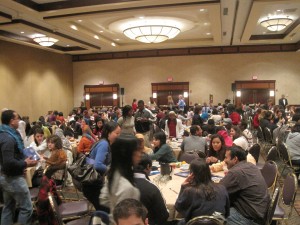 Meanwhile, the conference itself is very warm gathering of 409 Fulbrighters from 49 countries teaching hundreds of languages all over the country. I have met old friends who remember me, and those who don’t. I have also met new ones who had heard about me and those who hadn’t. There will be more conference sessions tomorrow, and more feeding sessions too, until Saturday when the conference officially ends. We have learnt about Social Networking for the Foreign Language Classroom, Writing for Publication in Foreign Language Journals, and Scenarios & Strageties: Addressing Individual Student Concerns. Tomorrow, there will be more… Before this conference ends, we will meet with some representatives from the State Department. No, I don’t think that there is a chance to see the Secretary of State, so that’s that, already crossed out.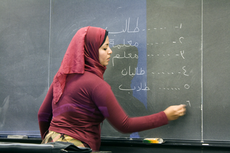
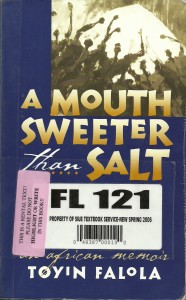 Toyin Falola which is our second class text. In many ways, the book is much like Wole Soyinka’s “Ake”, in style, content, and value, especially in the clever turns of phrase, eloquence, and reference to recognizable landmarks in the history of South-Western Nigeria before independence. The chapter is set when the author was nine years old, and the whole work is written in a way that makes it seem that we are listening to a child talk, even though we know that it is an adult relaying his many interesting experiences from childhood.