Full Circle – Short Faction

Written at Cougar Village.

Looking up into the predictable night sky, he saunters home. In other climes, he might have been a little high on the freedom of the night to surprise, and to appease his seething exhilaration and bubbling fears. Here, he just paces home in little steps that completely ignore the need for caution, yet a buoyancy remains. Even the geese have gone to bed, and the road is free of any surprises. Only the warm wind blows from all directions, and his open shirt blows with it opening spaces around his armpit and exiting through his similarly open cuffs. From afar and against the background of light – except for the colour of his shirt or the size of his frame – he could have been mistaken for a waving flag, or a moving scarecrow.

Once upon a time this was home to more shuffling feet and heaps of snow. But that was then. Once upon a time, trees and their leaves that now whistle with the night shedding grains of white pollinated flowers were only high and dry, and winter shook the alien city to the barest limit of its own survival. Then there was nothing but death and dryness, and a certain music to the melancholy of heavy and seemingly wounded trees. It was seasonal. Hope had sprung up later like the flowers that now scatter on his head from on top of the tall pine trees. All in one night the change came, suddenly and without warning. Even to him a traveller, it was an unexpected miracle of a seasonal revival.

Like a visitor in a now growing market place, he looks around again with a certain brightness. The fears that returned were about how in a different place and a different time this might have been unwise, coming home at this time of the night. In his mind was something similar to a mother’s scoff of a rage: “Bloody fool, you toss your life around like a game of cards.” The delight in mischief of such confrontations has gone now, and only a nostalgic smile remains drawn on the face of the dark night sky that breathes on his upward gaze. Like looking at a mirror of one own smeared reflection, he muses, head up towards a direction that could only be east, judging by the position of the crescent moon. Home lies there, he whispers.
Introducing African Roar!

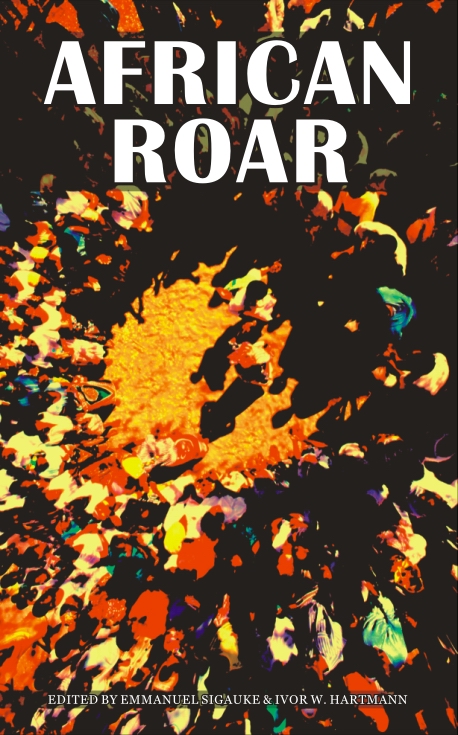
In a few days time, a new book will hit the shelves all over the world. It’s African Roar! It is a collection of short stories written by authors from different countries in Africa. As the name suggests, it is an African roar! Do you hear the rumbles?

My first published story, first titled The First Test has now been published in the anthology as Behind the Door. It is a story of one man in contemplation while going through the aisle of a private hospital.

But African Roar has more than just one story. From Novuyo Rosa’s Big Pieces, Little Pieces to Ayodele Morocco Clarke’s The Nestbury Tree to Beaven Tapureta’s Cost Of Courage, Chuma Nwokolo’s QuarterBack & Co and Ivor W. Hartmann’s Lost Love, the collection takes you onto imaginative plains and hills, and all the eleven stories leave you with an exhilaration that you can only get from the little pleasures of the other person’s imagination. Other stories in the collection are Yesterday’s Dog by Masimba Musodza, Cost Of Courage by Beaven Tapureta, A Cicada In The Shimmer by Christopher Mlalazi, A Return To The Moonlight by Emmanuel Sigauke, Truth Floats by Nana A. Damoah’s and Tamale Blues by Ayesha H. Attah. Each of the stories tells something of the African experience, and more.

The stories that make up the work were all drawn from the very best stories published from 2007-2009 on the Story Time website. The anthology is published by Lion Press Ltd UK, and is edited by Ivor Hartmann and Emmanuel Sigauke. It will be available on Amazon, Barnes & Nobles and some physical book stores worldwide in a few days. It will also be available on the Kindle.

You may follow the twitter feeds of African Roar at http://www.twitter.com/africanroar and on Facebook at http://www.facebook.com/African.Roar for more information. Autographed copies will also be available, I’m sure, as soon as possible.

I’m ex… ex… excited. Are you?

Abayomi and I

In this guest post, children’s story writer Ayodele Olofintuade writes a autobiographical account of growing up with her brother in Nigeria. It’s reproduced her as cross posted on her blog totallyhawaya-haywire.blogspot.com.

_____________________________________

… At five years old

“What’s the west of the stowy?” He asked staring at the pictures in the comic book

“The oko baba dudu first!” I said making a grab for the sweet.

He clutched it tighter, “Who is that man standing behind Spiderman?” He pointed at the comic.

“Oh he’s just there.” I said dismissively. “You promised to give me the sweet if I read the comic to you.” I said eyeing the oko baba dudu anxiously. In spite of the fact that I am three years older than Yomi he’s always one step ahead of me.

“What is this man doing there?” he repeated holding up the comic.

“How will I know? There is no balloon coming out of his mouth.” Then it dawned on me that Abayomi has no intention of giving me the sweet, so I made a grab for it . Abayomi gave the loud screech that always fetched our mother from wherever she was … I snapped my fingers at him. “I will show you! Mcheew!!” I know when to run …

“Wale! Biodun!!” he called his friends. “I have finished weading the comic. But you have to give me one oko baba dudu each before I tell you the stowy … is it me that said you should not know how to wead like me? … This is spiderman and the other one is emm… emm, …superfly…!”

***

… And then he turned eleven

“But why is your cousin not talking now?” Jide said, eyeing my ‘cousin’ who is dressed up in a black mini skirt with a pair of very high heels and a big afro wig.

“I told you she’s mute, she can hear you but she cannot talk.” I said smiling at my ‘cousin’ as she applied … no smeared… more lipstick on already blood red lips and added powder to a ghostly face.

“But that your cousin looks like Yomi.” Jide said staring at the huge boobs straining at the tee-shirt.

“Wo Jide, I’m tired of this jare, do you want a girlfriend or not? She will allow you touch one of her breasts, just pay up.” I held out my hand for the twenty naira. Jide reluctantly handed over his life savings to me, his eyes still glued to my ‘cousin’s’ balloons… “Are you sure she will let me touch th…the…them?”

“You can take your 20 naira back if you don’t trust me.” I watched with disgust as Jide started squeezing one of the big pimples on his face … no wonder he doesn’t have a girlfriend.

“Where is Yomi?” He asked as he dipped a finger inside one of his nostrils.

“He’s in Lagos.” I said haughtily. “Come back around 8.30pm, my cousin will wait by that door.”

“It will be too dark.” He whined

“You did not say you want to see a breast you just want to feel it, so you don’t need light. You have to leave now, mummy is back.” I said pushing him through the door.

“Good afternoon ma. Bye-bye.” Jide said as he ran off.

“Abayomi what are you doing in my shoes … my wig and my make-up?” Yomi stood up from the chair and nearly fell off the heels he was wearing.

“Get that muck off your face. Go and change. What’s that on your chest? The balloons I bought for Oba’s birthday abi? Don’t worry; I’ll get to the bottom of this later. I hope you’re done packing because the taxi that will take us to Lagos is waiting outside…”

***

… Yomi at 34

What fun we had in those days didn’t we?

_____________________________________

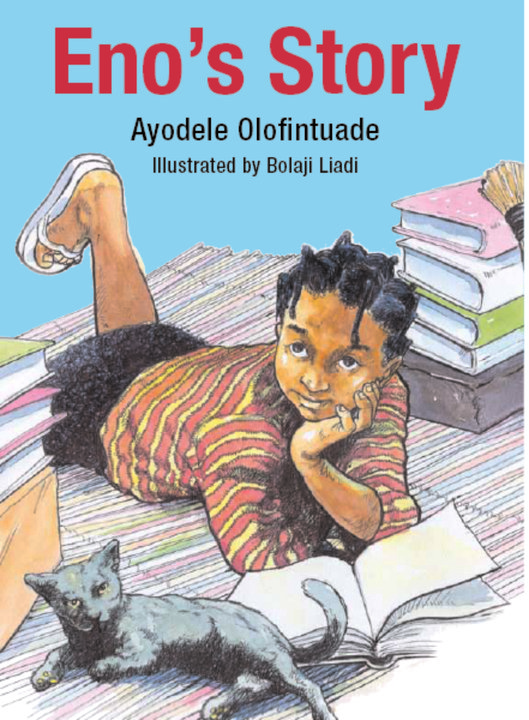
Ayo is the author of a forthcoming socially-conscious children’s storybook titled Eno’s Story scheduled to be published by Cassava Republic.

A Review

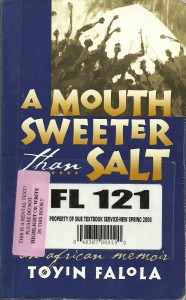
I love this review of the book A Mouth Sweeter Than Salt by Toyin Falola. It was done by Nigerian writer Ikhide Ikheloa in 2008. By the the time I was writing my mini review of that book last year on this blog, I had no idea that some other person had written something longer, deeper, more expressive of my earlier perception of the work.

Like last semester, we shall be reading the book again this semester for the foreign language and culture class. It is a fascinating account of a man’s childhood in the Nigeria of the 50s, 60s and 70s. Get and read the book if you can, and take a very wild ride in the serene happy days of my country’s early nationhood.

At the end of last semester, I asked all my class students to write a two-paged review of their experience in my class. The following is an excerpt from the submission one of them.

“The one thing that I did not like about the class was the book, “A Mouth Sweeter Than Salt.”  I know you did not pick it out, but it was the worst book I have read in a very long time.  If you could, I would get a different novel for your class to read next semester because every chapter I read felt like pulling teeth.  Well it was not quite that bad, but it was not enjoyable.  Besides the book though everything else was very enjoyable.  I cannot remember a class more enjoyable than this one, or a class that I laughed so much in.

Overall I could not have been more satisfied with the class.  The material that I learned helped me grow as a person and made me see a part of the world how it should be looked at, and not just from a “single story.”  My perception of the Yoruba and Africans in general was corrected.  After going through the semester I could not have been happier in my choice to take this class.  It is a great feeling knowing that I can communicate in Yoruba, even if it is at a rudimentary level.  The class was more than fair in difficulty and work required.  When looking back at the first day of class I realize that I never had anything to worry about and the man who walked in with the traditional attire on was a lot like me.  Although I may have not changed the place where I sit in the class, almost all of my views of the African culture have been altered throughout the semester.  I am thankful that I chose to take this class because it has made me a better person as a whole and have come to greater appreciate people of different cultures.”

Needless to say, he was the only one of nine people who felt sufficiently annoyed by the book to write about it in a final essay. Others passed their displeasure to me outside the class about the often winding and distracted writing style of the author. Nevertheless, it’s a great book. I recommend it.

This Week

Class is winding down in three weeks’ time, but in my case, work will officially close on Monday the 7th of December when all assignments and essays are due for submission. For the final paper, the students have been given two distinct essays to write. The first one – which is unrelated to an anonymous teacher assessment form that they will all have to complete about me anyway at the end of the term – is a standard sized essay which must detail their most memorable experiences in the Yoruba language class. Their essay must say what they learnt, what they wished they had learnt, what their expectations were at the beginning of the course and whether or not it had been met by the end, what they liked and what they hated about the course and about learning the language and culture. They have been given the liberty to be free with whatever they express, but they must write something, and it counts for their assessment, I said.

The second essay, which is mostly academic is a short story that has been decided on as the main final examination. In the beginning of the course, I had made them read a short story titled “Why Atide is Talking To A Coin” by Anja Choon, and write an essay on what they learnt from it. The story is one written by a German friend of mine for her Yoruba language and culture course under Karin Barber in Birmingham, and it gave me a tour of the students’ mind about how they perceived the culture. Since then of course, we have also completed summaries of Toyin Falola’s A Mouth Sweeter Than Salt, an autobiographical novel this time written by a Yoruba man about experiences growing up in Nigeria of the 60s and 7os. The short stories previously submitted by my students but which I have now returned to them with my notes of correction all detail their own imaginative truths about Yoruba people, expressed in nine individual interesting short stories. They are as diverse as they are original. Though written in English, the instructions were followed that the characters must bear Yoruba names, must use a few Yoruba expressions that must be explained in the glossary, and must express Yoruba cultural sensibilities either in dressing or in demeanour. All I wait to receive now on the last day of class is their final draft and corrections of the stories, which I have also promised them to keep close to me as valuable materials from an unforgettable experience. What would be better – as I told them as well – is to discuss with the head of department about the possibility of making the nine stories into a book, a sort of “Collection of Yoruba Stories from an American Yoruba Language Class”. I like the idea, and they liked it too.

Meanwhile the standard anonymous teacher assessment questionnaire is a regular part of the academic review exercise at the end of the American school term which includes students having to say what they felt about the course, the teacher and the whole learning experience. It would be anonymous so that students are free to say what they feel without fear of future victimization. It always plays a part in deciding whether a member of staff is retained or dropped next year, the teacher in question will also have access to the questionnaire at least to see how his students perceive him. I like the idea, and I think that if the Nigerian educational system would adopt it, there would be less victimization, negligence and random lassitude in our educational system as we have now. No Professor will take his/her student for granted if s/he knows that they are the part of the overall deciders of his future position in that place of work.

But until Monday the 7th, I have two more classes to teach where I may or may not tell them about this blog. Now that they will no more be my students, they might need something to keep in touch with my ideas and progress, especially now that I’ve put on hold till 2010 every of their Facebook friendship request intentions.