CNN concludes through this mysterious poll that the Nigerian English accent is the 5th sexiest in the world but didn’t forget to coat the ‘honour’ in cheeky stereotypes. Meh.
If I were to rank all the awkward questions that I’ve been asked since I came here, I’d rate this one the highest: “Do you speak English in Nigeria?”, along with its many variants of “How do you learn to speak this well/this fluently?” and “I like your accent.” I have got inured to its silliness over time, and learnt to enjoy it as a compliment whenever I hear it. So I respond instead with “Oh, thank you.” Sometimes for effect, I also add “Oh, I like your accent too” just to relish the priceless expression of shock or incredulity that immediately shows on the face of the person to which it’s directed. “Who? Me? What do you mean that I have an accent? I’m American…” as if accents were either a disease, or only one person’s idiosyncrasy. I have realized that many people, even in the university (well, not students of language), do not know that there are many accents of American English, depending on where one resides. St. Louis English accent is definitely different sounding from Boston accent, Chicago accent or Mississippi accent that all have their own peculiarities of more than just pronunciation but also grammar. In any case, whenever I’m bored, I occasionally like to relish the pleasure of trying to distinguish accents and speech peculiarities. It’s not easy for me, needless to say, since I’ve not lived in the United States for more than just four months.
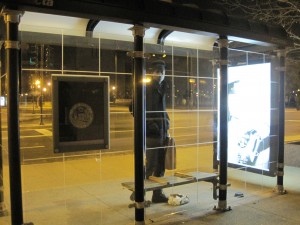
Away from accents for a little while. Less than two weeks ago, I was sitting in a bus stop at 5th and Missouri Metrolink train station waiting for the scheduled bus to take me from there back to Collinsville, and later to Edwardsville. Those familiar with the area would know how dangerous it could be at certain times of the day. It is in a part of Illinois called East St. Louis, just on the border of the state. It was evening, and it was cold. There were people around, but it didn’t give me any illusion of safety even as I put my iPod on and listened to some calming music. I was alert. There was a young African-American woman sitting beside me on the bench in the bus stop. A few seconds later, a young African-American man in sagged jeans and with a really loud phone, of perhaps around 24-25, who I’d seen prancing around talking to everyone passing by even when they didn’t stop to give him audience came towards me and said something. He was addressing me. I was listening to some of Fela’s best ballads. He was talking. I heard him clearly, but I didn’t pick out what he said, so I removed the earplugs and looked at him. I didn’t smile. He repeated what he was saying, and I still didn’t understand it, yet it sounded vaguely like English, so I gave up. I asked him to say it again and he did, for the last time. As she saw that I honestly didn’t understand him, the lady beside me looked at the young man and said “No, he don’t smoke/have weed.” What? That was what he’d been asking me (and the many other people) all the while, whether I had marijuana to share? Good Lord have mercy. Why didn’t he just say so in English? Well, he eventually left because I immediately turned my attention back to my music, and ignored his presence. Yet in me I wondered what would have happened if I’d said more than a sentence, and he’d discovered that I was not American, but an African with a heavy/strange English accent. Would that have made me a bigger target for mugging? There was a laptop in my bag, and there were my debit cards, along with my iPod and mobile phone. And my distinguished Nigerian passport. As I got on the bus a few long minutes later, I understood why George Bernard Shaw said that Britain and America are two countries divided by a common language.
And so today – thanks to patience, persistence, and prayers – I checked my account balance to find that my money has been refunded. Thanks providence. However, the part of it that inspired this post was in the email response I got from the bank representatives. I had sent them a complaint in an email, stating that I had made a transaction on Monday to the tune of a thousand dollars. From the response I got back, I have found out that it may be possible that American English doesn’t have any such expression as “to the tune of” in their language. Is this the case? I don’t think so too, but even if it is not, it doesn’t remove from the fact that Bernard Shaw could have been right after all.
Please read. It’s unedited, except for my account balance ;).
Dear KT, Thank you for contacting customer service. With reference to your e-mail, we regret to inform you that we do not see a transaction of over thousand dollars for “the tune” but there was a transaction on hold from SIUE Bursar’s Office, EDWARDSVILLE, IL, for $1,057.87 on 04th January 2010. This amount is already credited back to your account on 08th January 2010 and your current balance is $xxxx.xx. Whenever a transaction is on hold and if the merchant does not approve the transaction then the amount is released back to your account in 3-5 working days. Regards JP Morgan.
Dear Blog readers, today I want to get a little serious, taking a short break from my random pedestrian irreverent rants. Oh well, I confess, I have misplaced my funny bone. Maybe Holly’s cats took it. Okay, let me take that back. I don’t intend to get serious, but I’m trying so hard to enter a pensive mode of recollection and it’s not working. All memories of the nice funny things I wanted to tell you has suddenly disappeared, and all that stares me in the face is an empty bottle of Foris Pinot Noir. Again, I’m kidding.
My thoughts have ranged from the wonder of the world when observed from above, as well as the diversity of accents. But just last week I got a collection of songs from the movie My Fair Lady, and I was surprised at how amused I still was with the lead song “Why Can’t the English (Learn to Speak)” There was a nice line in the song which the actor Rex Harrison delivers with such a priceless speech and a straight face. It goes,
“Why can’t the English learn to set a good example to people whose English is painful to your ears… There even are places where English completely disappears: In America, they haven’t used it for years…”
That part always made me laugh, especially when read against the diversity of American English accents. Everywhere I went in America, everyone seems to speak so differently, and even the students do not share a common accent. The linguistics class that I attend weekly is one nice theatre of such differing sounds of speech. My Fair Lady is a treasure, and the play (Pygmalion) by George Bernard Shaw that spawned the movie and Broadway production is an even bigger delight. Take it from a thoroughbred Shavian like me who has sworn among other things to see at least one Broadway or Off-Broadway play before returning home. Come, come winter.
However, I do not go about campus like the Professor Henry Higgins now jotting down the varying sounds of the American working class, even though the prospects of such endeavour sound rewarding, but I can at least boast of a general delight in ear sampling of accents. The knowledge of such diversity of speech has built for me a stronger confidence to resume my own Nigerian accented English rather than trying hard to sound American. It is not always an easy effort to pronounce just about every “r” in every word whenever you speak. When a Nigerian pronounces the word “pork”, you are not likely to hear the “r” pronounced, and that always left my American confused, and they always replied with “What?” “I beg your pardon,” “Come again please.” On the plane from London, a co-passenger warned me that if I want to say “hot”, I should pronounce it as “hat” or else no one would understand me. It has turned out to be a good advice so far. “Flu shot” had been “flu shat”, and every word that I’d otherwise pronounce with a closed mouth has undergone such dramatic transformation. I even admit that I have to take conscious effort to speak slowly just so I can get my thoughts across.
I admit, I’m being gradually Americanized. My “butter”, “bitter” and “letter” are now easily pronounced if the “tt” segments are called like the American “r”, but thinking forward to my mandatory re-absorption into the Nigerian speech pattern a year from now, I’ve been selective in my assimilation. But I can never get away from the occasional strange glances that respond to my sometimes deliberate attempt to speak the British English, Nigerian style.