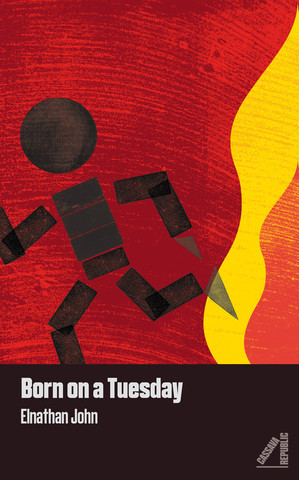
I have read only a few chapters in Elnathan John’s new book Born on a Tuesday, and I already formed a few opinions not just about the author and the publishers, but about the direction of literature on the continent. They are good opinions, by the way, and they were a long time coming too. See the following excerpt from the book’s first paragraph:
“Gobedanisa and I had gone into a lambu to steal sweet potatoes but the farmer had surprised us while we were there. As he chased us, swearing to kill us if he caught us, he fell into a bush trap for antelopes. Gobedanisa did not touch him. We just stood by and watched…”
 Notice anything? You have just read half a paragraph in English in which a non-English word was treated like every other word, and not made self-conscious through italicisation or gloss. This is a marvellous and remarkable thing! A smart reader might figure that “lambu” means either “farm” or “garden”. Or not. (The answer, according to a friend, is “irrigation farm”, but I didn’t know that until I asked, which is the whole point. If you live in the Nigeria and you can’t find anyone around you who speaks Hausa, then you need new friends. And what kind of Nigerian are you anyway? If you live anywhere in the world and Google can’t help you with the meaning of a word, or someone who can, you need a new computer and new friends).
Thankfully, the book is filled with many instances like this, like a chapter titled “Dogon Icce” (tall tree), and a number of other Hausa and Arabic-based expressions that the author leaves the reader to research on their own in order to enjoy a more fulfilling reading experience. And why not? What is an almajiri, and why is knowing what it means and who an almajiri is important to enjoying the story? What is a dan daudu, and why should the author spend his time translating it to you when he has a story to tell? What is santi? And if the English language is incompetent to render it to your monolingual mind, why should the author feel compelled to do anything else about it but let you figure it out for yourself?
Let’s hear it from Ikhide Ikheloa who has — in fairness — kept this issue at the forefront of African literary discussion for a number of years:
“African writers should perhaps learn to be more insular, I mean who italicizes akara and explains it as “bean cake” in the 21st century? If the reader is too lazy to use Google, tough luck. But then, to be fair, after all these years of railing at African writers, I now realize that African writers who choose to publish in the West are not negotiating from a position of strength; the editor is Western, the publishing company is Western and the audience is Western. It makes marketing sense. It doesn’t make it any less maddening. Imagine if Tolstoy in War and Peace had taken the time to italicize and explain every word foreign to the African reader. That book would have been way more than 50,000 pages. But then to be fair Nigeria has precious few indigenous publishing houses, what is a writer to do? You want to be published? Take the crap from the Western paymasters.” – From A review of E.C. Osondu’s This House is Not for Sale
All you need to do to see how tenacious Mr. Ikheloa has been on the matter is merely to type “italicize” into the search box on his blog. I did it, and the result was enormous. But he has a point, which is that in order to placate an industry whose nonchalance for our stories — in spite of its lip service to it — is unshy and pernicious, many authors have sold out by consciously dumbing down their literary capability for a token of “wider comprehension” (whatever that means). Literary facility has been exchanged for global acceptability which has, in turn, produced works of highly inarticulate form — not for a lack of viable content, but for the timidity of language and style. So, to have Elnathan’s book give a giant finger to old habits is a brilliant and satisfying triumph, but it’s only the beginning. For one, it is a surrender to the primacy of English as our most efficient literary vehicle albeit now an encompassing one. Having him write completely in Hausa, today, would still have been seen as extreme, which need not be the case.
But while we’re celebrating this interlanguage compromise, there are a few more doors that need to be knocked down. One of them is the habit of publishing Yorùbá (or other tonal African) names without the appropriate tone marks! It was understandable when the publishing gatekeepers were old British men to whom those names were nothing but arranged letters. We bought into it when Nigerian publishing executives followed suit, reinforcing the idea that tone marks were only for indigenous language texts. Now that we know better — and now that we have accepted the role of English in expressing our most genuine cultural and human experiences — there is no excuse not to make it as robust, capable, and representative, as possible.
So, here is a salute to Cassava Republic, and Elnathan John, for a bold (but ultimately merely sane) decision. Here’s to more writers following. And here’s to doing more, because we’re not there yet.
_____
(Photo credit: Cassava Republic)