This Weekend: A Blood Intervention

A couple of years ago, December 4, 2009, precisely, I wrote a blogpost in which I lamented a discriminatory practice in the blood donation system on the American campus where I was working then a visiting scholar. Because I was a Nigerian and for no other reason, I had been turned back from giving blood. Two years later, this time as a Masters student in the same university, I wrote a second report, acknowledging a change I noticed in the policy.

Since that first encounter, through the second one, the availability of blood (and the policies behind blood donation drives around the country) had remained on my mind as an abiding interest. So when, back in Nigeria, I was called into the founding of the One Percent Project and the Ten Thousand Donor project which both aim to make access to safe and healthy blood affordable and available through the means of information technology-driven applications, I jumped into it.
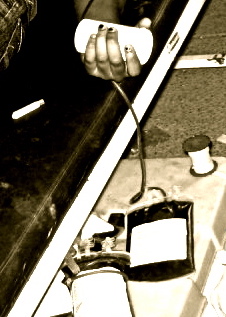
IMG_0178It had been fun, and enlightening, and rewarding. Since the founding of the organization in May 2012, the One Percent Project has helped facilitate the collection of about 754 pints of blood from young professionals from around the country, through the Nigerian National Blood Transfusion Service (NBTS) who then give it to hospitals where they are needed, thus potentially saving about 2262 lives (since a pint of blood is reputed to be able to save about three human lives).

But that was just the beginning. So, starting from tomorrow June 14, the best tech volunteers, programmers and hackers from around Nigeria are gathering in Yaba and Lekki to collaborate with the One Percent Project to create an app that can make it easier for potential donors to link up with blood donation centres around the country, and especially for patients needing blood to connect with willing donors who have signed up to be called whenever the situation arises.

Tomorrow is also the 2013 World Blood Donor Day

I will be part of the event, tweeting nuggets, pictures, and thoughts via my twitter feed @baroka. At 4pm on Sunday, at the Audax Solutions Office (at Plot 24, Block 113, Adebisi Ogunniyi Crescent, Lekki Phase 1, Lagos‎),  the app, called the LifeBank App, will be publicly launched. There will be bloggers, social media personalities, print media practitioners, and other trustees present. If you can make it, it would be nice to see you there too. It would be nice to introduce you to the advances this new generation of Nigerian youths are making to make the future much better than the present.

The LifeApp Facebook page has been set up, as well as a twitter page. Conversations on the hackaton and the app launch will be on twitter under the hashtags #hack4health and #LifeBank and on the LifeBank App blog.
The One Percent Project

Out of a need to save lives in Nigeria today comes this new idea called the One Percent Project. Nigeria, a country of over 160 million people, still gets by with a crippling healthcare system and a large portion of its population without access to adequate emergency care. 25% of maternal mortality today is due to unavailability of blood. The current blood donation and distribution system is poorly regulated and coordinated. Hospital based blood collection leads to a highly inefficient and fragmented system.

The recent UN bomb blast in Abuja is a case in point. Within minutes of the attack, the National Hospital in Abuja ran out of blood and many patients lay there, waiting to die. A bleeding trauma patient is said to need more than 100 units of blood. Blood usage today is growing at 3 times the national population growth and there is no other known substitute for human blood.  The Nigerian Ministry of Health estimates that 10% of HIV/AIDS infections in the country were caused by the use of unsafe blood. That is: 1 in 10 HIV positive people in Nigeria were infected because of unsafe blood transfusion.

The One Percent Project seeks to bridge this gap between blood donors and recipients. It is estimated that if one percent of all Nigerians (1.6 million people) will be willing to give blood when needed, much of the problem will be solved and over 13,500 lives of pregnant women and thousand others in need will be saved. With a need of about 1.5 million to 2 million pints of blood annually, the project hopes to recruit young voluntary non-remunerated blood donors. These donors will only have to sign up with One Percent, and share their location in the country. This information is then shared – as need be – with the National Blood Transfusion Service in Nigeria, and other hospitals, at their moment of need. With a database of 1.6 million people, there hopes to be at least one person near every emergency around the country who will show up when called upon to fulfil his/her pledge to donate blood when needed.

I’m involved in this project (along with a few other dedicated health professionals) and very passionate about its success. You should be too. If one percent of Nigerians to donate blood (3 times a year for women and 4 times a year for men), the problem is virtually solved. If you are reading this and you are a young Nigerian between the age of 17 and 65, or you have lived in the country for more than five years, please take a moment to complete this survey right now. It will take about five minutes. Then check out the website foronepercent.org. Follow the organization’s twitter account to get updates on the project and hear about blood drives coming near you. The organization also needs an army of volunteers to get the project working from the ground up in Nigeria. If we all will sign up to be called upon whenever a hospital near us needs blood to save lives, and we will heed that call, we can make a difference, one volunteer at a time.

(Please share this post on your networks)

The Blood Bank: Two Years After…

I’m happy to inform you that two years after I reported a discriminatory practice in blood donation by the Red Cross on our campus, the situation has been remedied, at least on campus. I walked up there with a friend today, as I’ve done for the last two years, to check their list of exemptions. Nothing in there mentions “Nigeria”, or “sexual contact” as it did the last time, although – now more understandably – people who have travelled to “malaria-prone” zones of the world are required to wait for about three years before donating blood. The science and the common sense are now finally catching up with the other.

Update: On the other hand, the Red Cross website still has the following under its eligibility criteria, under the topic of HIV:

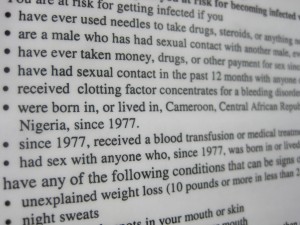
You are at risk for getting infected if you: … were born in, or lived in, Cameroon, Central African Republic, Chad, Congo, Equatorial Guinea,Gabon, Niger, or Nigeria, since 1977… had sex with anyone who, since 1977, was born in or lived in any of these countries… (http://www.redcrossblood.org/donating-blood/eligibility-requirements/eligibility-criteria-alphabetical-listing).

Could someone please inform the Red Cross that you are at risk of getting HIV if you live anywhere on the surface of the earth today and you do things that put you at risk?


The Blood Bank

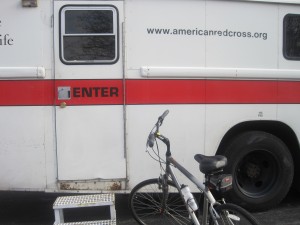
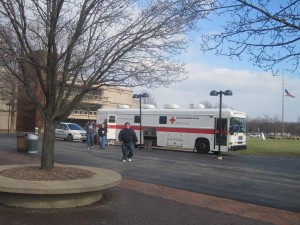
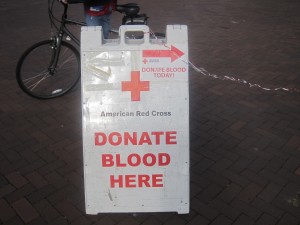
IMG_3127As soon as we passed by the Red Cross blood donation point at the SIUe quadrangle today, Chris and I, and managed to steer our conversation to donation of blood, I knew that I had come to another ktravula moment in the life of this journey. You see, I am conscious of all the dimensions of my Nigerianness, and about a year ago, just after I published my short story Behind the Door, I had had a conversation with an American friend who told me that she had been denied the chance to donate blood in America – for life – just because she ticked “yes” on a pre-donation questionaire that asked whether she has had “sexual contact” with anyone who was from or who had lived in Nigeria and some other sub-saharan African countries between 1977 to date. I didn’t believe it even after she sent me the online questionnaire, so I googled it up myself, and the result was indeed stunning. Nigerians, and everyone who has had sex with them were excluded from donating blood in America. (I don’t know yet if this is the same all over the world). The obvious question then is “Why?”, and it had circled my head for a while now, until that time this afternoon when I came within sight of the Red Cross truck on campus, asking students to donate blood. This website mentions requirements to donating blood in America but does not say why Nigeria is mentioned. So, you guessed it, I went right into the truck, leaving Chris outside to gape at what he said was an obvious time-wasting effort.
IMG_3124There was a sign-in sheet on the table. It had the name of those who are on the waiting list. On the examination table is a young woman whose blood was being taken. She had a pump in her right hand.
“Hi. Can I help you?” A young lady approached me. She wore a white lab coat.

“Yes,” I replied. “I’d like to donate blood.”

“Alright. You will have to write your name in here. The next slot opens at 1.45pm, and there are about three people before you already. Is that fine?”

“Yes, of course it is. I can always come back. But I’d like to know if there’s anything I need to read before you take my blood. Maybe instructions or anything like that.”

“Sure. Here, on the wall, is the first instruction. It’s important to read and understand it. And here is the comprehensive manual that every donor must read and comply with.”

“Can I sit and read it in lieu of going and coming back?”

“Yes, why not. Please sit over there.”

“Thank you.”

IMG_3137And read I did, carefully, until I got to where I am mentioned. Indeed, it’s written there in clear black ink of the excluded list. If you’re from Nigeria, If you have been to Nigeria, or had “sexual contact” with a Nigerian. Or if you have had malaria in the last three years, you CANNOT donate blood. I called her back and asked her why.
“HIV and AIDS, you know.”

“What?”

“HIV/AIDS”

“But you do know that not all Nigerians have HIV and AIDS, right?”

“I guess, but, erm, it’s what the FDA says. We just follow the law.”

“Oh my! So what you’re saying is that you have no way to know which blood is infected and which is not?”

“Like I said, it’s just the law, and we just follow it.”‘

By this time, a more mature looking woman also in a lab coat had shown interest in the conversation but maintained an aloofness that told me that she would allow the younger lady handle the situation rather than get involved. Whenever I looked in her direction expecting her to say something, she just smiled.

“I can’t believe this.” I said, as I gave back the booklet to her. “I guess I have to go now since you don’t want my blood.”

IMG_3125

They didn’t say anything so I left, back to listen to Chris say “I told you so.” If she had said they do this because of malaria, I could have been a little more understandable. But AIDS? By population figures, there are probably more HIV infections in North America right now than in West Africa, but it is not so pandemic here because of adequate healthcare and healthy living. With the right technological advancement in medicine in the United States, this definitely did not have to be a factor for denying opportunity to a certain demographic to contribute to efforts to save lives worldwide. If I sound a little upset, it could be because I am at the incredulity of the whole matter. Maybe there are some things that people like me are not meant to understand.