Boiling over Healthcare

Yesterday, the signature legislative achievement of the Obama Administration – the Healthcare Reform (also called Obamacare) was upheld by the Supreme Court in a 5-4 vote. Among other things, it prevents insurance companies from dropping people from insurance who have a pre-existing condition. It keeps children on their parents’ healthcare plan until they are twenty-six. It basically fundamentally changes the way healthcare has been provided in the United States – a success that has eluded many presidents for many years.

I spied a few newspaper headlines today to see how the people on the ground relate to the ruling. I was only in Iowa, so my perspective is limited to a swing midwestern state. The USA today as well as an Iowa newspaper were basically optimistic, cautiously celebratory while advising that rather than repeal it as Republicans and other conservative groups have sworn, they should work to improve on the parts of the law that they find objectionable. Returning to the chatter on cable news tonight, what I find is that this is going to be an uphill task.

I’m only a foreigner anyway, with just a little knowledge of the country’s history spanning a few generations. I know however that the divisiveness and polarization of the nation’s politics is as old as Lincoln and as young as Monica Lewinsky. What is most stunning however is that this much of a fight is going to be waged over the right of people to have access to affordable and patient-oriented healthcare like the rest of other developed countries. In a hundred years from now, no matter who wins the final battle to be waged on election day in November, those alive in the world would be able to look back and see how – like the time of slavery – a group of privileged people were willing to stake the future of the country for a chance to get their way and keep the status quo.

On the one hand, I’m now confident of the historical place for the president for his fortitude and perseverance, on the other hand, I fear for a country in which this kind of fight becomes elevated to national attention. America, you fascinate me.
The Lost Country

This post, originally intended to be titled “Mitt Romney Hates Me” in response to the decision of whoever manages his Youtube channel to ban me from leaving any further comments after I spent last week debating with some of the commenters on one of his videos. There’s something else in the news however that is a little more disconcerting than being banned from further debate by someone who wants to be the president of the country that champions free speech and democracy. It is about the so-called investigation in the corridors of power about someone in the Obama administration leaking “sensitive” foreign policy information.

It began about a week or more ago when two consecutive New York Times articles came out one of them boasting that President Obama has a “Kill List” of wanted terrorists marked for death by the US drones that he personally supervises. The other talked about an extensive cyber war conducted by the administration and Israel in which computer systems in Iran were targeted with debilitating viruses. Responses to the two articles were mixed. The response to the Kill List article was definitely very mixed, and very weird. Republicans and other right-wing conservatives who had tried to paint the president as otherwise soft on terror suddenly found themselves faced with a well-done reportage that showed that the commander-in-chief had actually been personally conducting a strong, brutal, foreign policy. The  Left however, the otherwise human-right touting base of the president who beat up on George Bush for being such a hawkish man who misled the country into war in which innocent lives (and of some bad people too, no less), kept curiously quiet. They found no contradiction whatsoever in the image of a president who won the Nobel Prize for Peace in 2009 personally supervising the killing of suspected terrorists not yet convicted of any crimes.

Therefore, in a weird twist of fate, logic, and political identity, Democrats silently cheered that their president finally locked down the foreign policy cred (nevermind that his supervising of the killing of Osama Bin Laden already wrote him into the history of decisive leadership), while Republicans – otherwise usual supporters for whistleblowers who leak government information that show abuse/misuse of power – are now up in arms, jumping up and down, and making loud noises that the leaker of the said information should be found. Why? Because the leaked information made the president look good. Of course if the information “leaked” to the New York Times had included some embezzlement or some sort of information, these same Republicans would have been the first to find ways of protecting whoever the person is, touting him/her as a hero.

So, here’s where we are. The biggest developing news on TV today (bipartisan, nevertheless) is about the call for a private investigation, not – as you would imagine – to examine the rationale for the president himself personally supervising the life/death decision on who lives or who dies in Yemen, Afghanistan or Iraq tomorrow, but to punish whoever made that information public. The Republicans making the most noise about the call for this panel do not care much for those accused bad guys (and the innocent collateral deaths accompanying it), but they hope on some level that the investigation would lead to the president himself, and he would thus be embarrassed. Again, not so that the killings would stop or become more open, but so that he would be painted as a weak, narcissistic leader. The president himself, calling the insinuations that he purposefully leaked classified information “offensive” is investigating the leaks so as to plug it, and not really to stop or modify the draconian policy that made some mockery of his 2009 Nobel Prize and his earlier stance on the policies of the George Bush administration.

It all just seem weird to me. But what do I know. I’m just one naive observer. But all liberal observers now keeping quiet would do best to remember that Obama won’t be president forever. The spy and killer drones however, and the capability for government abuse, will.

GOP Foreign Policy Debate

The latest GOP debate has just ended, with its illuminating moments. It’s one of those times when I had much to do but preferred to spend the time unwinding in front of my computer and television, with another finger on twitter. The United States foreign policy matters to everyone in the world since whoever gets to become president has to sit behind a desk with access to codes that can send nuclear bombs halfway across the world.

In spite of the aggravation I found myself experiencing at different times in the debate when candidates spouted sound bites to rounds of applause, I realize now that it was an important debate. For one, it showed the marked differences between all the men that want to sit in the position of the current president. Governor Romney wants to have a trade war with China. Governor Perry wants to scale back all foreign donations to zero, and Mr. Cain doesn’t have an idea about whether Pakistan is a friend or a foe, and Rep Bachman thinks that everyone wants to blow Israel up with nuclear weapons. I also realize how easy it is from this removed position of mine to scoff their foibles many of which stem from their inability to recognize the complexity of world politics.

In any case, this other news caught my attention and should probably keep me interested in US foreign policy interest for the next couple of weeks.

A Changing Country

When, two to three decades from now, I am sitting in my office, study or at a family dinner table looking back to my days in the United States, one of the things I will cherish the most is the opportunity to have been here to witness pivotal moments of notable changes, when a new fresh nation was born out of a tired vestige of the old.

From what I read, the last time something as significant as a popular uprising by citizens to demand change came about was in the 60s during the civil rights movement. From what we see around every day these days, those days – or at least something close to it and equally significant – are back. It showed itself first through the Tea Party movements in 2009, and now through the message of the Occupy ____ protesters that have taken their message to major cities around America.

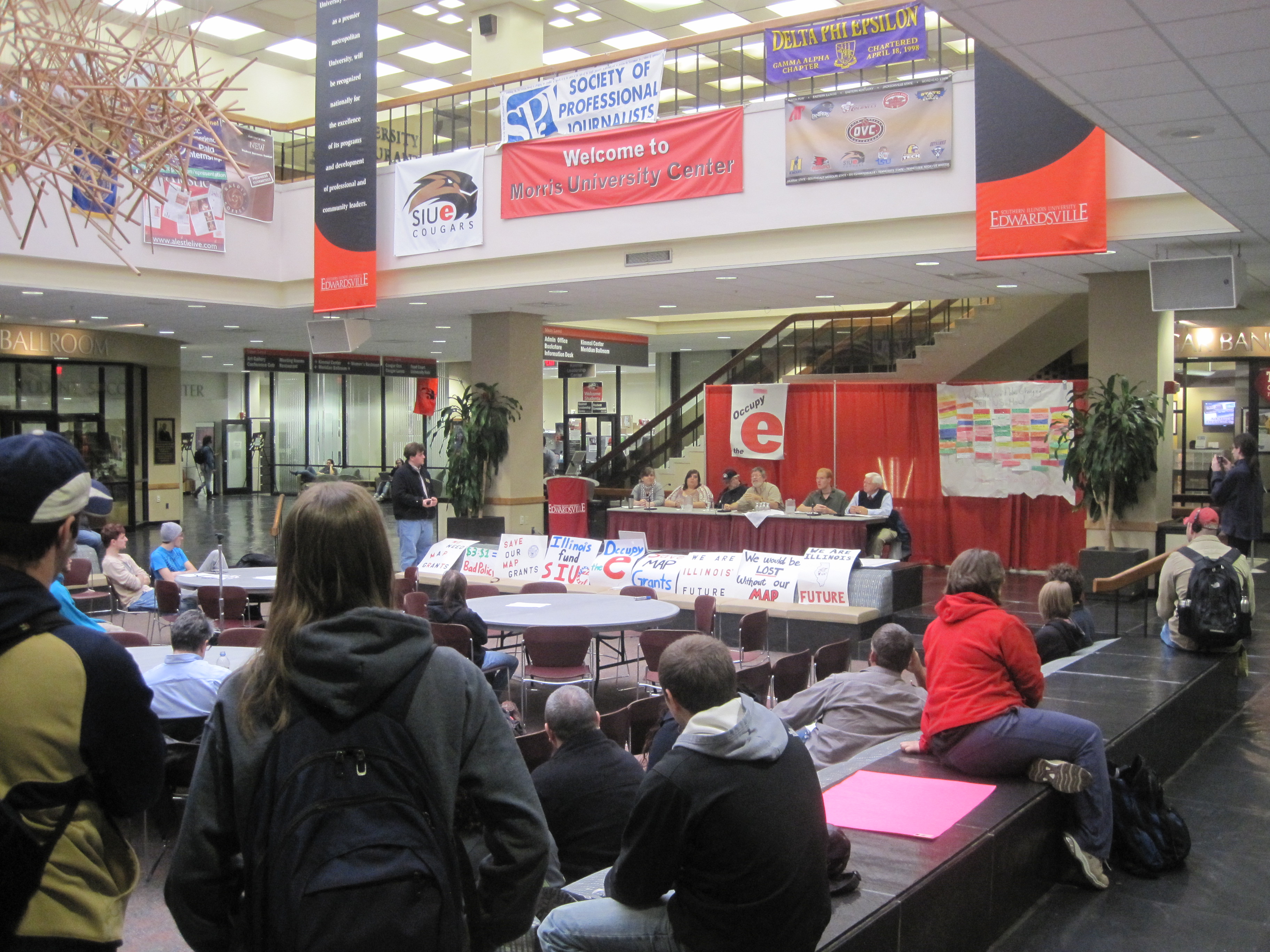
I was privileged to sit through one of the first sessions of the Occupy Edwardsville meetings today on campus. The movement which started as a reaction to the Oligarchy of Wall Street and unfair income disparity in the country has spread all around the country and is beginning to embody the disenchantment that most people feel about the direction of the country. Today’s event, being campus based, was more educational and brain-storming than anything else, but it was not any less significant.

I do not know a full list of their demands, but one of the major recent successes of the movement so far has been to force the Bank of America to reverse its decision to charge card users $5 monthly for debit card use. Another one is to change the national conversation from shrinking the government size to equitable living opportunities. Today’s meeting was open and democratic, allowing members and spectators ask questions and participate in brainstorming sessions to fashion reasonable and workable manifesto. I saw some professors in the crowd as well as students. At the back of the gathering were two cops standing and paying attention.

American politics, I have found, is one of the most fascinating in the world. This citizen opportunity for social and political change through a democratic means is not only stimulating, it is one of the country’s most admirable characteristics. All of this play out even in spite of obvious regrettable consequences of all mass action: infiltration by anarchists who want everything to fall apart as soon as possible, to no known end.

I see a new country emerging – as it always does season after season, and I again find myself tied to it. The news of my coming here got to me on the same day that the country elected its first black president. Being here at the crossroads of its changing environment provides for me a boon: a vantage point from which to contemplate the past and the present, while interacting with a new dynamic future of which I now find myself an integral part.

Defining Racism Wrong

I have come across this pernicious argument more than a few times now, and lately from Donald Trump and the “Hercules” actor Kevin Sorbo who appeared on Fox News yesterday to make the same point. The argument goes this way, that those who complain about Tea Party racism should direct their anger at what is the real racism: the fact that over 95% of black people voted for President Obama in 2008.

Sigh.

And there I was thinking that I live in a country that speaks English as its first language.

Sigh.

So here it goes, the real problem with that really pernicious argument: racism is defined as “the belief that inherent different traits in human racial groups justify discrimination.” I’ll break it down: racism is deciding that someone should NOT get something that everyone has access to, just because of the colour of their skin.

So, here again is a reason why it is less likely that it is racist that Obama was voted overwhelmingly into the White House by an overwhelming black vote: by the time he was voted as president, he was the first person of his race ever to get that close to a position that had been dominated for hundreds of years by people of a certain race.

I’ll make another analogy. Imagine these scenarios.

A: There is a school somewhere in the world which for four hundred years had admitted only people of a certain height/hair colour/dentition etc, and then one day, people who have for that period of time had been excluded from that process found a candidate that qualified as an outsider and was overwhelmingly supported – along with other support from the people who hitherto had that privilege. The student shorter than the average height requirement/hair colour/dentition is finally admitted, and everyone is happy.

B: There is a school somewhere in the world in which only one shorter/different-hair-coloured/wrongly-dentitioned student was recently admitted after about four hundred years. He is about to be removed by an overwhelming majority of the “establishment” regular people for no other reason that made sense, or had been applied for other “regular” people up until then.

Now, here is my conclusion. There is absolutely no evidence from the above to show that there is racism in any of the two scenarios A and B. Perhaps.

But…

It is MUCH LESS LIKELY racist that an underdog is collectively SUPPORTED to get equal opportunity, than that an underdog is collectively DENIED access to equal opportunity. And this is where Sean Hannity, Hercules, Donald Trump, and all the others got it wrong.

And here is one more thing. There is a clear difference between racial and racist politics. It is racial politics to vote for someone on the basis of their skin colour, but not necessarily racist. It is however clearly racist (as well as racial) to try to remove someone from a position because of their skin colour. The difference is the harm inherent in only one of them.

And here is one more thing I found on a Youtube comment: “black (and other minority) people, until 2008, have voted 100% for white candidates.” How racist is that?