Festivity & Fun Feedbacks

Chapter nine of Toyin Falola’s A Mouth Sweeter Than Salt was probably the most difficult for the students to handle. It started on a rather shocking note of the sex songs sung yearly at the Okebadan Celebration of his youth. The songs were supposed to induce fertility in nature, praying down the rain to come and fertilize the earth, yet their words were those of the human anatomy, and they were explicit. Very. And little children as well as adults sang along on the street as they go from house to house taunting each other in the most explicit way possible. According to Falola, the songs for which one would ordinarily be punished had they being sung on an ordinary day would be sung loudly in public throughout the celebration and everyone would be joyous.

I have just finished reading my student’s report on the chapter and many of their observations left me in stitches of laughter. Many claimed to have been confused. Some were shocked, and a few said they found it interesting. Those who were shocked claimed not to have been exposed to any occasion in America where sex is discussed in such an open manner. I’m guessing that they had never attended the Mardi Gras. 🙂 In all, I have always had a good time reading their feedback on the text portrayed by Falola. Interestingly I myself have never witnessed the Okebadan festival, but beyond the words of the songs by the little children singing them, I don’t believe that it ever got any “raunchier” – to use the word – than the Mardi Gras, which I still think is a wonderful celebration of life as well.

This was – verbatim – one of the reports from a student:

The most interesting part of the ninth chapter for me by far was the beginning. The groups of people were running around the city and going to different houses singing all kinds of crazy sexual songs. It was not just the fact that the songs were somewhat explicit that made them interesting. The logic of the songs was rather interesting as well. One song stated that “Penis times vagina equals penis. Vagina times penis equals vagina.” I am not sure about this. Still, I found the songs very comical. After all, I am not a mathematics major.

Reading it here in my room, especially the last sentence, I couldn’t stop laughing at his sense of humour. And somewhere in my mind, I believe that Toyin Falola must have taken great efforts to make this chapter controversial with a subtle confrontation of African sexuality and spirituality with accepted Western standards of morality and propriety, since it looks like the book was written with foreign audiences in mind. Or why else would he devote so many pages at the beginning of that chapter to the matter of sex and the Okebadan festival? I’m glad at least for the discussion it generates. How for instance there is so much sex portrayed in the American media, and how different and conservative the real life society seems when observed at a close range. It’s all an interesting paradox.

PS: Photo taken at the 2010 Mardi Gras in St. Louis of two guys simulating homosexuality with rubber penises.
What Else Is New?

Q: How do I prepare for teaching class, usually?

A: I don’t.

Well, that’s not true, technically. It’s just a short response. I spend all waking hours, especially at weekends usually mentally mapping the format of the next class that by the time it’s Saturday evening, I’m in an almost panic mode, worrying whether I’ve done enough even though I’ve been noting things down and recalling examples that could help pass the messages across better. But I don’t study much just for the class. I follow relevant links that I find online or offline, and I follow up on new and old leads. Yesterday I looked through the first chapters of Je Ká Ka Yoruba, the text for the language teaching again, and tried to see if there was something there that I hadn’t seen before or taught before. I needed to cover much of the weekly syllabus because of the Martin Luther King holiday that fell on Monday, effectively reducing my week by half.

Before I went to bed at 3am on Sunday night, I managed to read the first chapter of A Mouth Sweeter Than Salt for the very first time in one sitting. Last semester, I had only just glanced through that chapter because I had too much to read then. I got much of the ideas of it from the students’ summaries and what we discussed in class. Lazy, I know. But after reading it yesterday, I understood why anyone could be forgiven for trying to avoid reading it. For an avid reader, each sentence is a treasure of lore. It tells of some thing or the other that the author has either not talked about before earlier, or that he wants to say again in another way. I agree, the chapter could have been a little shorter, but you should read it. You should read it. It brings memories of things parents talk about. Reading it, I felt like I was listening to a seasoned elder speak of his childhood in a closely knit extended Yoruba family. If I could meet the writer, I would ask him too many questions. Or I would just sit at his feet, just listening to him talk. He is a good writer. He’s a good story teller too. Why is this book not read in Nigerian schools? Oh, I forgot, Wole Soyinka’s Ake has already taken control of that spot in autobiographical narratives in colonial and pre-colonial Nigeria. Their experiences are not the same, but they are similar, as I pointed out in class, lest they get the idea that everyone of us in Nigeria – just like this writer – do not know our exact date of birth. Alright, go and get the book, and read.

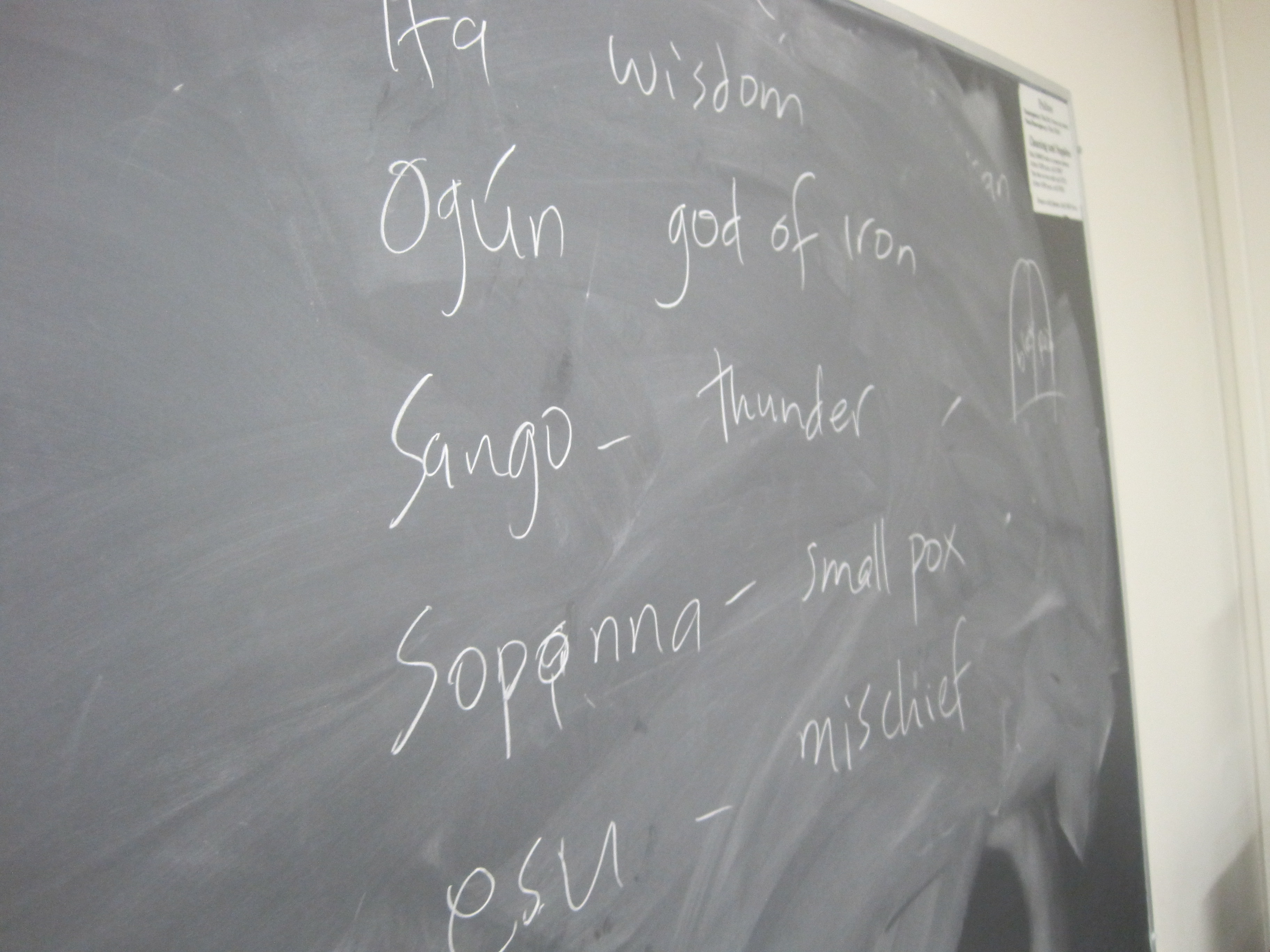
There is nothing new I want to tell you about today’s class. It stated on time and it ended on time. No other student has dropped off beside Gretchen who had dropped out after a first class. She left us for a class in Finance, so we’re nineteen now. Still, the textbooks are not sufficient. Many will have to share. We can’t complain. Now we can greet, introduce ourselves, respond in Yoruba and ask few introductory questions in Yoruba as well. It’s a start. These students are more agile, a little faster to learn than the last ones. I think. I could be wrong. They got the “kp” and “gb” far easily, for sure. Maybe it is because of the size of the class that gives this positive feeling and active participation. It is turning out to be a blessing after all. We may not be able to joke around as much as we did last semester, but we will try. I may find it harder to learn everyone’s names on time as I want to. It will take a while, but I’ll get there. Today we met esu, ifa, Obatala, and Sango. Next week, we’re meeting Wole Soyinka, and maybe later Suzanne Wenger. Maybe it’s not a bad idea to have such a large class. It feels warm enough. I love it.

I think that the most memorable thing I have found as a pattern is that I usually wake up early whenever I have to teach a class, notwithstanding when I go to bed. It’s a good thing. Maybe that’s why I’m tired on Thursdays…

A Review

I love this review of the book A Mouth Sweeter Than Salt by Toyin Falola. It was done by Nigerian writer Ikhide Ikheloa in 2008. By the the time I was writing my mini review of that book last year on this blog, I had no idea that some other person had written something longer, deeper, more expressive of my earlier perception of the work.

Like last semester, we shall be reading the book again this semester for the foreign language and culture class. It is a fascinating account of a man’s childhood in the Nigeria of the 50s, 60s and 70s. Get and read the book if you can, and take a very wild ride in the serene happy days of my country’s early nationhood.

At the end of last semester, I asked all my class students to write a two-paged review of their experience in my class. The following is an excerpt from the submission one of them.

“The one thing that I did not like about the class was the book, “A Mouth Sweeter Than Salt.”  I know you did not pick it out, but it was the worst book I have read in a very long time.  If you could, I would get a different novel for your class to read next semester because every chapter I read felt like pulling teeth.  Well it was not quite that bad, but it was not enjoyable.  Besides the book though everything else was very enjoyable.  I cannot remember a class more enjoyable than this one, or a class that I laughed so much in.

Overall I could not have been more satisfied with the class.  The material that I learned helped me grow as a person and made me see a part of the world how it should be looked at, and not just from a “single story.”  My perception of the Yoruba and Africans in general was corrected.  After going through the semester I could not have been happier in my choice to take this class.  It is a great feeling knowing that I can communicate in Yoruba, even if it is at a rudimentary level.  The class was more than fair in difficulty and work required.  When looking back at the first day of class I realize that I never had anything to worry about and the man who walked in with the traditional attire on was a lot like me.  Although I may have not changed the place where I sit in the class, almost all of my views of the African culture have been altered throughout the semester.  I am thankful that I chose to take this class because it has made me a better person as a whole and have come to greater appreciate people of different cultures.”

Needless to say, he was the only one of nine people who felt sufficiently annoyed by the book to write about it in a final essay. Others passed their displeasure to me outside the class about the often winding and distracted writing style of the author. Nevertheless, it’s a great book. I recommend it.

A Mouth Sweeter Than Salt

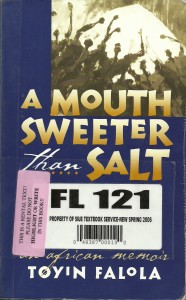
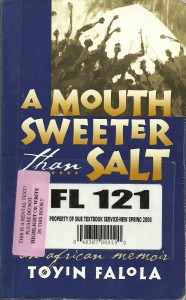
On Wednesday, we spent much of the hour discussing the third chapter of a book of fiction titled “A Mouth Sweeter Than Salt” by scan0017Toyin Falola which is our second class text. In many ways, the book is much like Wole Soyinka’s “Ake”, in style, content, and value, especially in the clever turns of phrase, eloquence, and reference to recognizable landmarks in the history of South-Western Nigeria before independence. The chapter is set when the author was nine years old, and the whole work is written in a way that makes it seem that we are listening to a child talk, even though we know that it is an adult relaying his many interesting experiences from childhood.

The third chapter dealt with the author’s first train trip in the 1950s from Ibadan to Ilorin, and his adventures on the streets as a beggar’s boy. He had started school, yet he could not resist a chance to ride on a train which was then a novelty in town. In the end, even though he didn’t have the train fare, he found himself in the belly of the electric “snake”, as he called it, delighting at the wonder of the European invention. As soon as he was discovered to have been riding without a ticket, he was dropped off somewhere along the way, and he found that he was in Ilorin, all the way from Ibadan, and he was loving it. Soon he became a “beggar’s stick boy”, holding the stick for one of the many fake blind men on the streets of the town who begged for alms in lieu of decent work. That job, which provided him with stipends on which to survive, and plenty adventures on the street, ended on the day he mistakenly spoke in English to a postman, wondering if he could send a letter home. Even though he was dirty and looked totally ragged, his grasp of the language shocked both his fake “blind” boss who immediately dropped his end of the stick, and fled as far as he could so as not to be arrested, and the postman who immediately grabbed the boy, and promptly drove him back home to Ibadan to the arms of his bewildered parents and neighbours. It surely reminds of some parts of Soyinka’s “Ake.”

I am convinced that the reason why this book is a recommended text is because of its many descriptions of Nigerian, nay Yoruba cultural life, especially before and during colonial times. The author was born in the 50s, and he grew up in a less educated environment than, say, Wole Soyinka(who was born in the 30s, yet had a whole library of books to read before he even went into school for the first time.) But in the end, there were so many questions raised than could be answered in that one class even though we tried very hard: Why did the boy find the train strange? Why did the postman take him home instead of to the police? Why was a boy not immediately embraced when he got home, instead of being suspiciously viewed by family and neighbours as some form of emere who was born only to torment his folks? Did children beg for alms a lot on the streets of Nigeria? How much of human sacrifice did the Yoruba believe in? Do they still sacrifice people to make money? What is the punishment for such a crime? What is the Justice system like? Do they hang condemned criminals in public or not? Do children have toys to play with? Do you have Amusement Parks in Nigeria? Do you have Six Flags in Nigeria? How come some people do not know/remember their dates of birth? Do you know yours, Traveller? etc.

Every day, I discover new reasons for the perceptions and misconceptions (many of which are justified) about Africa and it cultural practices. Every day, I learn new things about the influence of literature, and the power of words. And every day, I find new reasons why this programme is one of the best, and most useful projects of the American government, in helping us to understand better the world in which we live.