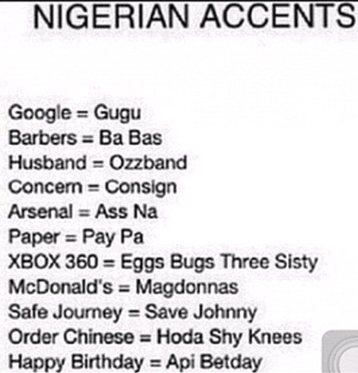
I had this discussion a few days ago about the inevitability of accent change, which had given me pause about what I had hitherto dismissed as something inconsequential. My wife, an American from the Midwest, wonders at times why some Nigerians in big cities – particularly those that have never travelled out of the country – always put on an affective foreign accent while in public. She is not alone, there have been countless discussions online and in the media about the importation of American accents into Nigerian spoken English. What irked her the most however, was the change in my accent from one originally Nigerian to one that now a cross between Nigerian and Midwestern American.
 As I explained to her from the more pragmatic (rather than the linguist) side of me, this is how it always goes: an educated someone from Africa or anywhere else with a distinctly local English accent arrives in America and is suddenly surprised at the inability of his/her American hosts to understand a single sentence he/she speaks. “Pardon?” “Come again!” “What?” “What did you say?” Even for me who could boast of a fairly regular intelligible diction long before arriving on the shores of the United States, there was a sudden loss as to why it seemed that I had to repeat myself before I was properly understood.
Mind you, this goes beyond localized peculiarities of dialects that makes one call elevators “lifts” or movies “cinemas” or soccer “football”. No. As peculiar as those are, with the right context and intelligible speech, the listener might smile at the quirkiness, but would immediately understand the meaning and intentions. But not when pronunciations are involved. I called “route” as “root” (as any Nigerian, or British, would), pronounced “anti” as “anti” and not “antai”, and “semi” as “semi”. There were a few more, and if I didn’t know better, I would also have called “model” just as spelt, rather than as “mawdl” as most Americans no doubt would.
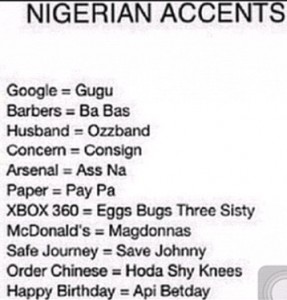 In other words, my accent was pretty Nigerian/British, or what I called the Lagos/Middle Class Accent (aka the 5th Sexiest Accent in the World), with many other peculiarities I didn’t notice until my students and friends started pointing them out. And then I became conscious. My route gradually became “raut”, my door (which had hitherto sounded as “daw”) started sounding with the “r” conspicuously pronounced. It took three years of socialization which began with my very good friend and classmate asking “You come from Nigeria. How did you learn to speak English this well?”, and ended in my final class presentation where another colleague, this time a female, asked why I speak an English comprehensible to Americans since many of the Nigerians/Africans she had previously interacted with had such a heavy accent. (My response to her, in any case, was that she needed to see how I speak when conversing with other said Africans. I switch again).
It is what it is, where accents are concerned. We tend speak in the fashion most comfortable to us, but most importantly, in a way most relevant to present company and environment. Teaching now in a school in Lagos, I have had to contend with instances where my students found my usage laughable and sometimes worthy of a debate. Until a dictionary surfaced to settle the matter, a smart ass sixteen year old in one of my English classes argued on end that the word “prevalent” should be pronounced with the stress on the second syllable, hence [priVAlent] (as a Nigerian would usually call it) rather than the correct [PREvalent]. I also once spelt pyjamas as “pajamas”, to really disruptive consequences. So when my wife wonders at the now present “r” in my words, she is in tune with current arguments, except to the real-life reasons of the inevitability: habit, social conditioning, and personal preferences/idiosyncracies.
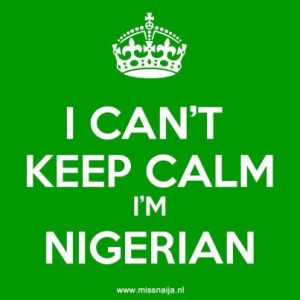 New York (dialect of American) English developed because of the influx and strong influence of Italian culture on the city, while the New England dialect came from the settlement of Protestants from England. Over time, notwithstanding where future immigrants into the city come from, the strong influence of the prevalent, dominating, culture will always keep the dialect around certain recognizable forms. In Lagos today, the accent you hear is – as it should be – a cross between the British-influenced Nigerian accent of English with urban modifications and modern American mannerisms. For denizens who have had the opportunity to travel to either Britain or the US, the influences would be obvious, as it also should be. And for the rest, the influence would rub off to whatever extent permissible.
As I also pointed out to her, while on the phone or when speaking with people she has never met before, the Americanness of her accent is more pronounced than when she’s speaking with me in a more relaxed family environment, where the Nigerianness in both of us is allowed to flourish whenever they can. I am back to “lifts” instead of elevators, “bonnet” rather than hood, “trolley” instead of “cart”, and “waste basket” rather than the American “trash can”, but for now, my door, course, more, tour, and shore have all retained the American “r” which I am reluctant now to relinquish, even at the risk of having to stare at the snobbishly rolling eyes of my darling wife.
______
Photos culled from the internet.
 …on President Obama’s historic visit to Israel for the first time in his presidency was going to focus on his peculiar preference on young people as his primary audience and thus a vessel for his message to the rest of the country and the world. It was going to highlight the ingenious characteristic of such address that shuns the insular confines of the Knesset (and old politicians with calcified opinions, ideologies, and voting patterns) and takes the message directly to the young citizens of the country on whom real change truly rests, and for whom a secure future is something of much significant value than perhaps to those who may not live long enough to see it. (I’m being slightly hyperbolic here, of course, but I hope you get the point.)