On Written English

Prompted by my sister’s observation on reading Larry King’s My Remarkable Journey. “The language is remarkably simple,” she said. The fact is that we have been so used to the literary culture that passes off grandiose English as the only true means of good literary communication that when we see one that pulls off a feat of enchanting us without pretending to be grand, we are pleasantly surprised and are forced to look at ourselves again.

How the literary culture in Nigeria (as borrowed from Britain) successfully evolved into the idea that it is better and more acceptable to write (and speak) as difficult possible when given the opportunity is really beyond me. And for all who bother about it, this is the singular most (de)pressing issue in Nigerian literature today. Not just the language of our writing – which will remain English for a long while – but the way we use it. The argument is long and tedious, and will – if not properly articulated – spill over into very many distracting directions, but what is clear is that we still haven’t mastered the ability to simply write, simply.

My favourite essay of all time is by George Orwell, titled Politics and the English Language(1946), and I’ve always recommended it for anyone wishing to be called a writer. In it, he highlights the very many wrong ways in which we use the English language a famous one being the rendering of a verse in Ecclesiastes in “modern” English. According to him, and I agree, this verse…

I returned and saw under the sun, that the race is not to the swift, nor the battle to the strong, neither yet bread to the wise, nor yet riches to men of understanding, nor yet favour to men of skill; but time and chance happeneth to them all.

would most likely be written by today’s writers as follows:

Objective considerations of contemporary phenomena compel the conclusion that success or failure in competitive activities exhibits no tendency to be commensurate with innate capacity, but that a considerable element of the unpredictable must invariably be taken into account.

He admits in the end, as I do now, that he too may have occasionally fallen into the temptation to use more words than necessary in order to sound grand, or just for the drought of ideas. Yet, it is inexcusable. There is a reason why I was able to complete Larry King’s book in two days and I’m yet to complete one by a Nigerian writer since more than a year ago, and it doesn’t have to do with their personalties, a glossy cover or their countries of origin. And it is the same reason why V.S. Naipaul is now one of my favourite Nobel Prize winners. There is just something enchanting about a simply but brilliantly-written work.
Q & A

Q: What really have you been up to?

A: Many of them are really personal, family stuff. I have also taken steps to properly “graduate” from the University. This includes a very long and tedious process of undergoing “clearance” from almost every section of the University – Sports, Alumni etc. Yesterday, I got my certificate, but discovered that my name was written with an extra “N” in a wrong place, again. Sigh.

I’ve also been watching Michael Moore. Two days ago, it was Capitalism, a Love Story, a really enlightening documentary. Yesterday, it was “Bowling for Columbine.” I’m not done with that yet. When I am, I’ll be onto “Sicko”. Michael Moore is one of my favourite film makers. He is an inspiration, and I like the way he takes on issues. If I ever make movies someday, I’ll be borrowing so much of his ideas. The very moving last scene of Capitalism, a Love Story has him drawing a “Crime Scene – Do not Cross” tape around Wall Street. Then he made a bullhorn announcement for all the CEOs to come down and voluntarily arrested for defrauding the nation. I recommend the movie to everyone.

Q: Who is your next favourite team in the World Cup since the exit of the Nigerian Super Eagles?

A: I support the USA (of course) and Ghana. The US because they have not been known as a football-playing nation (I know they call it “soccer”), yet they have been spectacular in the tournament. I hope they go far. Maybe it will reduce some of the craze for American Football :). I support Ghana because they have also been quite spectacular, and of course since they’re the only African team left in the competition. But here is my dilemma: Ghana will be playing with the United States in their next match, and one of them must be knocked out. I will have my fingers crossed for that one.

Q: So when are you coming to a city near me, as you promised?

A: Soon. One other new discovery I’ve made is that it is more costly, and tedious to move around the country without a private helicopter or a travel grant. Still, the plan is on course, very much. Are there particular places in Nigeria that you’d like me to visit? And why?

Q: Where will you be this weekend?

A: Maybe at the Bookjam event in Lagos. Will you be there?

See you guys around.

Oh Shoes!

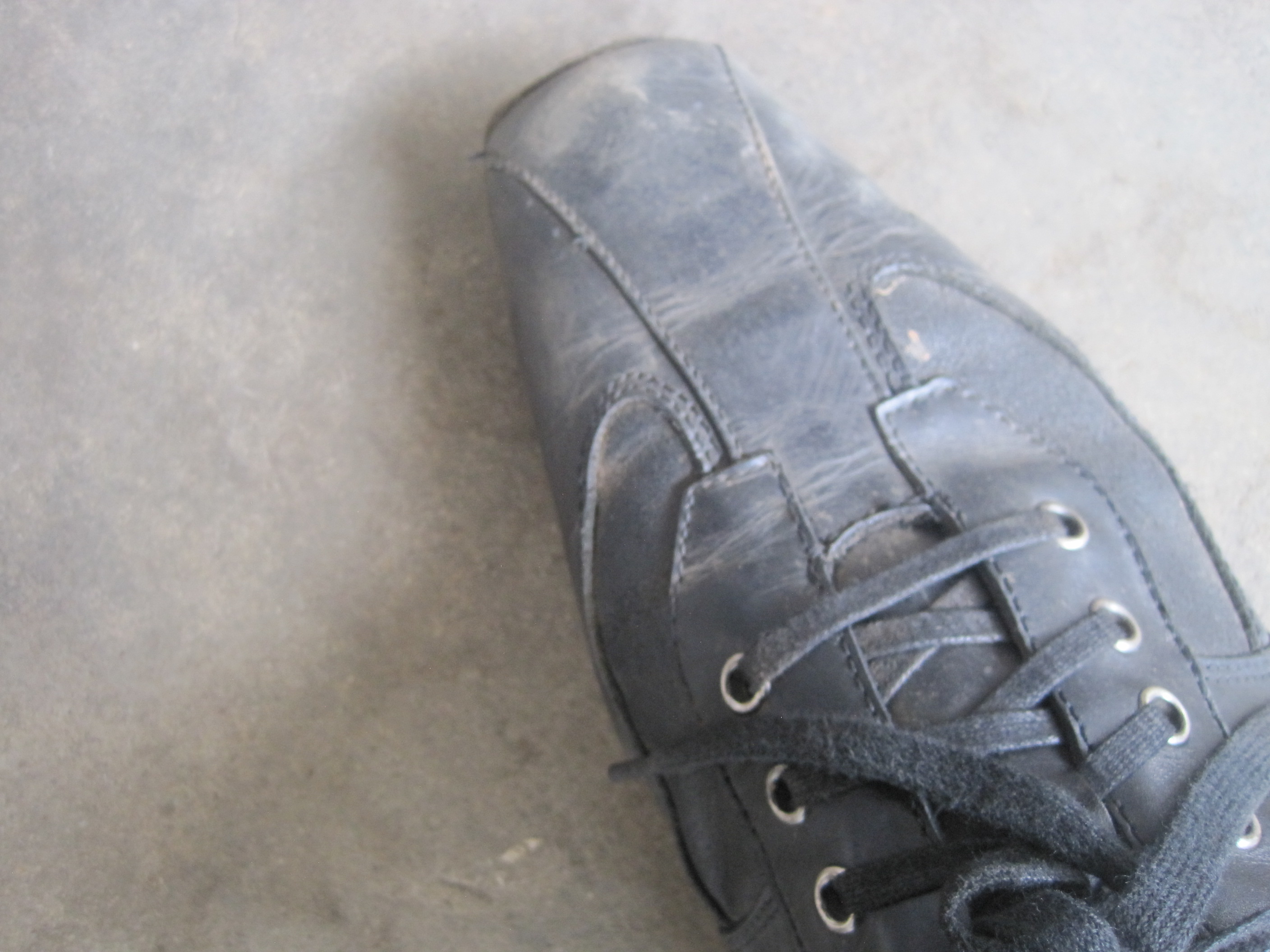
I do love my shoes. I wish I could simply say “I love shoes”, but that would mean competing with at least  two people in my life that I know too well. (Stop looking around Yemi). I don’t love shoes that much, but the few ones I have, I love them very much, and would do anything to keep them looking good. Well, not everything really, but if they get good polishing and get prevented from submerging in mud, I would be grateful indeed. And there lies the problem. It is raining season here in much of Nigeria and the consequence of that is plenty street puddles after every rain. It doesn’t help having to ride on bikes around town. No matter how shiny the shoe is in the morning, by evening, it is dusty when there is no rain and muddy when there is.

There was this joke about a guy who met someone who wouldn’t stop showing off his new wristwatch. The wristwatch guy comes in with all confidence looking at his watch once every two seconds, pretending to be pressed for time. “I’m in a hurry,” he said, “Do you know the way to…” let’s call it… “Miguel Street? I have to be there in less than ten minutes.” The other guy who had also just got a new shoe stretched forth his leg and tried to describe the way to the former’s destination. “You want to go to Miguel Street? Just go forward like this,” he said, pointing with his feet, “and then turn right, and left, and right again…” I have sometimes felt like the other guy. “Oh Kola, you look so tall,” people would say, and I’d respond in the now typical way, “Oh no, it’s the shoes I’m wearing.” They would look down at them, then at me, shake their heads, “No way man”, smile and go their way. It works only when my shoes are shiny and well polished. Otherwise, I am the one who is left feeling silly.

There is another joke I always remembered. It goes like this, that women remember the shape, colour, and size of a man’s shoes on a first date than anything else. Why? Because whenever they avoid eye contact, their eyes would inevitably rest on the man’s foot. I have never dared to keep my shoes unpolished since I first heard the quasi-sexist joke. I may wear a shirt not well ironed, or a pair of jeans that I’ve worn for a few days already, but my shoes will always be polished. Yesterday, things changed. Badly.

My polish can was nowhere to be found and I had to get out of the house on time, so I planned to meet with my reliable cobbler right in front of the University gate to do what he always did. But by the time I got there and he wasn’t there. In his place were a dozen law enforcement agencies clearing his and other shops illegally erected along the fence of the shopping complex opposite the University. Whether they had given advance warning of the raid to those shop owners or not is not the question here, but that my favourite cobbler was nowhere to be found, and his stall had been levelled and removed. And my shoe has remain muddied, or at best ugly ever since. I’ve not been able to retort to the now many people asking “Oh Kola, you have grown taller since I last saw you.”  Yeah right. It must be all the pizza I’ve been eating. It’s two days now without a shoe polish, and I’m about to lose it.

Okay, I’ll buy a new Kiwi polish tonight, but why should I take the fall for the state government’s late discovery of how best to make the city beautiful? No, they don’t get my sympathy now for finally waking up to their duties to clear the fence of the shopping complex of its many illegal squatters after all this years. I’m not asking for much. All I want is my cobbler back in his famous spot. Yes, the government’s action might be in the public service, I know. I would just love to say, “public service my foot!” if only for once, although I know that that the pun might get lost in the translation. 🙂

Caveat: This post should not be taken too seriously. The government policy to clean up the Shopping Complex at Agbowo is a very laudable project. You need to see how nice the place looks now.

Conversations

Ivor: Do you feel that current Nigerian politics has influenced your writing? And if so to what extent?

KT: No, but that is as far as my deliberate rebellion will allow, and I have tried as much as possible to fuse much of my own outlook in the speech of the characters I create. I cannot control the unconscious however. If I’m a writer at all, I’m one because of my upbringing and influences all tainted with patches of Nigerian history and my own upbringing in the many cultures that I’ve interacted with. The rest are my own questing polemics. In essence, I don’t write so as to be patriotic except to defy and to question, but mostly to locate the common humanity in my characters as well as in those who read and connect with them. I like the simple, small, family things, not the grand “national” political ones, and I’ve dedicated myself to exploring the small ones. I’ve discovered that they’re often even more fun than big politics. And as a writer, you get the liberty of imagination. Politics is more restricting. In that, Marachera was right. But overall, we are still a sum of our individual experiences, and are conditioned by our environments whether we like it or not.

Read my full conversation with Ivor Hartmann on new writing in Africa on the Sentinel Blog. Ivor is the writer and publisher from Zimbabwe, now living in “economic exile” in South Africa.

BookJam At Silverbird

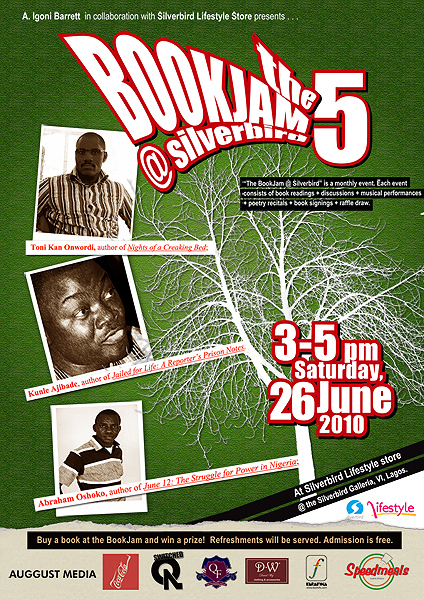
“The BookJam @ Silverbird” is a monthly event that consists of book readings, discussions, musical performances, poetry recitals, book signings and a raffle draw.

The BookJam is hosted by A. Igoni Barrett and the Silverbird Lifestyle store.

The 5th edition of “The BookJam @ Silverbird” will hold between 3 to 5 pm on Saturday 26 June, 2010 at the Silverbird Lifestyle store, Silverbird Galleria, Victoria Island, Lagos.

The guest writers are:

  • Toni Kan Onwordi, author of Nights of the Creaking Bed;
  • Abraham Oshoko, author of June 12: The Struggle for Power in Nigeria;
  • Kunle Ajibade, author of Jailed for Life: A Reporter’s Prison Notes.

Admission to the BookJam is free. Members of the audience who purchase books during the event stand a chance to win a special prize in a raffle draw.

For more information send an email to auggustmedia@gmail.com.