Browsing the archives for the Uncategorized category.

Giving Descriptions

Sometimes yesterday across the dining table at a colleague’s house, this conversation took place among seven people of different nationalities. It is a discussion of how to ask for directions, and what the result usually is, in different countries.

You approach someone to ask for directions…

Rabat, Morocco: In order not to seem rude, the person you have asked would give you an elaborate description of the place you are supposed to be going. When you finally get there, you will find out that it had been a wrong description and your guide had given you that description in order to save face.

Lagos, Nigeria: Your guide ignores you, thinking that you’re a criminal with a malicious intent. Or, waits for you, then defrauds you in some way. Or sends you on your way with a wrong description. Or sends you on your way with a right description. Depends.

Cairo, Egypt: Same as in Rabat, or Lagos, depending on where, and whom.

Honduras: Your guide doesn’t know the way to where you are going. S/he doesn’t say so. Both of you then go to a third person to ask. The third person doesn’t know either, so the four of you look around for another person to ask. Depending on how long it takes you to find who knows the way, you may have a dozen people walking down the street looking for directions to the place where only one person is going.


“Waka!”

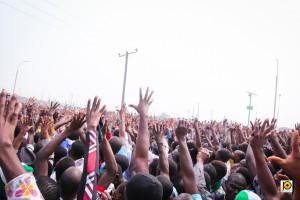
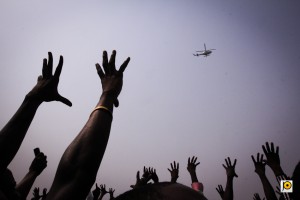
Image of the day: Protesters in Lagos, Nigeria, gesturing their displeasure at patrolling police helicopter.


Source.

The Light in Double Equivalents

The outrage that greeted Republican front-runner Newt Gingrich’s recent comment about poor people stemmed mostly from his condescension, and not from the fact of his assertion. Speaking at a campaign in Iowa last week, two weeks after he had called the labour laws in America “truly stupid”, Mr. Gingrich said:

Really poor children in really poor neighborhoods have no habits of working and have nobody around them who works. So, they literally have no habit of showing up on Monday. They have no habit of staying all day. They have no habit of ‘I do this and you give me cash’ unless it’s illegal.

Coming from a middle-class background and growing up in Nigeria’s lousy economy of the 90s, I relate with much of what he said with regards to the habit of working. The disingenuity of the argument he makes, however, is in the way it casually omits the truth in a similar argument for the other side. Read below:

“Really rich children in really affluent neighborhoods have no habits of working and have nobody around them who works. So, they literally have no habit of showing up on Monday. They have no habit of staying all day. They have no habit of ‘I do this and you give me cash’ unless it’s for partying.”

Did you see what I did there? I substituted the words “poor” for “rich” and other “negative” equivalents for “positive” ones. Does that little trick change the truth in the assertion of Mr. Gingrich? No. The problem however is that he did not make this balanced claim. By focusing only one side and demonizing poor children, he pits himself on one side of the argument, and thus muddles the issue he was supposed to be solving. If the focus of his comment was to breed a culture of working, is there a particular reason why it should focus only on poor children?

Let me make a second example, also from Mr. Gingrich’s attempt at political commentary. While speaking with a Jewish television last week, Mr. Gingrich said that Palestinians are, after all, “an invented people” who didn’t exist as a nation until after the exit of the Ottoman empire. Of course, he was right. The people now referred to as the Palestinian people, now craving for a state of their own, are just Arab people living in the middle east. However, so are the Jewish people as well! The Jewish State of Israel (at least as we know it today) was just as well “invented” in self-determination after the Second World War. So why did Newt Gingrich not state the second equivalent truth of his assertion? Because it is not politically expedient, and – like other Republican candidates – all he wanted to do was to sound Pro-Israel than the incumbent president whose job he seeks.

Now, to my final two examples on this matter, this time on race. I found out to my chagrin that the most popular post on my earlier wordpress blog (before moving to this domain) has remained this one where I wondered if oyinbo – a Yoruba word for “white person” was a racist word. I knew it wasn’t, but I was interested in reader perspectives on the way a word conditions the way we look at the world and other people. I got feisty, energetic responses. But what struck me earlier this morning however is a fact that I had overlooked for too long: that more than half of what is considered racist – even here in the United States – were anything but. Here are two quotes, the first by Donald Trump: “I have a great relationship with the blacks,” said a few months ago to public outrage, and Ann Coulter’s “Our blacks are so much better than their blacks” – a reference to African-Americans in the Republican party as opposed to those in the Democratic party.

It is easy for me as an African to take umbrage at each of these statements (as I undoubtedly did for a few days without being able to lay my hands on why the statements seemed so jarring). A few months removed from the uttering of those words however, I finally got it. It took a short memory trip back to the sociopolitical environment of my home country. “I have a great relationship with the whites” would not have elicited such a public umbrage in Nigeria but it would have raised eyebrows of social awkwardness. There is a consensus that there is something awkward with a citizen who felt the need to associate himself with a particular race for political advantage. “Our whites are so much better than their whites” would have elicited a similar response of awkwardness, albeit with a heavy dose of scorn and derision. It definitely would take some self-loathing and inferiority complex to make such a public proclamation. Implicit in these statements however is the acceptance of the “otherness”, and thus the problem. In Nigeria, this “otherness” is accepted, considering our colonial history The “whites” are not one of us. In America, it is not, because of the country’s history of slavery and civil rights. The “blacks” are also Americans, and undeserving of such “otherization,” thus the outrage. If Mr. Trump had said “I have a great relationship with the Nigerians”, or Ann Coulter, “our Nigerians are better than their Nigerians,” no one would have taken notice.

There is something to be said for double equivalents. Some things don’t make much sense until we put them in front of a mirror of polar equivalents. Some don’t make sense at all, eventually, of course, but it sometimes helps to pare them off all their political overtones. Mister Trump and Miss Coulter get a pass from racism but not from bigotry, and Speaker Gingrich gets all the blame he very well deserves.
Occupy!

Every time I have to think about the “Occupy” protests which, although initially aimed at Wall Street, has now spread to many cities in the world, I inevitably think of the streets of Nigeria and wonder how this kind of protest would play out were it to be tried. And I have no doubt that it would eventually be tried. Having witnessed a number of public insurrections while growing up, I know the tendency of such protests to turn violent before anyone pays any major attention to it. We were socialized under a very repressive, military government, and it has become an unwritten rule of public protests that for it to have any impact – if only to capture public attention and sympathy – it must have an element of tension.

Here is a guide however, culled from one of my favourite texts of all time: Martin Luther King Jnr’s Letter from Birmingham Jail. For everyone considering a public reaction to systematic oppression:

I had hoped that the white moderate would understand that law and order exist for the purpose of establishing justice and that when they fail in this purpose they become the dangerously structured dams that block the flow of social progress. I had hoped that the white moderate would understand that the present tension in the South is a necessary phase of the transition from an obnoxious negative peace, in which the Negro passively accepted his unjust plight, to a substantive and positive peace, in which all men will respect the dignity and worth of human personality. Actually, we who engage in nonviolent direct action are not the creators of tension. We merely bring to the surface the hidden tension that is already alive. We bring it out in the open, where it can be seen and dealt with. Like a boil that can never be cured so long as it is covered up but must be opened with all its ugliness to the natural medicines of air and light, injustice must be exposed, with all the tension its exposure creates, to the light of human conscience and the air of national opinion before it can be cured.

I’d recommend replacing the racial references in the text to economic/social or whatever the situation is wherever oppressed people live, and the message works just as perfectly. The full text of the letter is here. Protests like the present Occupy are usually a watershed/crossroads of a new era. I can not imagine a better place to stand than on the right side of history.

I write this in response to the high-handedness of NYPD cops arresting peaceful demonstrators who had occupied Citibank premises to close their bank accounts in protest. It would seem that the agents of state have learnt nothing at all from the lessons of history.

The American Spring?

The Occupy Wall Street protests began like a joke. I remember the folks at The Five on Fox News deriding them for seeking just an avenue to party (since the first day of their protest happened to be a weekend when there wasn’t going to be plenty activity). A few days later, it has become a movement now too large to ignore. A version of the protests is now taking place in almost every major city. The nearest one to me is called “Occupy St. Louis”.

Louder now than the lack of cohesion in the list of demands that the protesters want however is the fact that there has been a substantial police crackdown on protesters. They have been maced and pepper-sprayed while many have been arrested, and some eventually released for breaking laws regarding public protests. The Tea Party protests started like this, albeit with older and well-to-do people in funny clothes. While the Tea Party however evolved eventually into a political force, it has been suggested that this might be the exact Liberal equivalent.

And while it is unlikely that a sitting president is removed through these public protests as it happened in Egypt, it is inspiring to see people get out and demand for change, especially as regards Wall Street and the people who led the nation’s financial system to disaster. It is equally impressive to see how much stronger the movement is getting in spite of a media bias especially on the political right. I look forward to a day when one thing as simple as a public protest can be seen as the same thing by all parts of the country: as a genuine response to frustration and a demand for change and accountability.

A Question: Will I be arrested if I go see the protests in St. Louis if only to take pictures and speak with the protesters?