Browsing the archives for the technology category.

Decolonizing Innovation | Speech at Sussex

By Kola Tubosun

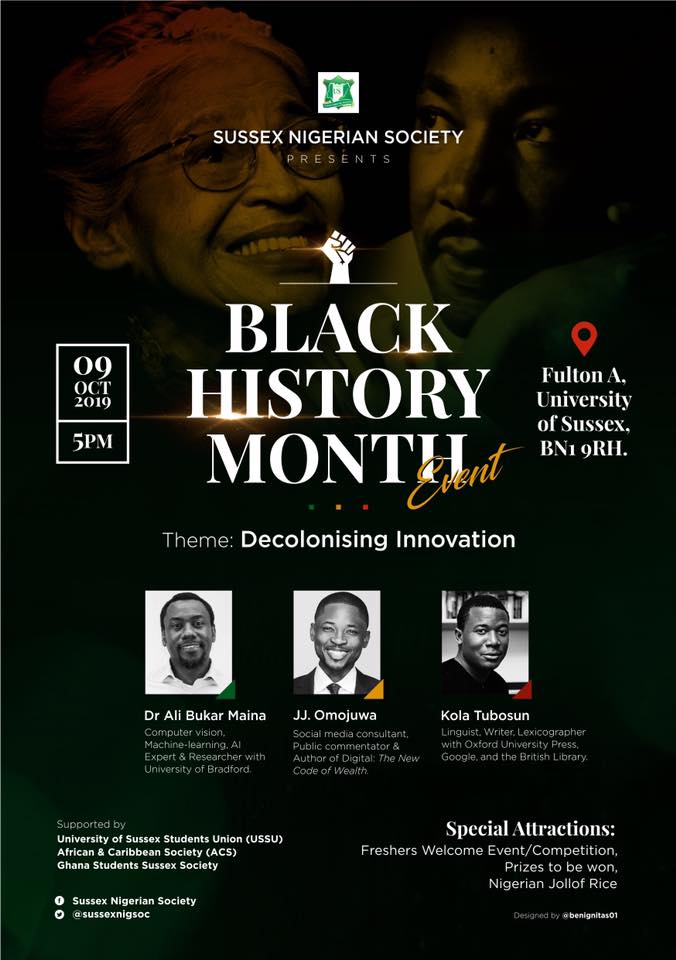
 Being the text of a talk delivered at the Black History Month event at the University of Sussex on Wednesday, October 10, 2019
One of the things I remember while growing up in Ìbàdàn was that almost every technological item in the house was made in China. I knew this because it was written there: “Made in China.” It was hard to avoid. You just needed to look a bit under the item, or around it, and the sign was there: “Made in China.” I know this hasn’t changed as much today because a couple of weeks ago, my son, who is now almost six, asked me, “Is everything made in China?” He must have been observing too.

But it was not just electronic items that I associated with a particular place. I remember the razor blades we used — probably the same ones we still use in Nigeria — were made in Czechoslovakia. Well now, the country no longer exists, so it will now likely be written as “Made in Czech Republic”, but the association persisted long enough in my mind that I could not associate razor blades with any other place than Czechoslovakia, a country I could not place on the map, nor even properly spell if not for the razor blade.

Later as an adult, I would know of other places where technological or mechanical tools were manufactured. We learnt of Japan, and later Korea. Actually, today, many tools and items have become synonymous with those countries where they’re made. My mechanic would often say “This is Original! It’s not China. It’s Korea!” and I would automatically know what he means to say. When I visited Seoul in January of 2018, I discovered for the first time that Kia and Hyundai were made by the same company. I learnt that Honda and Hyundai were made in different countries (Japan and Korea respectively), and that Daewoo and Samsung were Korean companies, and not Japanese. Yes, I’m not very versatile in automotive news, but it was gratifying to find out that — after all — not everything was made in China.

When personal computers came to use in the late nineties and early 2000s, for some reason, the perception around their provenance was not Asian. Yes, intellectually, we could understand that the hardware was likely made in Asian spaces, but the idea of personal computers, made prominent by their software — this time Windows — was American. We associated it with Bill Gates and his company, Microsoft. And so another level of association took place and spread as the use of PCs themselves spread around the place. This phenomenon also conditioned how we reacted to the capabilities of these devices: they were American tools, and so they provided the user with an access one would expect for an American user. It made sense.

This was why when I got my first Personal Computer, in my second year of university, around 2002, I understood — or let me say surrendered to — the idea that it could only type in English. Whenever any word was used that was not in English, or that the computer did not recognize, it underlined it with a red wriggly line. It was easy to excuse as ‘normal’ and expected. The PC was an American invention and so there was nothing to complain about. After all, it could do other things like play Prince of Persia, a game about castles, Mullahs, and princesses. It could also play Fifa 98, a simulated soccer game that got our endorphins rushing whenever we had free time to indulge in it. It could play Chess, a game invented in India at around the 6th Century AD and perfected in Europe. In short, it did the ‘expected’ things.

But I was not satisfied, though there was nothing I could do about it. When I started working on my final year project, which was called The Multilingual Dictionary of Yorùbá Names, I complained but ultimately accepted that the computer couldn’t properly tonemark the names I was compiling in the proper way. When my professor gave us homework to translate technical terms in electrical engineering or mechanical engineering into our local languages, I turned mine in with the Yorùbá terms written in the Latin script without the tone markings that properly disambiguates the words. He probably didn’t notice, nor care — again, we used the same computers, so he was familiar with the obstacles — but it distured me. I was not satisfied.

It was the same dissatisfaction I would feel when Twitter, in 2011, announced that they were opening the platform for translation into many world languages but excluded any African languages from the list. It was the same way I would feel realizing that Siri, that automated computer voice on the iPhone and iPad existed in Swedish (~10.5 million speakers), Norweigian (~4.32 million speakers), and Danish languages (~5.5 million speakers) but not in Yorùbá (with over 40 million speakers). It is the same disappointment I would feel reading Nigerian writers write in English with proper attention to the diacritics of foreign words like French or German or Swedish, but total disregard for words in their own language in the same text. 

In all, there seemed to be a perception that things were only meant to be in English, meant to be in a European language to be proper. When I used to teach English in a high school in Nigeria, a colleague of mine — ironically also a graduate of linguistics — said it was ‘unprofessional’ to speak Yorùbá, or any Nigerian language among members of staff while in school. I asked him if he’d feel the same way if the language being spoken among the staff was French or Spanish. He said ‘No, that is different.’ I couldn’t see the difference at all. In Kenya, students and teachers are allowed to speak any Kenyan language, along with English, while in school, and there is nothing wrong with it. In Wales, schools now exist where Welsh is used as a medium of instruction. Why, after fifty nine years of so-called independence from Britain do we still need our educational system to reflect British ideas of propriety, British sensibilities, or British manner of speaking?

When the Nigerian English accent on Google was launched in July, the responses were mixed, as is usual for most things in Nigeria. But some of the negative comments were curious because they were not based on whether the voice mispronounced things or any other objective disagreement. They hated it because it was a “Nigerian” voice. Someone tweeted something to the effect of “Why do I have to listen to a ‘local’ voice for Christ’s sake?” And there were others who said something like “Why do I want to hear a voice that sounds like mine?” So, in all, there seems to exist, even if not in the majority, a part of our society that resists anything that actually empowers us to be ourselves, or to see ourselves reflected in technology. I have seen journalists speak with taxi and Uber drivers, who actually use the voice every day, and are grateful that they have a computer voice that can correctly pronounce “Lekki-Epe Expressway” or “Ajọ́sẹ̀ Adéògún Street” or “Okokomaiko”. These are incremental ways in which we are decolonizing technology.

But innovation itself, as today’s topic suggests, is what needs decolonizing, which is a more fundamental dimension. Why, for instance, are students denied access to universities because of a lack of a ‘credit’ grade in English? Yes, the answer is because English is the primary means of teaching in our universities. But why is this so? Why is this one of the things we have accepted without question? Could it be that we can never pass down knowledge of complex ideas in education unless it is in English? This cannot be the case. Imagine Albert Einstein, who spoke German as a first language, and who may not have left Germany had Hitler not taken over, being denied access to a university education because of his lack of English competence! Education and knowledge, for some reason, have been conflated with English language competence, which it should not be. Kia, Hyundai, Samsung, Sony, etc, and even the makers of the razor blade we still continue to import in Nigeria are proof that it is not the language you speak that determines your future, but the knowledge with which you deploy the language, and the use to which that knowledge is put.

So, today, there is a Nigerian English accent on Google Assistant and Maps. Other Nigerian languages might follow. Twitter tried to create a Yorùbá language platform. At YorubaName.com, we created a free tonemarking software which can be used to properly write/type the language on your computer and on the internet. And at TTSYoruba.com, in 2016, we created the first text-to-speech application for Yorùbá. These are very few in the resources that would be needed to empower the African to use technology. I mean, you still can’t use an ATM in Nigeria today in any Nigerian language, so there’s still a long way to go. 

But using technology that has been brought to use from the outside — even in our own language — is not enough. Not by far. We need to be able to think —using our own native knowledge — to create tools that can not only empower us and solve our problems, but also solve the world’s problems. Someone sat down and invented a car. Someone invented companies that make more fuel-efficient cars, and electric cars, and the radio, and computers. They come from different language and cultural backgrounds, but the common thing with all of them is the spirit of innovation, and the absence of a limit placed on them just because of their first language. It doesn’t matter that the creator of Kia or Honda do not speak English nor does it matter that the person buying the car does not speak Korean or Japanese. How do we get to this stage with our own ideas? One way, of course, is to stop limiting ourselves and our imagination. 

When we no longer create needless obstacles for ourselves, either in the form of language discrimination in education or politics, then the change can truly begin. My obsession only happens to be language and technology and literature, and ways to decolonize them as much as possible, providing opportunities for our inner selves to thrive. There are still so many other ways in which we can achieve freedom from the constraints we put on ourselves, using other skills and competencies. I am glad to be able to do mine with the skills I have. And, sometimes, that’s all one can ask for.

I thank you for your time.
Meeting Zuckerberg

Not personally (though that would have been nice).TemieZuck

The CEO of Facebook dropped by Lagos, Nigeria yesterday – his first visit to the continent – to visit with the tech community and see for himself what they’re (we’re) doing. He also stopped by places where his foundation has invested millions of dollars, e.g. Andela. Read more here on QZ.

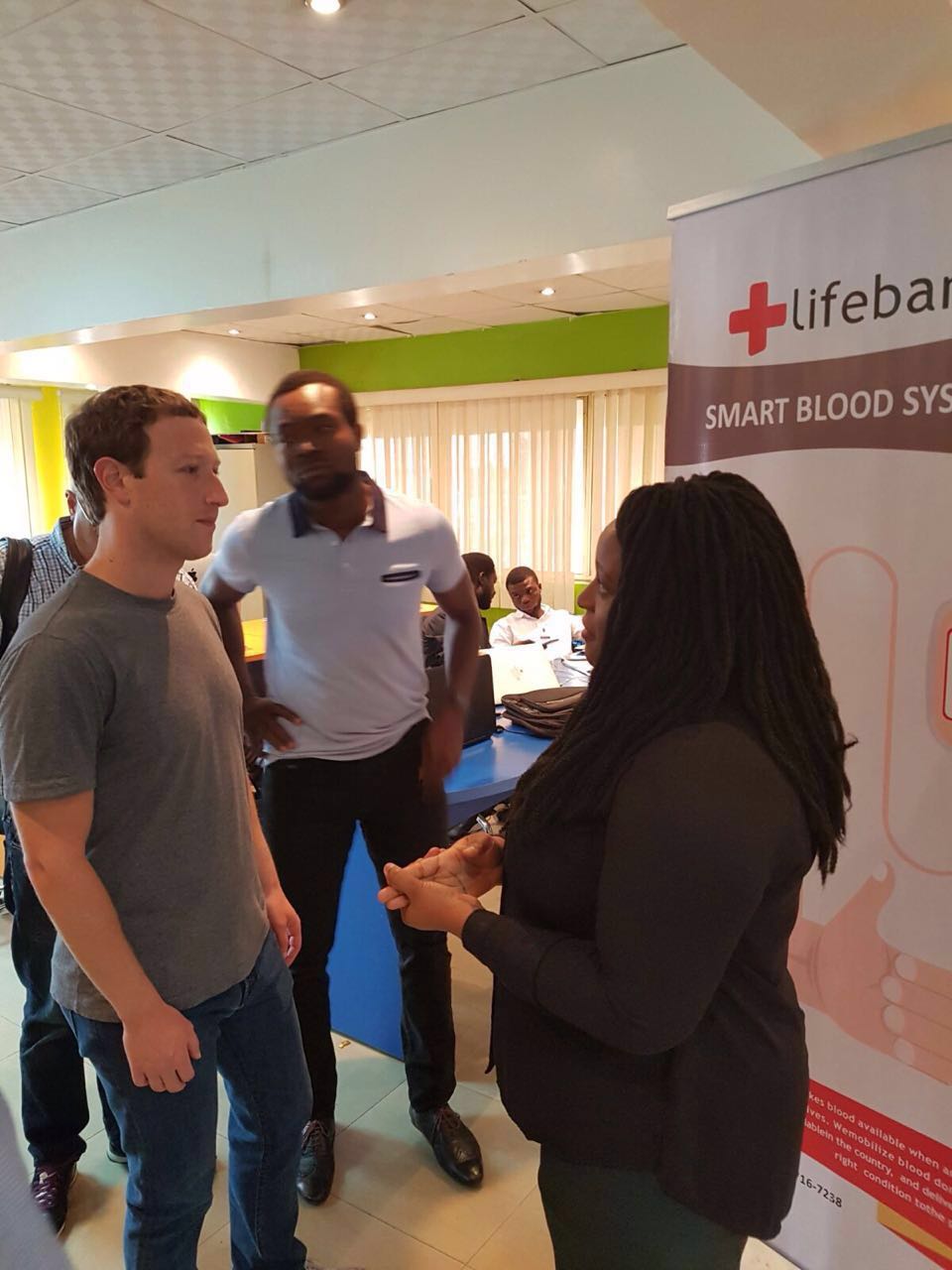
What I’m most pleased by, though (along with the usual delight at his interest in the growing tech space in Nigeria where a number of amazing things are happening every day by young people working very hard with very little) is the fact that he met Temie Giwa whom I’ve talked about on this site countless times – she’s someone whose company LifeBank is doing a lot of good things in the technology space, using a mobile app to connect hospitals and patients to sources of clean and affordable blood supply at record time, thus saving hundreds of lives around Lagos.

What she’s doing hasn’t happened in Nigeria before. Hospitals usually had to physically go around looking for matching blood, usually during emergencies. This has led to many problems, failed matches, and dying patients. The intervention of LifeBank comes to provide not only matching blood types with patients who need it, but also delivering said blood (which has been tested by the lab and by the state government) in record time, and in good condition, to the hospital 24/7. This is poised to change the way healthcare delivery happens in Africa’s most populous country.

Temie talks about the meeting here.

temieMarkGetting investment from a person of Zuckerberg’s stature in such a startup will be revolutionary for the speed and expansion of LifeBank’s work – and I hope that he considers doing that. Getting it from anyone actually will. The possibility of such eventuality has now hopefully risen with such a public validation, and that’s delightful news. Also delightful is the reality of a dawning future in which technology is being adapted to different field in order to deliver outstanding results. This is the future. Nigeria, now officially in a recession, is certainly in need of such not-so-divine intervention.

This is what Mark has to say about LifeBank (around the 8.30 minute mark in this video):

“If everyone had the opportunity to build something like this, then the world would be a better place… I’ve been to a lot of different cities… people around the world are trying to build stuff like that. If she actually pulls it off, then she’d show a model that will impact not just Lagos, not just Nigeria, but countries all around the world.”

During his live town hall meeting referenced above with developers and entrepreneurs, Mr. Zuckerberg referenced a quote which he said guides much of his work: “The best way to predict the future is to build it.” From the amount of great changes now taking place around the country and around the world fueled by the power of imagination and the tools of technology, it’s hard not to wholeheartedly agree.

Raising Money: The Dictionary Experience

There are many ways to fund a project, I’ve realized. One can work hard, save up for many months, and then put all that savings into the choice project, ignoring family and other more important commitments in the process; or one can ask friends and family for a raise, promising that the money will not all go down the drain of sometimes unrealistic dreams. This is usually a good idea if they are not, at the moment, committed to something else more important themselves. Usually very rare. Or one can apply for a number of grants in the world, promising to make one’s dreams come true.

Most grants however are specific. I got a MacArthur-sponsored grant in 2005, for instance. It came with a stipend of $600 for all of six weeks, with a paid trip to Moi University in Eldoret Kenya for a “Sociocultural Exchange”. The Fulbright of four years later came with a monthly stipend of about $1200 but one had to pay for lodging, and feeding in the United States (totaling usually up to around $800) such that by the end of the program, there was just enough to buy an iPod Classic, a hand-held camera, and a few gifts for hordes of friends and family back home.

Some grants require that the grantee do a couple of things (like write a book, for instance), or stay in a particular location for a period of time. Or do work in a certain area for a period of time. In most cases, except one is already established in that field, it’s hard to find a grant that fits conveniently. That was why when sometimes last year, while pondering a way to continue and expand a project I started as an undergraduate in the University of Ibadan “A Multimedia Dictionary of Yoruba Names”, I constantly ran into a wall of doubt as to the possibility of raising enough funds (and finding enough interested people) to get the project moving. The model I had submitted as an undergraduate project was of just a thousand names borne by Yoruba children, with their meanings and (for the first time) audio pronunciations done by Yoruba speakers. For 2005 Department of Linguistics at the University of Ibadan, it was an impressive work. For a 2015 adult with access to more efficient technology and crowd-sourcing, it was less than a tip of the iceberg.

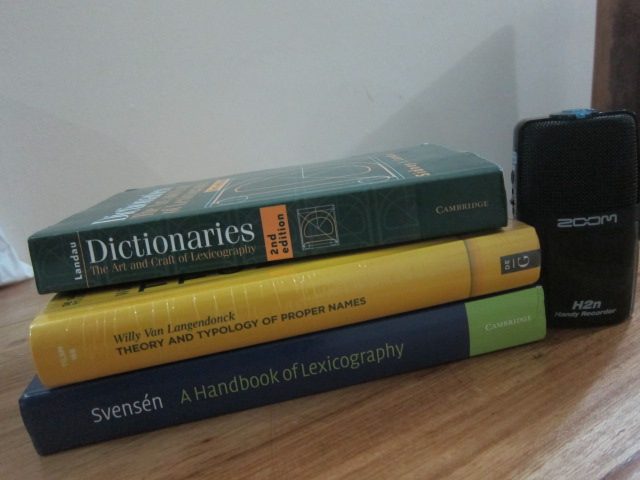
IMG_6625I didn’t have enough savings to start the project on such a scale that I envisioned, and I couldn’t think of any grants that could fund it. Even the Fulbright Alumni Innovative Fund (for past Fulbrighters), as diverse as it is, was limited to a number of categories which doesn’t accommodate a project focused on lexicography and language documentation. There is the MacArthur Genius Grant, a suitable and appropriate grant that makes no demands on the grantee but rewards them (with $650,000 over five years) to be able to achieve their dreams without the drag of a 9-5 job in a busy city. Problem was, one needed to be nominated, and the folks who nominate are usually not known to anyone but the MacArthur folks. Finally out of options, the idea of crowd-funding struck me, just as quickly as the imperative to use 2015 as a year to proceed with the dictionary idea in the first place. I’ve had some contact with Indiegogo before now, but only through friends who had asked me to donate to their project. I’d also heard of Kickstarter, GoFundMe, GlobalGiving, and a couple of other crowd-funding sites. I did a little search on all of them and found Indiegogo most appropriate. Unlike Kickstarter, they don’t send all the pledged amount back to the owners if the goal is not reached. They do take 5%-9% on all the funds raised though, which makes sense when we realize that they’re also in business to make a profit.

So, on January 6 (a not-so-smart date to start a fundraising drive, when one considers the expense that usually goes into the Christmas holiday period), I launched the Indiegogo campaign, open for 60 days. Yet, in spite of the inauspicious beginning, the idea resonated with a lot of friends, family and colleagues with whom I shared it, and they gave, surpassing my expectations. It may also have had something to do with how obnoxiously I pestered a couple of them who promised to donate and then promptly went AWOL :). More importantly, word about the project got out and many people who had nurtured similar ideas about documenting the Yoruba experience but lacked the means or network to do so wrote to me to volunteer their time and services. It has been the best part of the whole experience. There have also been other not-so-encouraging ones: colleagues who matter-of-factly expressed their unwillingness to support either because I’d never supported their projects in the past (even without my knowing it) or because they had their own projects that also needed financial attention. In all, I learn a lesson in human relation, fundraising (I wonder how politicians do it. Explains why I’d never be one), drive, and persistence.

There are now about 15 days to go until the fundraising effort is over. But yesterday, I realized that this is only a start. Yes, I do want to create a Yoruba Dictionary of Names, and the dream is now more realer than ever, thanks to a number of known and unknown people. I however also want to create a Lexical Dictionary of Yoruba containing all the words in the language, also crowd-sourced, and also multimedia and internet based. There is no excuse for the absence of such a document online and such app in mobile phones of interested people all around the world. I want to translate more work from English into Yoruba (I’ve still not completed the one I’ve been working on for years), and render more work from Yoruba into English, and into audio. I want to work with as many people as are willing to make Yoruba relevant to the next century in information technology. The industry for mother tongue education, and documentation is one that is huge and waiting to be tapped. Yes, we are translating twitter into Yoruba, but that can’t be all. Where’s Facebook? Instagram? Google? Where are machine translations? Where is Siri Yoruba? And to do all of these will take more than the $5000 that we are now on the path to raising. We need more.

Yesterday, I applied for the TED Prize 2015, a prize worth a million dollars to support any dream from anywhere in the world. A total stranger had sent me a link to it via Facebook, believing that I have a shot. I scoffed for all of one second and then sobered up. If life has taught me anything, it’s that more than hard work and persistence (which usually pays), taking a chance on oneself is also usually a good idea. I have also begun to look for any other grants that can support a dream of creating a thriving ecosystem of mother tongue education and use in Nigeria. Not just limited to Yoruba, by the way, but the over 500 languages in the country.  It might happen, or it might not, but it will not be for lack of trying. There is a future worth pursuing. From the kind of enthusiastic support I’ve seen from the Dictionary fundraising, one also within reach.

Documenting African Names

I’ve always been fascinated by names, and I can’t say since when. I’ve also always been fascinated with technology. It was no coincidence then when, while researching topics for my undergraduate project at the University of Ibadan, I settled on creating A Multimedia Dictionary of Yoruba Names. It was the first undergraduate project in the department (and, I hear, in the university) which made use of only electronic materials. There was no hard bound copy of any written material. Everything was hypertext and audio, burnt onto a compact disk. For audio I had the help of friends and colleagues to obtain fluent Yoruba speakers willing to help pronounce these names that formed the bulk of the audio database. Then, with my little knowledge of html, I designed an reference interface to access the sounds. Users could click to hear a name pronounced, or they could merely look up a name to discover the meaning.

oruko-logoI found the project stimulating  to work on, hard as the challenge of audio recording was, sometimes across two continents, but it gave me great pleasure, and something worthwhile to work on at that time when academic endeavour as a student looked like a chore with no silver linings. It helped to have had a couple of published materials to use, but researching the meaning of names proved interesting enough to mitigate the boredom of the final years of school. I got my degree, and left the university, with a niggling desire at the back of my mind to one day return to the project in a larger form. The choice was either to find money, call up some of the original collaborators and do it again, this time without the constraints of a university environment, or to simply pursue it as a solo side project. The reality turned out to be that because of other commitments, I would never be able to individually pursue it as a solo project anymore.


Time and chance has kept me in the orbit of project and vocations that relate to African (Yoruba particularly) languages and culture, and my masters thesis focused on the problems and peculiarities of learning Yoruba tone as a second language learner/speaker. Growing up as a monolingual speaker of English in Europe or America, how easy is it to learn Yoruba (or any other tone language for that matter? Mandarin, Vietnamese, Igbo etc). The result of my research yielded fascinating insights to second language learning and acquisition and I have sworn to return to that research as well at a later date. Scholars who have dismissed the possibility of monolingual English speakers to learn and master tone at a second language level will be disappointed by the challenge posed to their premature conclusion.

The reason I have been interested and involved in these things (beside the obvious one of it being in the orbit of my profession as a linguist) is my consternation at the absence of enough cultural materials online from this (Yoruba) and many other African cultures. In this century when most of what is knowable (particularly about Western culture and civilisation) is online and accessible to everyone, it is appalling that Africa seems to be left out. True, most of our cultural information are oral and thus based in the memory of griots and other living libraries scattered around our hamlets. This however can’t be an excuse to shy away from the tools of new technology to document them for future generations. Foreign media who need to pronounce names of African celebrities resort to Anglicizing them without consequences. If a Nigerian can pronounce “Krauthammer” or “Schwarzenegger” or “Spielberg” or “Reagan”, why would folks like Chiwetalu Ejiofor (as the Igbo will spell and pronounce the name) need to change their names to “Chiwetel” in order to get by in Hollywood? In this video from The Tonight’s Show, British actor of Nigerian origin, David Oyelowo tries to teach Jimmy Fallon how to correctly pronounce his Yoruba name.

In a world where linguists and cultural practitioners from Africa do their jobs well, Jimmy Fallon would have had to consult a dictionary of African names online and learnt the correct pronunciation before his guest comes on the show. He would do that for a Swedish guest, after all, no?

My life’s work then, it seems day after day (as I’ve found myself gradually gravitating towards) is to find all the ways possible to make the African experience part of the world experience, using tools provided by information technology. But not just that, it will also include making technology friendly and accessible to Africans who would otherwise have been put off by its alien language and lack of enough user-friendliness. Between 2012  and 2014, we successfully petitioned Twitter to allow the platform be translated into Yoruba. This was a huge victory for language survival and a testament to the open-mindedness of the folks at Twitter, recognizing the ability of the platform to be even more efficient in the hands of more people, and in more languages.

logo1My current project is to document ALL Yoruba names, by crowdsourcing, along with their etymology, meaning, phonetic/morphological properties, and all other stories and cultural dimensions to them. This time, we’re trying to make not just a dictionary, but a resource centre with dictionary, encyclopedic, and linguistic/multimedia information. I am raising funds on Indiegogo to meet the goal of creating the software backbone of the project and we have got a number of volunteers and goodwill. The larger aim is to kickstart a process that will lead to an awakening, and an eventual movement by all concerned, to put more effort in the documentation of our cultural experience in spite of the onslaught of a type of monolcultural globalisation that only leaves us bereft of any signpost of our identity and place in the world. Not just for Yoruba, however, but for all African languages. But we have to start somewhere.

If you believe in this dream, please go to the project page on Indiegogo to donate whatever you can. Every dollar counts.

New Project: A Yoruba Names Dictionary

Hi Blog Readers,

Happy new year to you! I hope that you’ve been busy. I have.

IMG_6258 - CopyAlong with a few researchers (and with anticipated support from a few institutions), we are proposing to build a multimedia dictionary of Yoruba names. It is a project that has been dear to my heart for a while now, and a continuation of an earlier project from university days. As the name suggests, it will be a dictionary. And being a dictionary, it will have a number of important linguistic, cultural, and artistic resources attached to each entry. We envision a cross between a wiki and a dictionary.

I wrote more about it on the Indiegogo campaign page. Please donate and help make it happen. (UPDATE: I hear that the previous link wasn’t working. I’ve fixed it now. Thanks @hardcorekancil on twitter)

It’s been ten days so far, and we have already been featured at Tech Cabal, WeRunThings and The Cable, and in countless retweets and words of mouth. We thank them! We have also raised about 30% of our target, which is incredible considering the period (after a major spending holiday). We have 50 days to go, so there is still time to chip in no matter how little.

Many of you readers have already heard about the project, and many of you have donated. Thank you. If anyone of you are interested in joining in the campaign in any way (or supporting it in any other non-financial way), please drop me a line at kt at ktravula dot com.

So, what have you guys been up to?