#Fact. The month of July is named after Julius Caesar who was born in the month, and who gave the world the calendar we use today.
Browsing the archives for the Soliloquy category.
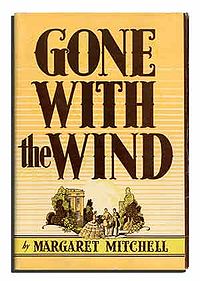 Gone With the Wind and Glory are two sides of the same coin in the civil war history of the United States. Well, not really. One of them is a story that glorified slavery in some way, or at best treated it like just another part of life. The other was a feature on a real life event of an attempt to resolve the institution of slavery among other political differences in the country.
Gone with the Wind is a beautiful story of love, gallantry, bravery and honour. Bella loved Rhett, but Rhett loved Scarlett. Scarlett however loved Ashley, and Ashley loved his wife. Scarlett never got over her love until it was too late. A very moving ending to a story that spanned the period of the American civil war.
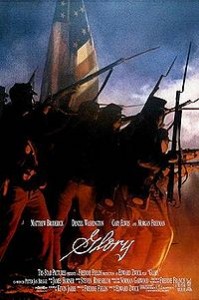
Glory is a moving story of honour, bravery, pride and a tragic military campaign of the first “coloured” regiment of the Union army in an attempt to take over the confederate Fort Wagner. Brilliantly told, the true life story never failed to rouse emotion at very memorable intervals. And Denzel Washington won his Academy Award as a supporting actor.
I can’t explain why I have been watching movies about the American Civil War in the past days, but I can say that it’s been worth it. It is filling a few gaps in my history lesson. And it raises a few questions too, why it was important to black men to enlist in the Union army to fight the confederates when all they would get was death, or at best a chance to kill. And how those capable of keeping slaves in servitude and fighting to entrench the evil system could be capable of gallantry, honour and love. Gone With The Wind manages to elicit my empathy for the Old South, and Glory managed to arouse my anger at slavery, war, and inequality. And all I learnt at the end of watching them both is the power of stories.
“We real cool…/we jazz June” – Gwendolyn Brooks
The month is over, almost so. “Thirty days have September, April, June and November…” Now we’re about to enter the second half of the year. Wasn’t it just yesterday when the new year sneaked in without warning? Before we know it, the year’s over again. How did you enjoy the month? Is the World Cup living up to its expectation of excitement?
June here was full of rains and humid heat. July will be more of that. You know that kind of rain that just never stops? Drizzles and little showers from morning till evening? Yes, that’s the kind July is known for here. Urban legends have it that the rain is due to the Osun Osogbo celebrations in Osogbo during the month. How true is that?
Here’s a thought: how would you like a book made out of this blog? Do you like it enough to want to gift out a book made out of a collection of some of the favourite past posts/poems/thoughts on the blog? Is it worth it or is it a waste of time. Do people still read? Can you at the moment think of people you’d like to amuse with some of the thoughts that have made you smile here in a book? There is a new poll to your right. I’d like to know what you think.
July promises to be a fun month for many reasons. And the beat of life goes on. Regards everyone.
Anwuli Ojogwu has asked me if this blog will remain a travelogue “now that you’re back.”
 It is a question the answer to which I’ve resolved since a few weeks before I got on the plane heading back home. Yes, the blog is tagged “a travelogue”, and yes, so it will remain, and the contents will remain what they’ve always been: my observations on the world around me wherever I go. It has never really been strictly about travelling anyway, but about my interests, views, observations, progress, ups and downs, friends, and the way my life seems mixed up in the American (and world) experience warts and all. It will remain so.
In this spirit of the beautiful game, check out this World Cup of Fiction.
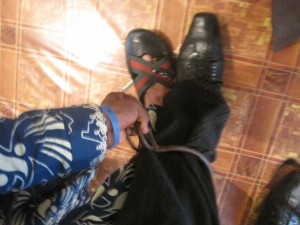
Slavery in the world was an absolute evil, and its transatlantic brand has become one of the most visible and contemporary pointers to its gruesome reality. Many things have crossed my mind since I wrote the article for the Nigerian newspaper NEXT (reproduced here on the blog) on my experience at Badagry examining the slave relics and the role of African (nay, Nigerian) families in the propagation of the trade. One of the pressing ones was whether it was right or moral or fair that descendants of the slave traders were the owners of the many private museums now at Badagry housing the original relics of the horrible time. Unfortunately it is not a slam-dunk open and shut case.
On the one hand is the right of any citizen to make money off of anything as long as it doesn’t pose any harm to the other person. On the other hand is the tug of annoyance in our heads when we realize that every time we pay money to gain access into the private museums, we continue to fund the machinery that once profited at the expense of millions of helpless lives. Then there is the added complexity we find in the need for information from whatever source. The slave trade is a historical fact, and there is so much that needs to be told about it. Generations after us will retain the same level of curiosity as us, if not more, and would ask questions. And who best to answer them than the true descendants of the slavers who know either from word of mouth or from family treasures of relics exactly what went on at the time and the role their families played.
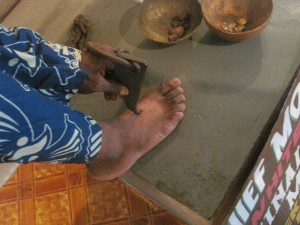
In a normal working society though, one would expect that those artifacts would be in custody of a working government, with sufficient documents and audio-visual materials there detailing all that needs to be told about the period, and the proceeds going to take care of the citizens. Will this, if implemented, violate some principle of “free market” and private ownerships? Maybe. But when descendants of slavers still profit from the trade this indirectly, it rubs the nose of the society in the indignity, and it elevates evil one some level. The Mobee “royal family” of Badagry are an elite family already there. I don’t assume that they need any more of the dirty money that must come from tourists all over the world wanting to know about slavery. How do they even deal with the shame it must bring to ask people to bring their money to see what your ancestors used to enslave others? Have they thought about it, or don’t they care about what their lineage represent in history? I imagine a private concentration camp in Germany – if there was one – being run today by descendants of the racist anti-semitic people and profiting from it, whether or not their descendants still retain the same level of hate for the descendants of the victims. Or descendants of John Wilkes Booth being the ones in charge of the Lincoln Presidenial Museum earning money by showing off a few of the killer’s tools to the world. Something is definitely wrong there.