Browsing the archives for the Observations category.

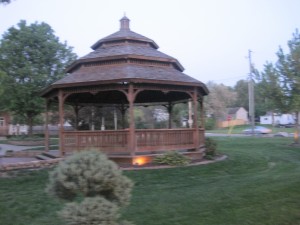
The Glen Carbon Centennial Library

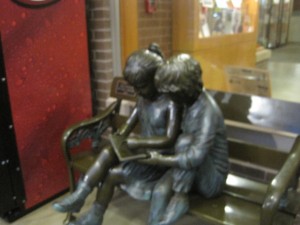
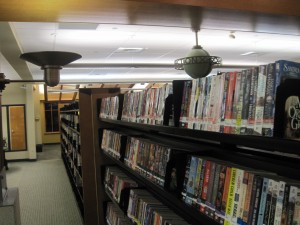
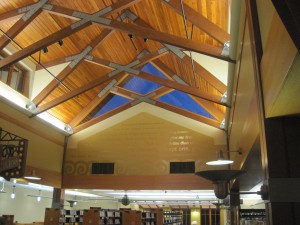
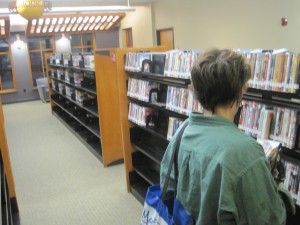
Pictures from the Glen Carbon Centennial Library, voted the best small library in America by the Bill and Belinda Gates Foundation for 2010.

I was there yesterday. See this YouTube video of my tour of the Library, and a newspaper article I wrote about the library.

A Different Kind of Hoe

This is my post #400.

I have now lost count of how many times I used a perfectly clean English expression only to later discover that it meant something totally different in American English. Once upon a time, the “black book” was a place to write names of people you don’t like. But while telling a story of my first really brutal treatment in the hands of a woman bus driver in Edwardsville, I mentioned in passing that she had now entered my black book, and my students’ eyebrows went up. A black book, I was later informed, is a book where men wrote the name of their objects of desire. Surely that was new to me, and I immediately corrected myself. If I had a black book, the woman bus driver won’t be in it, definitely. Nine months ago, the only time you’d ever have heard me use the word “flashing” would be while remarking that someone had been calling my mobile phone without allowing me to pick it up before hanging up. In Nigeria, as in many other countries, that is “flashing”. I’m now aware – as I have actually been for a while even before coming here, from watching American movies – that flashing doesn’t have much to do with phones at all as with body parts. No, I don’t want to be saying that anyone has been flashing now. No sir, that’s why I have a voicemail. 😀
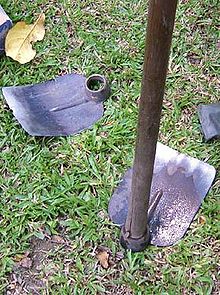
“This is a hoe.” Picture from Wikipedia

The influence of the mass media and their obsession with sex may have done irreparable damage to the innocence of words today. It is nows harder than ever to communicate without the risk of saying something totally different. Growing up in Nigeria in the eighties and nineties, I remember vividly that soda (soft drink) covers used to be called “crown corks” and that on radio during promotion, the jingles always were something like “Look under your corks and you might win a gift of…” (Hint: Nigerians typically don’t pronounce the ‘r’ in these kinds of words). Even to me today, that doesn’t sound to the ears as innocent as used to before, as neither is the use of pussies or doggys to refer to pets. Whatever happened to the language?

I am thinking of these things today only because during yesterday’s class, I was asked to tell the students the meaning of Ìwé kíkọ́ láìsí ọkọ́ àti àdá kò ì pé o and other lyrics of the song that they had learnt for the past three weeks from the class tutor. I painstakingly wrote out the translation on the blackboard (“learning from books without hoes and cutlasses is not a complete education”) and then suddenly realized that I could be wrong to assume that they all knew what kind of farm implements used in rural areas in Nigeria. The song itself came out an old culture of farming, and the grown folks who composed it had hoped to remind the young ones that farming is just as important as schooling. And so I asked, pointing to the writings on the wall. “You know what a cutlass is, right?” They didn’t. “What about a machete?” They did. “Alright, the cutlass is almost like a machete, and it’s used to cut down trees and to farm.”

And then it came. “What about a hoe?” Silence. Giggles. Laughter. Stares of horror.

He mentioned a hoe!

Then someone said, “yes” he knew what it was. I was at first relieved, until a few seconds later when I discovered that he actually didn’t, and it was my turn to be shocked. He definitely knew what he knew. And what he knew is neither used on the farm nor is supposed to be used in decent speech. Sigh. This is what has happened to my beloved English language. Oh, but how exactly did we get here? I’m going back to speaking only Yorùbá from now on, except that when written without sub-dots, the word for hoe in my language doesn’t fare better either on the scale of cleanliness.
The Best of KTravula

Out of fear that I may abandon this blog after my programme is complete, a friend suggested that I feature the some of my favourite post from over the past eight months and almost four hundred posts. That I will do beginning from this week. The most popular posts are already automatically listed on the right hand tab. But as has happened a few times on this blog, my favourite, or the most commented, sometimes do not always make it is to the list. So here we are. My top five favourites for this week. I sometimes go back to read them once in a while. What are your favourites?

A Short History of My Face

On the Origin of Names

How I Discovered the Value of a Quarter

Pumpkin

This Step, This Spot – A poem

PS: I just heard some horrible news about volcanic clouds all over Europe that is making it impossible for airplanes to fly. For me who would be going home via France (a welcome departure from the rudeness of London’s Heathrow Airport), I am worried. I do not want anything that will have to make me fly for 13 straight hours directly from the US to Nigeria. I don’t believe that anyone should stay for that length of time in the air, and definitely not someone with long legs and a resentment for cramped spaces.

Baby Showers

Some day before I leave here, I’ll be attending a baby shower of a friend and former student of this institution. A baby shower is an event where people gather to celebrate the life of a baby that has not yet been born. Alright. Forget all that naming ceremonies we do in Nigeria eight days after the child is born. Here, the baby shower takes place before the child is born. Isn’t it amazing? The said baby by the time of the shower would have already gotten a name. All that will be left is delivery.

There are many reasons pregnant women in Nigeria and much of Africa don’t celebrate their babies before they are born, and much of them are based on superstition. The most concrete of reasons will have to do with the maternal and infant mortality. Because of lack of adequate healthcare for much of the poor pregnant women in the villages who also lack access to education, good food and good shelter, many children are lost at childbirth, or to debilitating diseases afterwards. In cities, due to lack of good state or private hospitals, this happens to middle class people in the cities as well, except they are rich enough to go abroad to have their babies. I guess in cases like that, it would be futile to celebrate life when even its beginning is in doubt. The rest is cultural. From history, and from a tradition that probably predates the migration of Yoruba people to the west of the Niger river from wherever the came from initially, children are celebrated at birth, and named on the eighth day. End of story.

Among many other differences in pregnancy attitudes in America and Nigeria is disclosure. Unlike what I am more familiar with, here, people would tell you that they are pregnant even before the protrusion shows itself. For a reason perhaps close to superstition as well, you won’t find African women doing that. And you can’t ask them why. So,as it has happened to me several time while I was growing up, I would find myself unable to discuss the existence of someone’s pregnancy – even when it stared me in the face – until they gave birth. I wonder how much of that has changed with modernization.

With access to stable electricity, much of the problems (especially in Nigeria’s healthcare) would be solved. Sometimes, it is that simple. Hospitals will be able to offer better healthcare services if there is stable power. That is one of the biggest challenges before the Acting President Goodluck Jonathan who is now in the United States on a state visit to meet with the US President. He has about a year to set in motion plans to put the nation back on the track of development. A huge but worthwile task. There is a longer article about maternal mortality here by Eyinade Adedotun.

Check out other solutions for improving maternal health or to participate in the global call to solutions, please visit Healthy Mothers, Strong World: The Next Generation of Ideas for Maternal Health. www.changemakers.com/maternalhealth

Jungle Fever

I translated a poem for my Slovenian poet and musician from English into Yoruba a few weeks ago. It was a very short but humorous piece of work. I’ve also recorded it for him in my own voice.

But while we were looking for an appropriate background sound for the poetry recital, he sent me the following:

“I put the voice of birds. This would actually stress that you read in an African language and it would give some jungle atmosphere.”

Even though the bird effect turned out pretty well in the end, I really couldn’t stop wondering about what his reasons for it really reflects. It sounds like there is definitely a wrong assumption somewhere in there. Or maybe it’s just me. There are birds in England, India and Canada too, right? If birds and the “jungle atmosphere” is enough to identify an African language, what animals would be required to make noise in the background if I were to read in an American language? A bear, perhaps? Hard rock? Or a gun shot? How far do we go until such assumptions just turn into a bunch of pointless categorizations?

It was not long ago that I discovered that many people here wouldn’t really believe that I’d never seen animals in the wild until I came to the United States. (I saw a monkey, a chimp, a gorilla, a zebra, a lion, an elephant, a camel, a fox, and an ostrich for the first time in a public zoo of what later became my University in Ibadan. I was about eight years old then. I later saw some baboons in the wild when I went to Kenya in 2005, but before then, beside dogs, chicken, cats, cattle and sheep, most of the animals I’ve seen have been in confinement.) Cougar Village alone however has a large population of deer, geese, raccoons, cats and squirrels than I’ve ever seen anywhere, walking free without confinement. And the geese are wilder than any I’ve ever seen anywhere. One day in the winter, I saw a lonely fox walking by itself on the highway close to where humans might be found walking innocently on a lonely day. Maybe Cougar Village was the kind of  jungle he meant!