The adaptation of a stage play to film is tricky, and one should credit Tyler Perry for attempting that uphill task with his adaptation of Ntozake Shange’s play into film. Full disclosure: I am a fan of plays. I am a bigger fan of adaptations, especially if I have read the play first. In this case, I hadn’t. All I had going for me was a perception of the director as one very much in tune with his female base, willing to approach them from the most emotional point of their interest.
 I had seen The Diary of a Mad Black Woman – his first film I saw. Then I saw the Madea Family Reunion which featured some of my favourite actresses. Maya Angelou was there. Then there was Why Did I Get Married and its sequel which I grossly disliked (and blogged about) for its over-sensationalist approach to family dysfunctions in the black community. In all his films I have seen, what I always took away is his ability to portray things as they exist in the reality of many. In doing so, he contributes to the (some have said “stereotypical”) portrayal of black life.
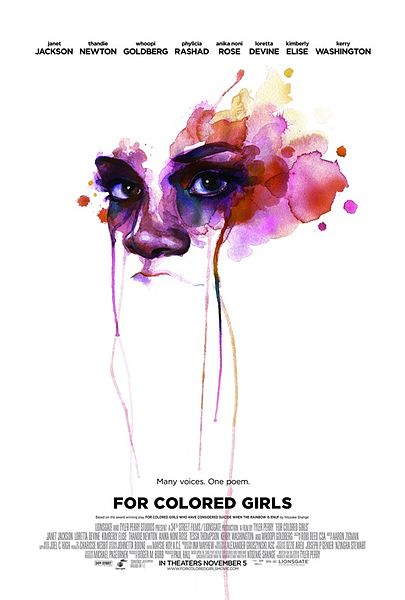
Initial thoughts on For Coloured Girls is that it does like all his work – with the brilliant performances of Kimberly Elise, Anika Rose, Phylicia Rashad, and Thandie Newton – once again takes an unflinching look at the painful lives of black women, their pains and victories. The positives are a star-studded cast, a language that sticks as much as possible to the lines of the play, and a story that is as complex as it is haunting. The negatives include the failure of the story to offer more than the pain of loss and the beauty of community. The promise of the first half of the story fails to move anymore after an hour, and at times seems like an earnest fight against an inevitable failing. Maybe it’s in my expectation of too much from it all, or my sociocultural distance from the emotional experience being so beautifully portrayed.
The summation of course is not that we need less of these kinds of works. It is that we need more, and better. And this is where Tyler Perry gets a thumb up.