…I drove to St. Louis.

I will save the details of the journey for my memoirs, but I can tell you that it is (one of) my most memorable experience so far in the United States, one that I will not forget in a hurry – except I lose my mind, of course. Thinking about that, no pun intended, maybe I should insure my memory. Now, the vehicle that I drove was an automatic with a very sound engine. I always preferred the shift gear vehicles, but I can’t complain when someone offers me a car to drive for free, and it turns out to be automatic. I have noticed that many cars in America are automatic, even the trucks and trailers. The passenger was female – a painter, and the road was clear because it was night. We set off at around 11pm to the Emergency Room at a certain “Barnes Jewish” Hospital, and we returned around 4am, tired and exhausted. I’ve never felt so alive, plying the many veins that make up the American road network.
Well, let me be a little less cryptic. The female passenger was my friend the artist, and she had broken her ankle earlier in the day while descending a flight of stairs. She twisted her ankle, tripped and fell on her back. I didn’t know how serious it was until she drove into campus and I saw it, all swollen and sore. It surely was an emergency. How she managed to drive to me, I had no idea. When I asked why she could not go to a nearby government hospital, she told me that the healthcare system of the US does not allow her adequate healthcare in a government hospital without having to pay more than she cold afford. A simple visit to the hospital for an x-ray scan might cost up to $1500 in bills. I couldn’t believe my ears. This piece of information only brought home the realitites of the national healthcare reform debate that has rocked American politics for a while now. In Nigeria, you could get a scan for $5 at any standard laboratory, and the government hospital will treat a patient immediately for any emergencies. And one doesn’t need a health insurance. America has the costliest healthcare system in the developed world, it seems. According to Holly Ruff, this is a country where people actually declare bankruptcy after recovering from a major illness, even when they have insurance.
“Barnes Jewish” is a charitable but well equipped hospital in St. Louis which sometimes allows its patients to pay according to their own plan, or not at all, depending on the state of their finances – according to what I hear. The foot was scanned, and the doctor found that my friend had only sprained her ankle, and would need to stay at home for a few more days. The leg was stablized, bandaged and braced, and we headed home. It was my first time of carrying my international driver’s license on me after the wine debacle, and it turned out to be a very good decision.
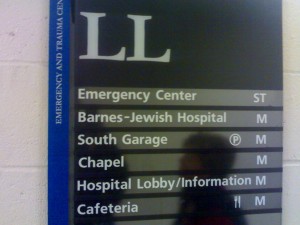 Healthcare is important to everyone, and no one, no one should have to die because they’re poor,, and no one should have to go broke because they fall sick. A society with as many rich citizens like America should be able to take care of it’s poor. This is not Obama’s policy. It is only common sense. The same goes for Nigeria. As I sat in the lobby waiting for Holly to emerge from the emergency room where she was being attended to, I began to think about the number of people who were rushed into the emergency room while I was there. I thought about all the sick people I know, and how much they already suffer, without worrying about having money to pay for it. I have a close family member diagnosed with cancer, and my heart goes out to her. A close friend of mine that I last saw in about 2008 in good health has now been diagnosed with a bone disease. He’s also sickle celler. One of the families here that has been very nice to me has a cancer patient in it. Patrick Swayze, the actor famous for his role in Point Break and Ghost has been announced dead after a long struggle with cancer. Just a few days ago, we had mourned the passing of Senator Edward Kennedy of the USA, and Gani Fawehinmi of Nigeria, both favourite public figures whose lives were cut short by old age, and a terminal disease. It is a world filled with sickness that we live in. We should not make it worse by restricting care and support to only the ones that can pay for it. Helping the weak and taking care of the sick may just be the most noblest act we could perform as conscious human beings, or the sanest reason of our existence.
This post is dedicated to healthcare reform, in the United States where it’s long overdue, and in my country still in need of much more infrastructural and human capital development.
 In today’s case however, it was none of the above reason. I was working on a translation task that took much of my time. I slept at twelve, woke up at two and slept again at five thirty. By the next time I woke up, I was thirty minutes late for my teaching class. I have never rode by bike as fast as I did today, and I got to campus panting like a deer. And silly me, I was still expecting to find the students waiting for me in class. I met only one of them the lobby, and I hurried up into the class to find an empty set of seats. Perfect. Back to the lobby, there was Bre reading, and waiting for her next class.