Browsing the archives for the News category.

SIUE Grad Student Launches International Nonprofit Org to Fill West African University Shelves with Textbooks

For Immediate Release (June 5, 2017)


A brand-new nonprofit organization initiated by a Southern Illinois University Edwardsville (SIUE) graduate student and a native of Nigeria is filling shelves in African universities with much-needed textbooks donated by faculty and students around the world.

Efiwe, Nigerian Pidgin for “bookworm,” is the charitable organization founded here in Edwardsville with a growing presence at book-drive locations on campuses across the United States. SIUE graduate student Philip Alabi’s fervor for equipping West African post-secondary students with badly-needed textbooks and related resources is resulting in the formation of a 501(c)(3) and two boards of directors, one in Edwardsville and one in Nigeria.  
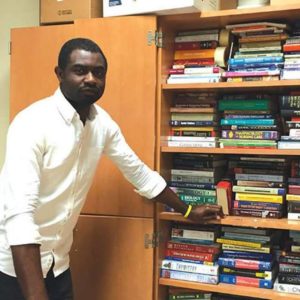
When Àlàbí first arrived in the U.S. two years ago to begin his master’s of science degree in chemistry at SIUE, he saw first-hand how relatively affordable university-level textbooks are to acquire in the U.S. compared to Nigeria. He also saw stacks of still-relevant textbooks in good condition that were being discarded.

“Even for university instructors, textbooks and relevant resource materials are extremely expensive and difficult to come by in West Africa,” Àlàbí said. “In the U.S., there’s the university bookstore, online academic resources and online vendors such as Amazon.com through which students can access the latest versions of textbooks required for their university courses. Sadly this is not the situation in Nigeria, even at the university level. Hard-copy books for courses are typically outdated and there are not enough to go around. If they are attainable, it is generally only the instructors who have a copy of the text, not the students.”

Adding to the challenges, Nigeria’s sporadic power supply and expensive Internet access makes it nearly impossible for university faculty and students in West Africa to access and download online academic resources, according to Àlàbí. “Our aim through Efiwe is to collect relevant textbooks across U.S. colleges and universities and send the books to university and community college libraries in Western Africa,” he said. “Our organizational mission is to send more than one million textbooks to African universities by the year 2030.”

The mission is ambitious, but Efiwe and its boards of directors, inspired by Àlàbí’s passion, are well on their way. In Spring of 2017, before Efiwe was formally conceived, Alabi and fellow SIUE colleagues launched an on-campus book drive with the same purpose. The results were astounding.
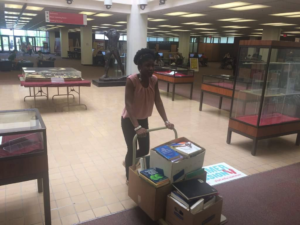
“We thought maybe we’d receive a couple hundred donated textbooks at our initial book drop-off sites on campus at SIUE,” said Àlàbí, who will pursue a doctoral degree in chemistry from Brown University in August. “That initial donation topped 1,000 textbooks in only a few months. We also raised funds to pay for the cost of transporting the books by ship to my home university, Tai Solarin University of Education in Nigeria. We are absolutely confident that we can continue the momentum and tap into the generosity of teachers and learners in the U.S.”

Tai Solarin Deputy University Librarian Jasiliu Kadiri said the donated textbooks would add value to teaching, learning and research work at the university. “We acknowledge with profound thanks the receipt of these volumes of books covering various fields including general and pure sciences, education, social sciences and children’s books,” Kadiri said.

Right now Efiwe is identifying university and community college campuses that are willing to establish a textbook drop-off site on their campuses. Efiwe is also seeking students who will operate and champion book drive initiatives in their respective universities and colleges, Alabi said. Ultimately Efiwe will ask for financial support to pay for the transportation of the books by ship from the U.S. to Nigeria and other West Africa destinations. But for now, the biggest and best way supporters can assist the nonprofit organization is by donating new or gently used textbooks on any and all academic subjects.
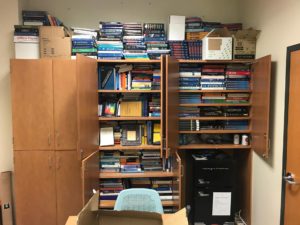
“We encourage individuals and student associations at community colleges, technical colleges and universities across the Midwestern states who are willing to designate a location on their campus as an Efiwe textbook drop-off site,” Àlàbí said.

Web developers are currently working to create an online book inventory of all the texts and supporting materials that are being donated so recipient universities can order the volumes they need.

For more information on Efiwe, go to Efiwe.org or email info@efiwe.org.


184 Poets Vie for the Nigerian Literature Prize

Today in Ikeja, the entries for this year’s NLNG Nigerian Literature Prize were delivered to the judges at an open ceremony. They contained entries by one hundred and eighty-four (184) Nigerian poets vying for the Literature Prize and five (5) literary critics vying for the Prize for Literary Criticism. The two categories are worth $100,000 and N1 million respectively.

“The hand-over of the entries to the Advisory Board, chaired by Professor Emeritus Ayọ̀ Bánjọ, signifies the beginning of the judging process which culminates in the announcement of the winner in October 2017,” reads the press release put out after the event.

Handing over the entries, Dr. Kudo Eresia-Eke and Professor Ayọ̀ Bánjọ. Photo: SabiNews

Handing over the entries, NLNG’s General Manager, External Relations, Dr. Kudo Eresia-Eke, said the prize has inspired some 1,630 books of which 533, representing 32%, were submitted in the Poetry category since the inception of the prize in 2004.

It continues:

The number of entries for the 2017 edition exceeded the 2016 numbers, showing a six percent rise in the number of entries received…. The entries… will be examined on their merits of excellence in language, creativity and book quality.”

The panel of judges for this year’s awards is led by Professor Ernest Emenyonu who is a professor of Africana Studies at the University of Michigan-Flint. He was Deputy Vice-Chancellor at the University of Calabar between 1988 and 1990, and Provost (Chief Executive) Alvan Ikoku College of Education, Owerri, between 1992 and 1996. He has taught in several Nigerian and American universities.

Other judges are Dr. Razinat Mohammed and Tádé Ìpàdéọlá. Dr. Mohammed is an Associate Professor of Literature at the University of Maiduguri. She teaches African Literature with specialization in Feminist Literary Criticism and Theoretical Approaches. She is an accomplished writer as well. Tádé Ìpàdéọlá won the Nigeria Prize for Literature in 2013 in the Poetry category with his third volume of poetry, The Sahara Testament. A poet and a lawyer, Ìpàdéọlá has won several awards and is a resource person for the Rockefeller Foundation around Africa on building resilience.

Members of the Advisory Board for the Literature Prize, besides Professor Bánjọ, two-time Vice-Chancellor of Nigeria’s premier university, University of Ibadan, are Prof. Jerry Agada, former Minister of State for Education, former President of the Association of Nigerian Authors, and Professor Emeritus Ben Elugbe, former President of the Nigerian Academy of Letters and president of the West-African Linguistic Society (2004-2013).

“The Nigeria Prize for Literature has since 2005 rewarded eminent writers such as Gabriel Okara (co-winner, 2005, poetry), Professor Ezenwa Ohaeto (co-winner, 2005, poetry); Ahmed Yerima (2006, drama) for his classic, Hard Ground;  Mabel Sẹ́gun (co-winner, 2007, children’s literature) for her collection of short plays Reader’s Theatre; Professor Akachi Adimora-Ezeigbo (co-winner, 2007, children’s literature) with her book, My Cousin Sammy; Kaine Agary (2008, prose); Esiaba Irobi (2010, drama) who clinched the prize posthumously with his book Cemetery Road; Adélékè Adéyẹmí (2011, children’s literature) with his book The Missing Clock; Chika Unigwe (2012 – prose), with her novel, On Black Sister’s Street; Tádé Ìpàdéọlá (2013; Poetry) with his collection of poems, Sahara Testaments and Sam Ukala (2014; Drama) with Iredi War,” the press release concluded.

The Nigerian for Literature is Africa’s biggest prize with a cash reward of $100,000, which rotates yearly amongst four literary categories of prose fiction, poetry, drama and children’s literature.

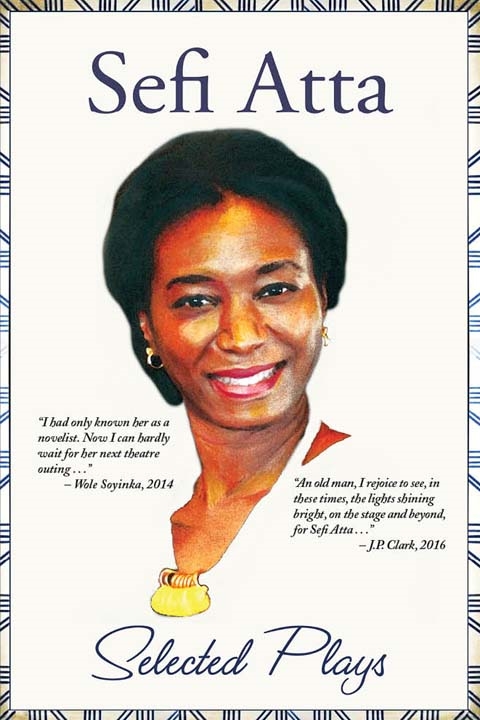
Book Signing for Sefi Atta’s “Selected Plays”

Save the date! On on Sunday, May 7, 2017, Nigerian writer Sefi Atta will be signing her new book of Selected Plays at the Art Gallery, Freedom Park, Lagos.

Those familiar with her work will know that the author has been known mostly as a novelist. Her third book Everything Good Will Come won the 2006 Wọlé Sóyínká Prize for Literature. Yet, her work credit includes a number of stage plays most of which have been produced and staged in Nigeria and overseas.

Credits for her work in drama include both for the stage and for radio. The Cost of Living (2011) and The Last Stand (2014) were produced at Terra Kulture in Lagos while An Ordinary Legacy (2012) and The Engagement (2005) were staged at MUSON Centre. The Naming Ceremony (2012) and Hagel auf Zamfara (2011) were both staged at the Theatre Royal Stratford East London and Theatre Krefeld Germany, respectively.

She has also done a lot for radio, including The Wake (2013) for Smooth FM radio, A Free Day (2007), Mákinwá’s Miracle (2004) and The Engagement (2002) all for BBC Radio.

The public book signing will take place from 5 p.m. to 7 p.m.

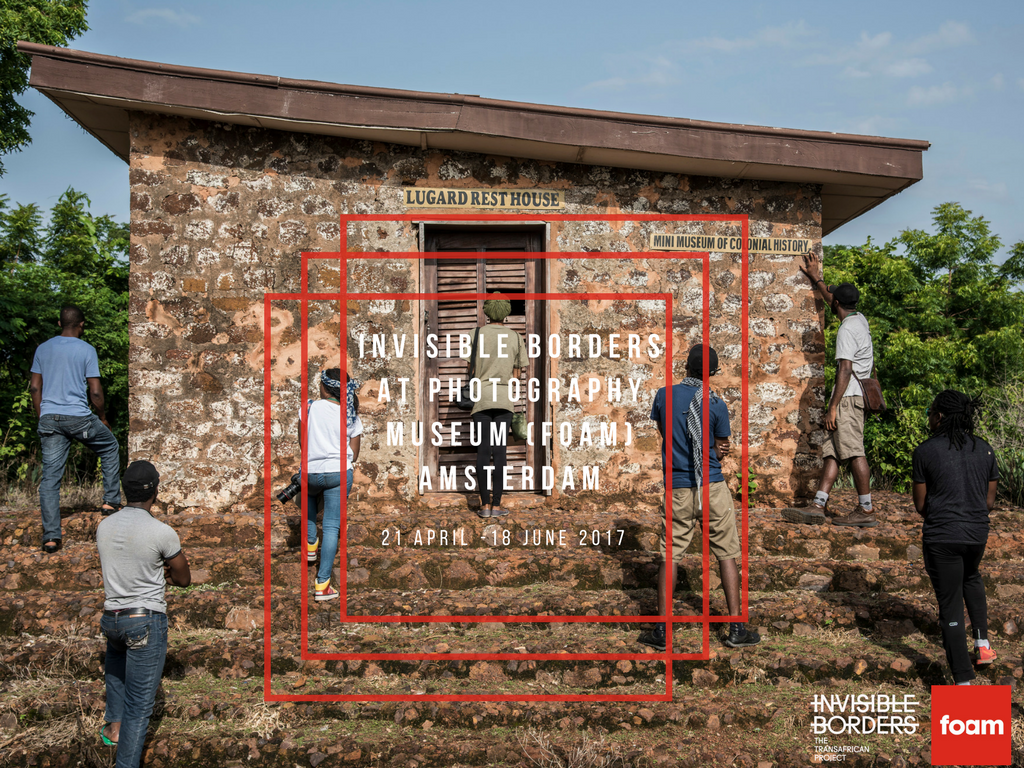
Invisible Borders at Photography Museum of Amsterdam

Over recent years, in all kinds of places around the globe, collectives have been formed that are not tied to specific institutes or to ways of organising activities that are imposed from above. There is a growing tendency among photographers and artists as well to join forces and organise themselves. Many such collectives are based on do-it-yourself principles of ‘cut out the middleman’.

Although their points of departure, artistic strategies, processes and visual end products are extremely diverse, they have in common an enthusiasm for interdisciplinary collaboration and an open view of the world. The collectives differ in organization and form: some are no more than loose associations of varying composition without an agenda, while others operate as far more business-like undertakings. One collective might present itself as an auction house, another as a shop, digital flower-power movement or tirelessly travelling caravan.

The digitalisation of photography and the rise of social media have unleashed a huge flood of images. The immense quantity and the transience of photos may make it hard to attribute more significance to photography than is intrinsic to a quick glance at yet another picture on Instagram. Working together to attach value and meaning to images is the central theme of the exhibition Collectivism. Collectives And Their Quest For Value. Some collectives investigate the mechanisms and distributions systems that cause financial values to be attributed to images. Others operate as social agents, bringing people together by means of images and creating communities, online or otherwise. The exhibition also presents collectives that concern themselves with the value of images in the media and the organisation of dissenting voices to challenge the mainstream media.

In a world obsessed with artefacts – the physical, final object – as the preferred form of artistic outcomes, Invisible Borders shifts the gaze to emphasise the never-ending, evolutive nature of Process. No distinction, hence, is made between the value of images showing the work-process and images showing the outcome; they are complementary. The artist’s presence on the road is as important as the work that commences from that presence.

Central to the Invisible Borders Installation in the exhibition Collectivism. Collectives and Their Quest For Value is the idea of the collective as a platform for the nurturing of mindsets and perceptions that offer alternative methodologies and ways of being in an increasingly narrow and enclosed notion of place, territory, and identity. As such, we shall employ as a metaphor the Road ‘s unending nature. The project will be presented as a work-of-process, an interminable voyage so to speak.

Thus, the works of the participating artists will be presented as a complimentary association between process and precipitated outcome, consisting of images, texts, sound, and videos.

Artists whose works make up the Invisible Borders exhibition are: Ala Kheir, Amaize Ojeikere, Jídé Odùkọ̀yàLilian Novo IsioroTeresa Meka, Tom SaaterVanessa PetersonJùmọ̀kẹ́ Sanwó, Charles Okereke, Uche Okpa Iroha, Emmanuel Iduma, Ray Daniels Okeugo, Uche OkonkwoLucy Azubuike , Yínká ElújọbaEmeka Okereke. 

Contributing collectives of the entire exhibition are 8Ball Community (USA), Dead Darlings (NL), # Dysturb (FR), The Eternal Internet Brother/ Sisterhood (GR), De Fotokopie (NL), InvisibleBorders (NG), and Werker Magazine (ES/NL).

###

For more information, visit: https://www.foam.org/museum/programme/collectivism

Press Release: Irawo Poetry Anthology

PRESS RELEASE – Ibadan, November 21, 2016

Irawo Poetry Anthology:

48 poems celebrating 48 years of Irawo University Centre, Ibadan

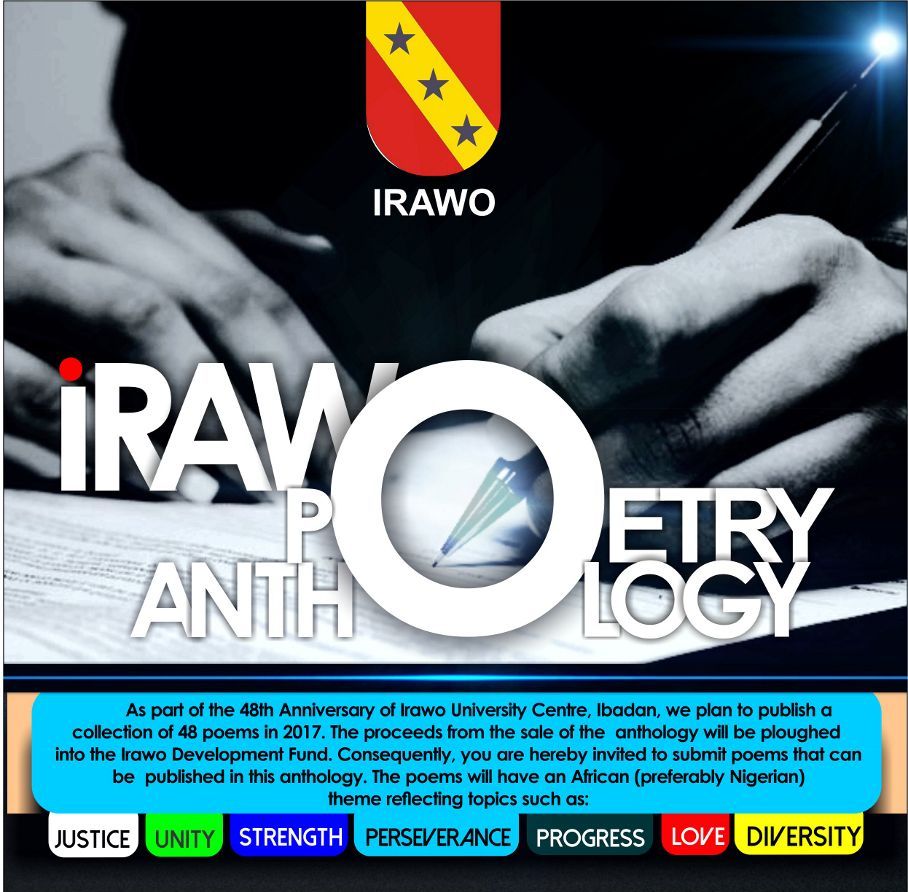
We are glad to announce that 48 poems have been accepted for publication in the 2017 Irawo Poetry Anthology.


Irawo University Centre is a private hall of residence for male students, principally of the University of Ibadan. This Centre is one of the numerous educational and social welfare projects promoted by the Educational Co-operation Society, a non-profit oriented body. Irawo was established in 1969, admitted her first residents in 1972 and moved to its definitive site in 1990. That same year, the University of Ibadan recognized Irawo University Centre as “a private hall of residence associated with the university” – the first to be thus acknowledged in the Nigeria University System. The key aim of Irawo is to contribute to the academic, professional, human, cultural and spiritual formation of the student. To do this, emphasis is placed on creating in Irawo an atmosphere conducive to serious academic work.

It will be recalled that earlier this year we made a call for submissions for the Irawo Poetry Anthology as part of activities to commemorate the 48th Anniversary of Irawo University Centre. The proceeds from the sale of the anthology will be ploughed into the Irawo Development Fund. The themes for the call for submissions were poems reflecting the following: justice, unity, strength, perseverance, progress, love and diversity. The call for entry closed at 12 midnight of August 31, 2016.

We received a total of 107 submissions from 54 Nigerian poets. The poems went through a blind review process by three renowned Nigerian writers. The three distinguished judges are: Tádé Ìpàdéọlá (lawyer, author of Sahara Testaments which won the 2013 NLNG Prize for Poetry and winner of the 2009 Delphic Laurel in Poetry), Mark Nwagwu (Professor of Molecular & Cell Biology and author of the poetry trilogy – Helen not of Troy, Cat Man Dew and HelenaVenus) and Kọ́lá Túbọ̀sún (Fulbright scholar, writer, linguist, Editor of The Sail Literary Anthology and irawo-poetry-anthology-posterFounder of YorubaName.com).

The 48 considered suitable by the judges for the Irawo Poetry Anthology are listed below.

S/No Title Poet
1 Crux Lawrence Aniawana
2 Timi Uchenna J. Obi-Ibeh
3 The Voice Ogunlaye Olatunde
4 A Letter to the Future Chidiebere G. Udeokechukwu
5 The Key Stanley Aduaka
6 Broken Boluwatife Afolabi
7 A Song of Colours Boluwatife Afolabi
8 Can Two Be One? Oluwatoyosi Agbaaikin
9 Is Love? Oluwatoyosi Agbaaikin
10 Ifunaya…. Ololade Akinlabi
11 The Scales, the Blindfold and the Sword Obinna Amaji
12 Bed of Stone Amamchukwu Chinonoso
13 Ife Mi Amamchukwu Chinonoso
14 Friendly Foes Amamchukwu Chinonoso
15 Awaken Sandra Arukwe
16 Tomorrow Sandra Arukwe
17 Herald Bukoye Emmanuel
18 One Bukoye Emmanuel
19 Vigor and Vapor Kelvin Enumah
20 Quake; the Future at Stake Kelvin Enumah
21 A Fu Gi Anaya Norbert Gora
22 The Broken Last Straw Ikeobi Samuel Chukwubuokem
23 Sapele Water Emuobome Jemikalajah
24 Ikenike Emuobome Jemikalajah
25 Lost Ones Fumbi Ajumobi
26 Dear Dunni Mofoluwawo O Mojolaoluwa
27 The Sun Will Smile Chuks Obi
28 Behind Bars Chuks Obi
29 The Sun Shall Soon Shine Ojo Oreluwa
30 Let’s Stay Together… Segun Onaade
31 Abiku Teleola Onifade
32 Kafanchan Ayomide Owoyemi
33 Kiniun Onibudo Ayomide Owoyemi
34 Palm Tree Oluwatobi Moses Sotanmide
35 One Day Oluwatobi Moses Sotanmide
36 Innocent Till Proven Guilty Chidi Joe Umechukwu
37 Virtual Reality Olufemi Abidogun
38 My Memorabilia Tumilara Adesina
39 Story of our Toppled Storey Tumilara Adesina
40 Moving Clouds Ebisike Chinedum
41 Unity Mofoluwawo Favour Ona-Ara
42 Dawn Taiwo Olawehinmi
43 The Housewife Luke Ogar
44 The Ghost Town Luke Ogar
45 Island of Ice Emmanuel Nwobi
46 Rumble in the Jungle Emmanuel Nwobi
47 The Repose of an Anthill Emmanuel Nwobi
48 Back to our Roots Mahuemolen Odibo

Nwachukwu Egbunike and Emmanuel Nwobi

Editors

Irawo Poetry Anthology