By Tolúlọpẹ́ Ọdẹ́bùnmi
In Mokalik Kúnlé Afọláyan invites his audience into the world of mechanics through the eyes of a 12-year-old who is struggling academically in school. The young boy, Pọ́nmilé, is brought to the village by his father, Mr Ògìdán, to have the apprenticeship experience which the latter thinks may scare Pọ́nmilé to become more serious in school (on the assumption that Pọ́nmilé’s poor performance in school is due to inadequate efforts) since the life of an apprentice is supposed to be full of hardships and lacking in dignity.

By the end of Pọ́nmilé’s day at the mechanic workshop, he decides to continue schooling but also says he will occasionally come back to the village to learn, having realised that such technical know-how can be complementary to his school education. This decision shocks Mr. Ògìdán but he is happy his son’s horizon has been expanded by his experiences in the mechanic village. When Chairman, who serves as Pọ́nmilé’s guardian in the village, reports that the child is exceptional at learning, indeed a fast learner, Mr Ògìdán looks surprised, almost confused as if Chairman was talking about someone else.
Mr. Afọ́láyan’s movie explores a couple of themes often neglected in Nigerian society. First, the misconception about education, the myopic view that education is possible only in the format of a walled school with duly certificated teachers; a general misunderstanding that education is undertaken only in the context of classrooms, prescribed textbooks, regulated syllabi, written exams, etc. In short, the delimitation of education to literacy and instruction in English acquired through formal schoolwork. Another subtle theme in Mokalik is the dignity of labour and the importance of “catching them young”, or encouraging young kids to acquire vocational skills or trades like, in this case, mastery of motor vehicle repair.
One of the thrills of Mokalik lies in the fact that the main character is Pọ́nmilé—someone on the threshold of becoming a teenager. There are only a handful of Nollywood movies that feature a teenager in such a role. In short, the movie is Pọ́nmilé’s interpretation of how the unfamiliar world he finds himself in works. His family resides on the Island (most likely Victoria Island, although that is not specified in the film). During Pọ́nmilé’s one-day internship at different workshops within the village—from the motor engineer’s to the panel beater’s to the electrician’s, etc.—he makes connections between the world he is from and the one he suddenly finds himself inserted in; the similarities between the two worlds are key in shaping his ability to learn and integrate in the mechanic village.
Punishment

Pọ́nmilé ends up in the mechanic yard as a “punishment” for not being book-smart. He is considered to be a “dull” student, not good enough for school but could be good as a mechanic apprentice. It is, however, the rare upper-class parent that would want to steer a child along such a path in Nigerian society—yanked from the classroom and thrust into a trade workshop—given the realities of the criteria for class reproduction and upward mobility here. What actually happens in the film is that Ponmile suffers demotion so that he may become determined and thus concentrate on his studies. After witnessing the suffering in the hell of the Nigerian blue-collar world, he would rededicate himself to getting into the heaven that certificates are supposed to open up for the “educated”.
Would Pọ́nmilé’s father have abandoned him to his choice had he opted to become a full-time apprentice in a mechanic workshop? That scenario would seem far-fetched within the Nigerian reality, but films are not meant to be photographic snapshots of life. In a more general sense, though, wrong parental judgment in relation to a child’s career choice is often the cause of untold anguish and self-doubt, not to mention self-rejection, to the latter. If you get good grades or are exceptional in junior high school, for instance, you are expected to get into “science class”; and average students get pushed to “arts” and “commercial” classes. Such divisions may seem sensible for matching kids to their scholastic capabilities, but the problems that may arise from this arrangement become starker when, say, a high-scoring student opts for “commercial class”, or expresses a desire to become a hairdresser. This is a serious issue but not the focus of the present write-up.
Pọ́nmilé discovers that the world of the apprentice mechanic is like the world of the student. Extending the period of learning for badly behaved apprentices is just like the punishment given to students who repeat classes due to poor performance. Just as there are slow-learning students, so also are there slow-learning apprentice mechanics, and all slow-learners are punished. Pọ́nmilé also discovers a whole world of apprentice misdemeanors in the village, things surely far more colourful and earthy than student misdemeanors in the world he is coming from. Having experienced this intriguing world, Pọ́nmilé wouldn’t want to be totally extricated from it. Thus the “punishment” works, even though the consequences are largely unexpected; yet Chairman, that enigmatic chaperon, seems to have always had inner insight that things would turn out very well for everyone, almost like he wrote the script.
Education and job prospect
It is taken for granted in the film that being educated creates the possibility for entry into certain kinds of jobs. Is it really unusual or unheard-of to find the so-called educated working in a mechanic workshop? The Nigerian social space once buzzed with noise over some “revelation” that a couple of PhD holders applied for the position of truck driver with the Dangote Group. Pọ́nmilé informs Kàmọ́rù that people study Mechanical Engineering in school, of course referring to post-secondary-school education. Kàmọ́rù scoffs at this, responding that such graduates end up working in positions not related to their fields of study, which is quite an accurate description of how things often play out in Nigeria and elsewhere too.
However, Kàmọ́rù is saying more than this. He is also arguing that if you studied Engineering in university and you do not work in a technical field, you’ve probably wasted your time in school. He goes further to mock some of the clients who come to the workshop, implying that some of them who are supposedly educated have no clue about how a car functions even though that status symbol is an essential part of their sense of self-worth. The mechanic is thus the sustainer of their status and self-worth. Indeed, the Nigerian middle-class experience is replete with tales of woe at the hands of “sharp” mechanics who keep finding ways of making sure that their clients come back to have this or that part of their vehicles repaired, tinkering with the vehicles, planting hidden faults that will manifest later, in order to ensure constant custom.
Assumptions and points of view

In the film, there are issues of class and the perspectival baggage that comes with it. The whole idea of bringing Pọ́nmilé to the mechanic village has its class overtones, as already hinted at above. The assumption, of course, has to do with how kids from well-to-do families spend their free time. For instance, there are well-founded assumptions, on the part of the denizens of the village, as to what kids from well-to-do families do with their free time, i.e. playing video games, watching TV, or acquiring other “sophisticated” skills like playing a musical instrument. Simi, the daughter of a food seller, expresses this notion when she asks “Báwo ni ọmọ olówó ṣe wá ń kọ́ mẹkáník?” Pọ́nmilé responds: “Wọ́n ni mi ò kí ń ṣe dáadáa ní school.”
Another question relating to labour, and specifically child labour in the case of Pọ́nmilé, can be raised here. No doubt, learning does take place in the mechanic workshop, but the workshop is not just a learning centre but a business venture also—one can argue that it is indeed primarily a business. The apprentice makes a direct contribution to income-earning activities in the workshop. The modalities may be different from workshop to workshop, but apprentices often earn a living from what they do in the workshop and may save up money towards the day of their “freedom”. Of course, such income-earning chances improve as the apprentice becomes more experienced and expert in the trade, earning the trust of the master to even run the workshop.
A child like Ponmile would make a great apprentice, from what we see in the film, and as confirmed by Chairman when his father comes to fetch him home. But would he not have been an exploited child in that context if he made contributions to his master’s income, and without receiving due remuneration? Maybe we should dispense with such a prism in this case? But considering what we know of what sometimes goes on in such places in real life—the corporal punishment that may come with the territory, especially for young apprentices, the risk of exposure to alcohol and drugs, etc.—the film may be charged with some degree of feel-good narrowness in its vision. Be that as it may, the film highlights an aspect of education that cannot be overstressed, namely, the fact that it is a learning process for both the “teacher” and the “learner”, rather than the view of the teacher as all-knowing and not capable of making mistakes. Part of the story in Mokalik relates to debunking the myth that knowledge comes with age, yet the story does not downplay elderly wisdom. These aspects play out several times between Pọ́nmilé and his teachers in the various workshops he visits in the village. It takes humility for a teacher to accept that they do not know everything as regards their trade; it takes humility and does not suggest incompetence.
Pọ́nmilé appears to have found himself in the perfect world. We see a child with heightened curiosity, eager to learn. He asks questions. Many questions. And he gets answers. But he is a privileged kid in that setting. Pọ́nmilé is treated with such care that may not be accorded to another young boy from the underclasses. His curiosity is entertained even on those occasions when it causes some annoyance or perplexity. He seems also to be protected by his naivety in that, though not rude by nature, he asks direct questions and offers criticism without quite observing the cultural form of deference to age. This naivety works well for him in the scene where he critiques Taofeek (the painter). Taofeek reluctantly accepts Pọ́nmilé as the necessary critical eye of the outsider.
But in the end, the world we see in the film is not Pọ́nmilé’s world. It is the rich world of the mechanics and other denizens of the mechanic village. Their lives open up before us; we see the simplicity and complications of their intertwined existence in that space, a world-within-a-world, for there is more to them than what they do and experience in that space. There is in the village the genius who is able to identify an airline by the sound of the engine of the plane flying overhead; there is that knowledgeable and yet dubious citizen of the world who calls himself Obama. The mechanic village itself is a shapeshifter. It can suddenly become a wrestling arena, only for it to transform into a wedding party the next moment. And the people there embody that thing we find hard to define, the dignity of labour.
______

Tolúlọpẹ́ Ọdẹ́bùnmi is a critical discourse analyst, a trained linguist, and a PhD candidate at Michigan Technological University, USA. Her interests include politics, globalization issues, gender politics and popular culture. She was a Fulbright Foreign Language Teaching Assistant at Michigan State University, USA. She is currently a visiting scholar at Jean Jaurès University, Toulouse, France where she teaches English communication.

 On Friday December 4, 2015, film lovers gathered for the screening of Firm Media Production’s short film The Bargain. The film screening was part of the commemoration of the annual United Nations 16 Days activism against Gender-based Violence. The film screening opened up a well of stories about domestic violence.


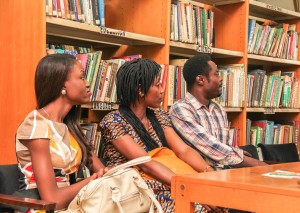 Story Two. The main character in the film, a woman experienced violence from childhood through adulthood. The film is in fact this character’s narration, of her experience, of the different lessons that women should learn. First lesson: as a woman, never respond. Second lesson: never out on a man. Third lesson: as a woman, you never struggle. Take everything lying low. Fourth lesson: As a woman, you should never grow too big. Never let your career grow big enough to shrink your husband’s balls. These lessons are from the book of society.
 “How many of you are willing to be accused of asking a married woman to leave her husband’s house?” She asked as she buttressed her point on the challenge that comes with change.
 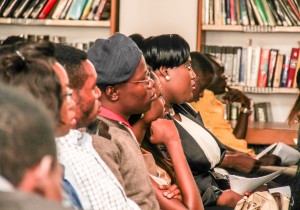 Edem Ossai emphasised the role of the society. It is not only in marriages. Teachers are abusing students. House girls are abusing house boys. Fathers are abusing their daughters. Rather than deal with the issues, we blame the victim and ask, in case of sexual abuse: what was she doing there? What was she wearing? Failure of the law at punishing violence in the Nigerian society also makes abuse thrive. “If you have to run to a judge who himself is an abuser, what do you do?” Ossai stressed the importance of parents being more watchful when raising their children; it is important to raise children who respect all human beings, male and female.