Browsing the archives for the Linguistics category.

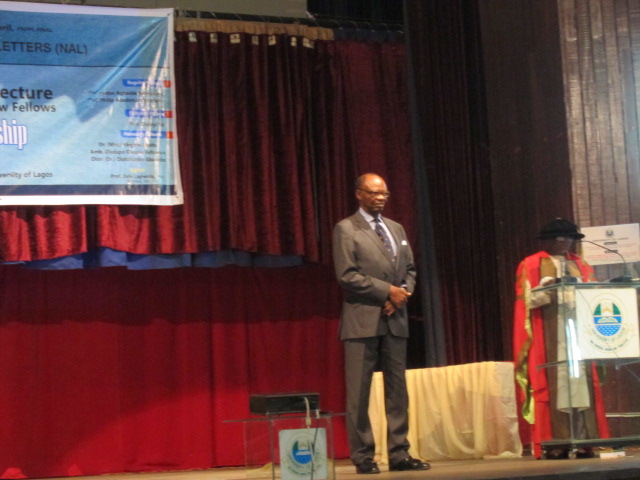
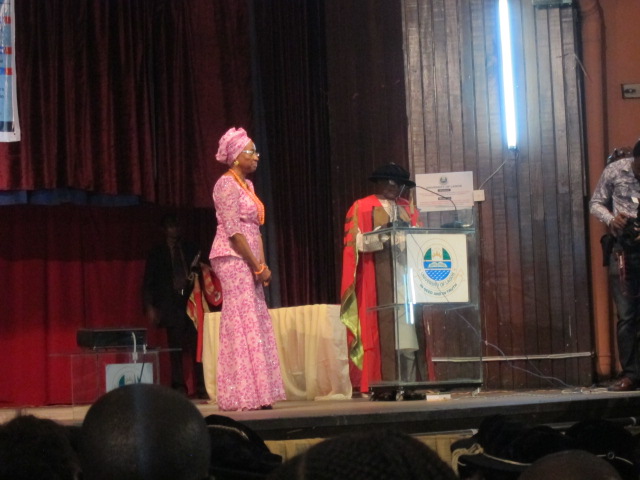
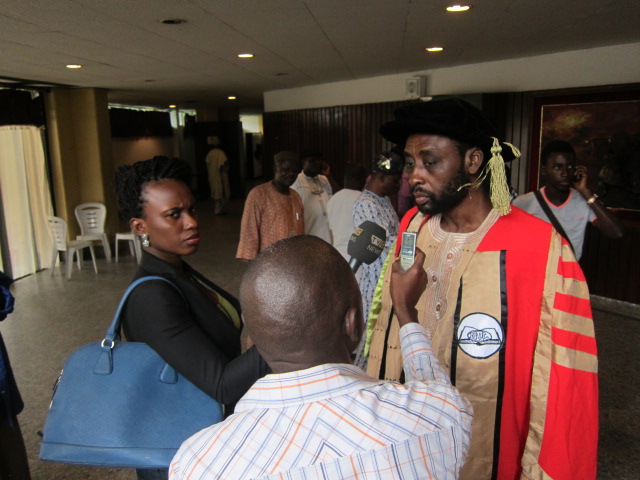
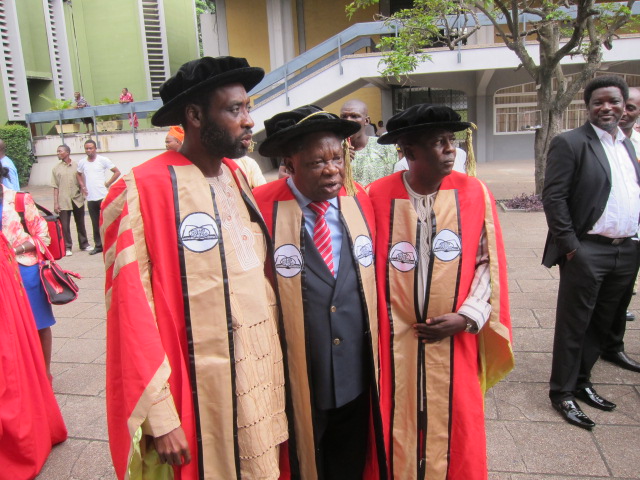
At NAL’s Convocation and Investiture

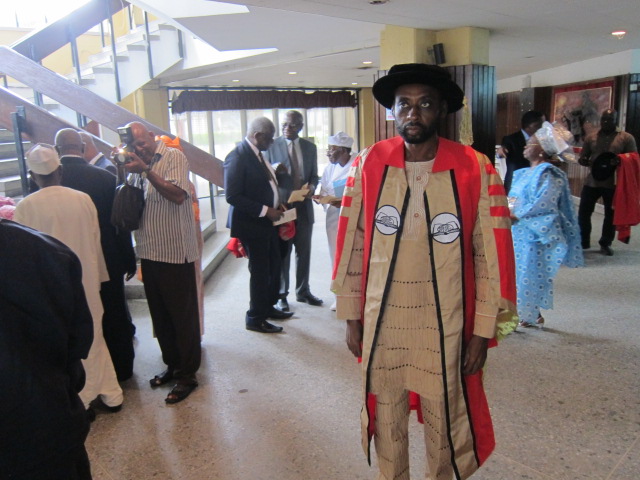
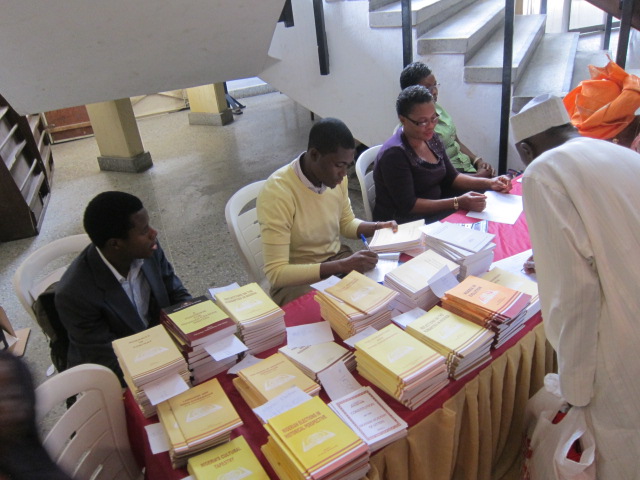
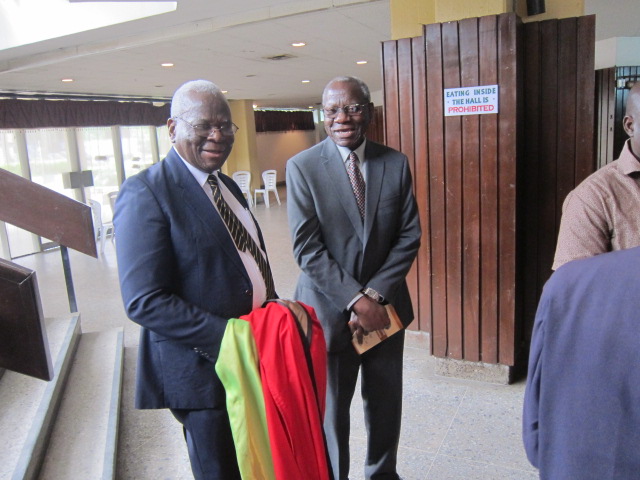
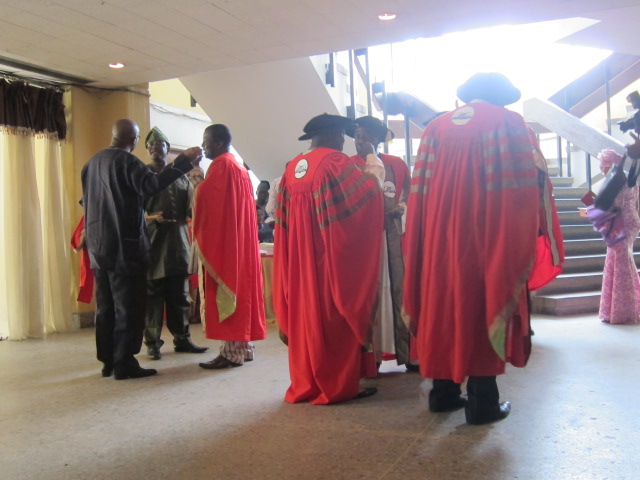
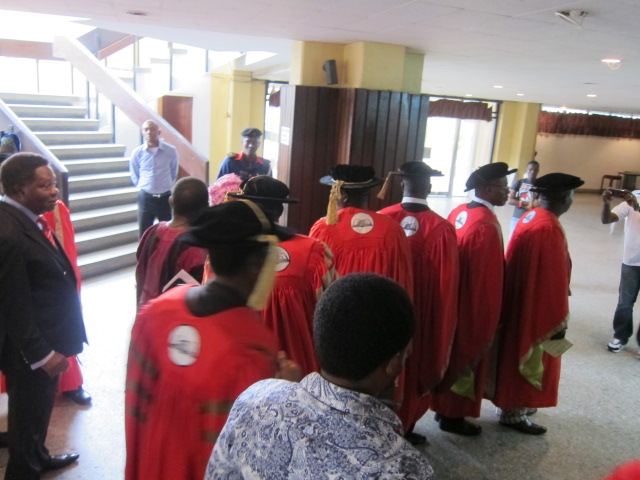
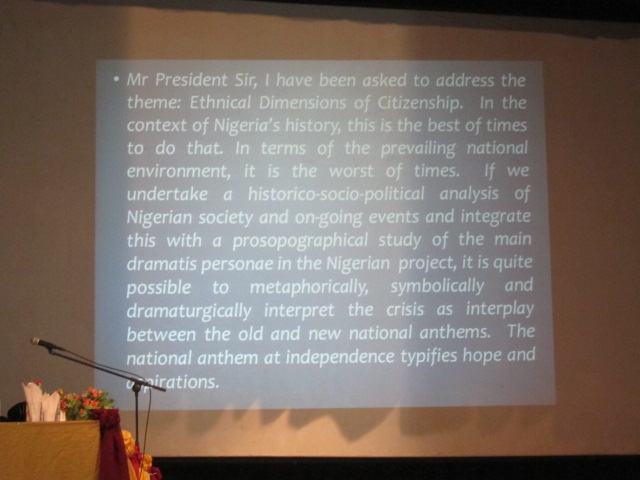
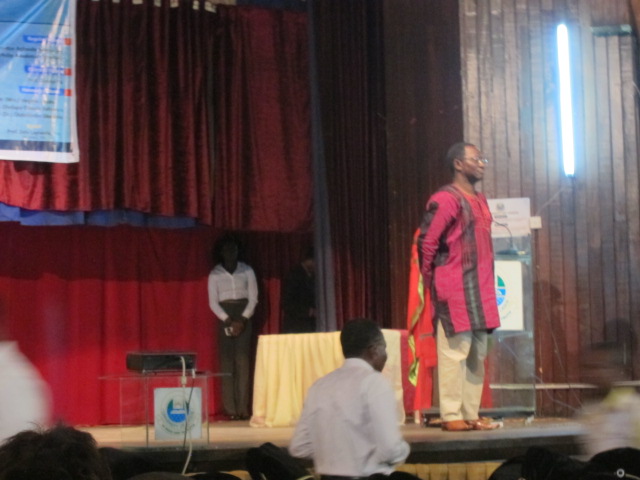
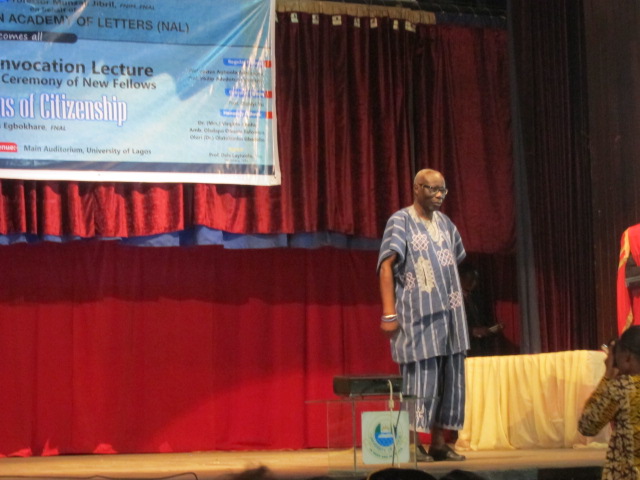
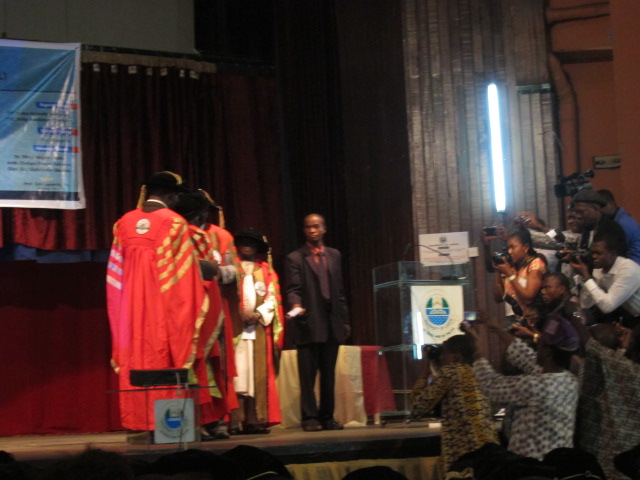
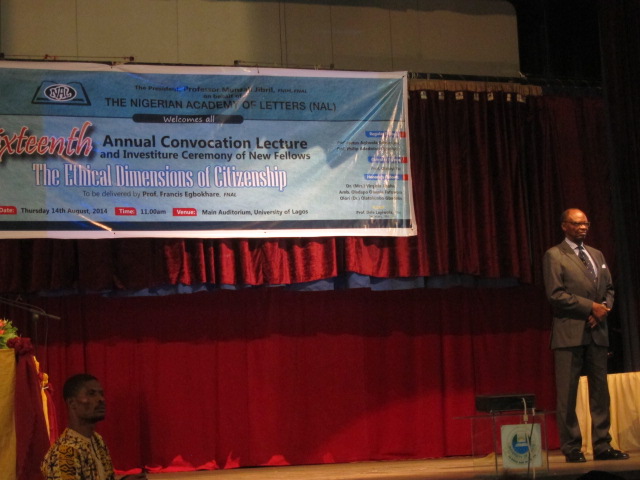
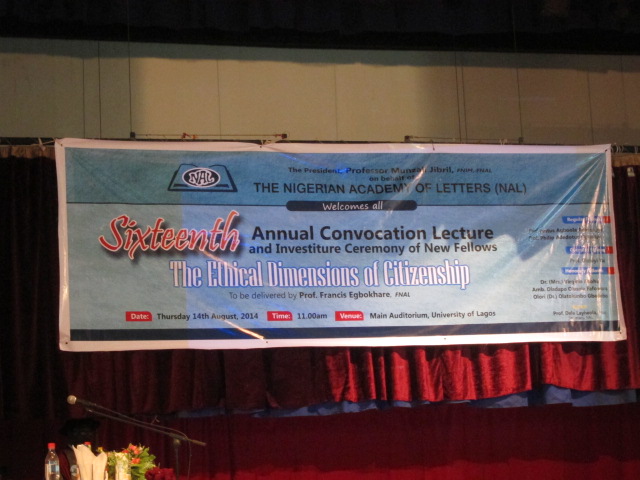
IMG_2850 IMG_2851 IMG_2854 IMG_2862 IMG_2868 IMG_2869 IMG_2873 IMG_2879 IMG_2882 IMG_2883 IMG_2884 IMG_2885 IMG_2886 IMG_2887 IMG_2888 IMG_2892 IMG_2899 IMG_2900Today at the main auditorium of the University of Lagos, the Nigerian Academy of Letters (an elite organisation of the most prestigious professors in liberal arts, language, and linguistics, at the top of their field), had its Sixteenth Convocation and Investiture of New Fellows. The Convocation speech was delivered by Professor Francis Egbokhare, in a speech titled “The Second Pledge: The Ethical Dimensions of Citizenship and the Challenges of Nation Building“.

The new fellows into the organisation were Professor. Festus Agboola Adesanoye and Professor Philip Adedotun Ogundeji, as Regular Fellows; Professor Olabiyi Yai, as an Overseas Fellow; and Dr. (Mrs.) Virginia Anohu, Ambassador Oladapo Olusola Fafowora and Olori (Dr.) Olatokunbo Gbadebo as Honorary Fellows. The oration was read by Professor Olu Obafemi, while the programme was moderated by Professor Dele Layiwola, the secretary of NAL.

NAL was founded in Ibadan on 14 November, 1991, with Professors Ayo Bamgbose, Chinua Achebe, J.F. Ade-Ajayi, A.E. Afigbo, Adeboye Babalola, J.P.Clark-Bekederemo and Wole Soyinka as founding fellows. It was founded as an apex organization of Nigerian academics and scholars in the Humanities to promote, maintain and encourage excellence in all branches of humanistic studies.

Aside: Of the founding fellows, only three of them are still living. Today, a moment of silence was held in honour of a recently departed foundation fellow, Professor Emeritus J.F. Ade-Ajayi, NNOM who died on August 11, 2014.


The Nigerian Constitution in Yoruba

The document, originally ratified in 1999 on the exit of the military, has been available only in English until now.

The Change Movement – a volunteer social and political organization dedicated to the promotion of “participatory democracy, open governance, open budgeting, accountability and citizens’ participation in Nigeria” just translated the Nigerian constitution into Yoruba and is looking for volunteers to translate it further into all the other major (and minor) Nigerian languages.

It can be downloaded on this page, where other information about the group and effort is also listed.

What is Your Name? Video and Dance

Here is a beautiful video by Femi Kayode Amogunla on names and contemporary attacks against it by ignorance and amnesia. Also, poetry, drums, and dance.

Read more about the artist here.

Check Yourself! Introducing a Homophone Checker

My friend, Jason Braun, has launched the world’s first free Homophone Checker app at  Homophonecheck.com!

According to the press release, it is a free web app that allows writers to quickly proofread for errors that word-processing software typically skips over.

homophone-2

“Writers copy text and paste it into the homophone checker. Then 40 of the most commonly confused homophones–words that sound the same but are spelled differently– are highlighted automatically. When writers move their cursor over the highlighted homophones, a box pops up showing each possible word, its part of speech, and a grammatically correct example sentence.”

Blogger’s comment: So far, the software only checks 40 commonly misspelt English homophones, which makes the app targeted mostly at a specific level of writing. It is a wonderful start. Also, rather than bemoan the problems of English language usage nowadays that makes this software inevitable and invaluable, I’ll celebrate its presence and its ability to makes essay writing easier (especially for high school or undergraduate students too distracted by other things to proofread their work right). Of course it will eventually take a smart writer to properly use a software that merely points one to where one might want to take a second look in an essay. Like every spell-checker, the work will still come back to the writer to be sure of exactly what they intend to write. As a piece of utility however, it is a brilliant invention and a good start. I love it. 

378172_4306321257743_1262440586_nJason Braun currently teaches English and is the Associate Editor of Sou’wester at Southern Illinois University Edwardsville. He hosts “Literature for the Halibut” a weekly hour-long literary program on KDHX 88.1. He has published fiction, poetry, reported or been featured in The Riverfont Times, Prime Number, ESPN.com, Big Bridge, Sou’wester, The Evergreen Review, SOFTBLOW, The Nashville City Paper, Jane Freidman’s blog, and many more. His Paradise Lost Office App contextualizes John Milton’s epic poem for the cubicle crowd and is available at iTunes. He releases music under the moniker Jason and the Beast. He is a member of the National Council of Teachers of English (NCTE) and the Learning Disability Association of America (LDA).

WALC2013 – Call for Papers

logo-redDespite years of scholarly research a large percentage of the indigenous languages of West Africa have not been documented. Several of the languages are at the risk of being lost. Greater attention to diversity, environment and sustainability in the global discourse has not reflected much in terms of support for and development of indigenous languages. Although there is a heightened sense of activities and activism for language documentation, there has been no commensurate attention to the very important aspects of description, development, modernization and integration of local (West African) languages with global information infrastructure. This appears to be leading us once more to the ideological issue of resource exploitation. The critical question remains, how do we make West African Languages relevant and work for those who speak them? We are once more forced to rethink the role of the linguist and interrogate West African Languages Curricula in the face of emerging realities. The task of language documentation is particularly necessary so as to plan the future with the past, since information/ facts derived from such efforts can have positive impact on current and future linguistic endeavours.

The aim of the conference is to explore the different perspectives from which language studies reflects or impacts on the different aspects of human endeavour. In addition it seeks to foreground the various areas in which language and linguistics interface with diverse capacities and disciplines. Given the current realities of modern human life it seems increasingly compelling for Linguists to find common grounds with other disciplines while emphasizing language as a core human capacity. The conference brings together researchers and students in the various fields of language studies as well as aspects of professional life in which indigenous languages play a part. This is expected to motivate an exchange of ideas and promote discussions of, progress in and development of these areas in West African languages. We hope that through the conference participants will be able to consider the issue of sustainability in research and practice.
The sub themes of the conference include (but are not limited to):

  • Language Typologies
  • Morphology and Syntax
  • Phonetics and Phonology
  • Semantics, Pragmatics and Discourse
  • Language shift, maintenance and documentation
  • Language and education
  • Language policy and language management
  • Language, the media and ICT
  • Language and the community
  • Language and industry
  • Language and medicine
  • Language and governance
  • Language and Business
  • Language and Law
  • Language and poverty
  • Language and migration
  • Cross-border languages and regional cooperation
  • Cognitive corpus linguistics and Corpus-based computational linguistics
  • Language competition: Ex-colonial languages vs. indigenous West African languages
  • Literature, film and popular culture
  • Language, gender and power
  • Language, identity, culture and translation
  • Language, Peace and Conflict

Participants are invited to submit abstracts dealing with any of the sub themes and other related areas. They can be up to a maximum of 300 words long. It must be typed in a 12– point font and in both word and pdf file formats. Deadline for the submission of abstracts has been extended from 31 March, 2013 to 30 May, 2013.

Individuals and organizations who would like to present demos and organize workshops/special events should contact the LOC Secretary, Dr Oye Taiwo, Department of Linguistics and African Languages, University of Ibadan, Ibadan, Nigeria through the e- mail address: oyepaultaiwo@gmail.com.

Abstracts can be submitted through the following e-mail addresses: tayolamidi@yahoo.com.  (Chairman, Abstract sub-committee: Dr Tayo Lamidi);oyepaultaiwo@gmail.com (Secretary, LOC: Dr Oye Taiwo)

More information can be obtained on the conference homepage at www.walc2013.com, the twitter page @WALC2013 and the Conference’s Facebook Page.