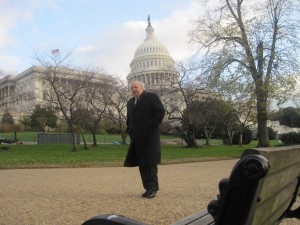
 The first thing I did after checking into the Hyatt hotel and finding out that the registration for the conference will take place much later in the evening, and that I had more than three idle hours to burn, was to pick up a map of the capital, and set out to discover it, on foot. Because of the so many American movies I have seen I had a certain confidence that I knew just where everything was located. The Capitol, a magnificent Dome that houses the two houses of the United States Legislature stood just a stone throw from the Hotel, so it was the obvious first choice. The first thing that I noticed was the not so adequate number of traffic lights. The traffic lights were indeed different in design from the ones I’m familiar with at Edwardsville, but they were not enough. Some times, I just had to cross the road the Nigerian style – after looking left, right, left and right again – when there was no light to guide.
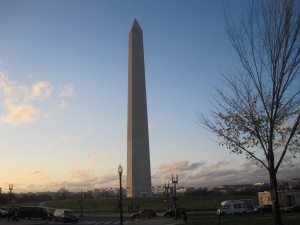 After I left the Capitol, whose interior I could not access only because it had closed to the public just a few minutes earlier, I headed to the Washington Monument. The Washington Monument is a brick obelisk structure built to commemorate the life of the city’s founding father President George Washington. Just like the Capitol, the Washington Monument was closed to the public, or I would have loved to go up to its top if there was such a chance, and look down on the city. According to Wikipedia, it is is both the world’s tallest stone structure and the world’s tallest obelisk, standing 555 feet 5⅛ inches, and representing the dead president’s overlooking eyes over his capital.
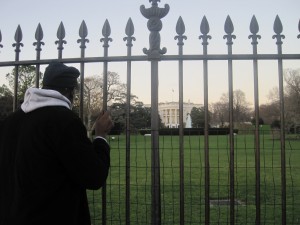 From the Washington Monument, I had two choices: The White House or the Lincoln Memorial, both of them almost equidistant from the Washington Monument. I chose The White House first. The long walk across public parks and winding roads to the White House took almost twenty minutes, only because I walked fast without stopping even for air. It was beginning to get dark. I got there in time, peeped through the black iron gates to look at First Lady Michelle’s garden project pictures displayed within reach inside. I could see the South Lawn fountain at a stone throw in front of me. on the second floor of the side of the building facing where I stood was also the Oval Office, where the president spends most of his office time. I was indeed looking at the magnificent mansion in which most of the world’s most important decisions were reached. I have never seen the State House of Nigeria. I don’t know what it looks like, nor do I know where exactly it is located.
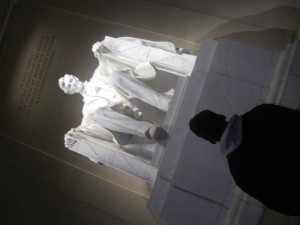 I then went, still on foot, towards the Lincoln Memorial – the site of the now famous “I Have A Dream” speech. It comprises of a small building which houses a larger than life marble sculpture of President Abraham Lincoln staring out towards the Obelisk of the Washington Monument. Actually, between the Washington Monument and the Lincoln Memorial is a long Reflecting Pool around which hundreds of thousands of supporters and civil right activists stood and sat while Reverend Martin Luther King Jnr read his speech. Looking at the sculpture of the late president did not fail to humble and inspire. On the walls to either of his hands were inscriptions from Abraham Lincoln’s famous speeches, and right behind the large marble sculpture are the words: “In this temple, as in the hearts of the people for whom he saved the union, the memory of Abraham Lincoln is enshrined forever.” Those words, along with the ones on the wall, bring a kind of solemnity and awe to the already hallowed feel of the memorial, and I left feeling quite inspired, especially when I think of the fact that on those same steps out of the building was where the words “I have a dream” were first uttered in a way that sowed a seed of hope whose result is now being felt all over the United States.
The walk back to the Hyatt was not easy nor short, but the sense of fulfillment and enlightenment from the trip gave me a lift that I would never trade for the world.
NOTE: More pictures coming soon
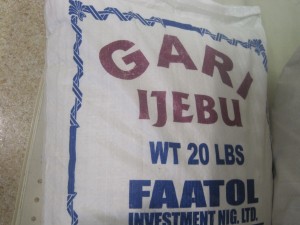 It was just as well a case of serendipity, because when I went out
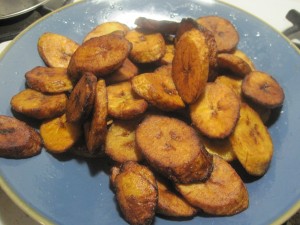
 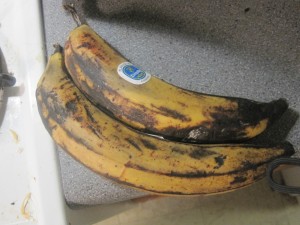 It was serendipity because just last week, the class consensus was an almost riotous but endearing request for Nigerian food before the end of the course. And as much as I tried to dodge the issue citing inability to get the foodstuff as well as the problem of conveying it to class in hot condition, I still wanted to give them an experience of the taste of Nigerian food and I despaired in me about how impossible it was going to be, especially since I feared a possible lawsuit from anyone that might find discomfort after a meal, and hold the teacher – me – responsible. But they made it clear that they wanted it too, so I spoke with Tola – a former FLTA (now a graduate student in the University) who said that we could work something out only if I could find the foodstuffs, and perhaps obtain a written consent from them absolving us of liability. It would prove not to be necessary in the end, as I luckily got sufficient plantain from the African shop, and woke up early enough today to prepare it to the best of ktravula‘s kitchen standards.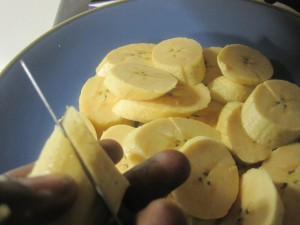
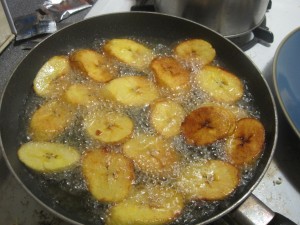
 With this, my teaching class for this semester has now come to an end. The class that

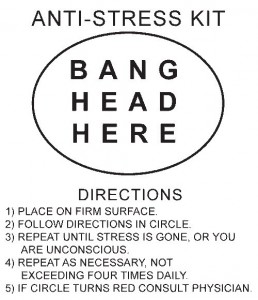
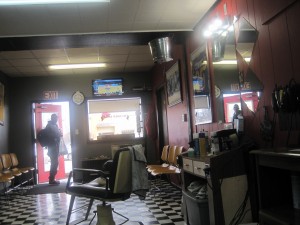 I will be the first to admit that the cliché of the “Barber’s Shop” experience topped my list of reasons to go and get a haircut yesterday downtown Edwardsville. You see, I’m one of those less-than-hairy folks who, even in the farther side of twenties, still has a shrub for beard, and even less – just a few strands of hair – for moustache. It has at least saved me the expense of large combs and shaving sticks, and I’ve delighted in being almost perpetually clean-shaven. In the case of this travel, it has so far saved me the ordeal of a regular haircut, and my three month-old head of hair still looked like one cut just a few weeks ago.