Browsing the archives for the adventures category.

Testimony Time

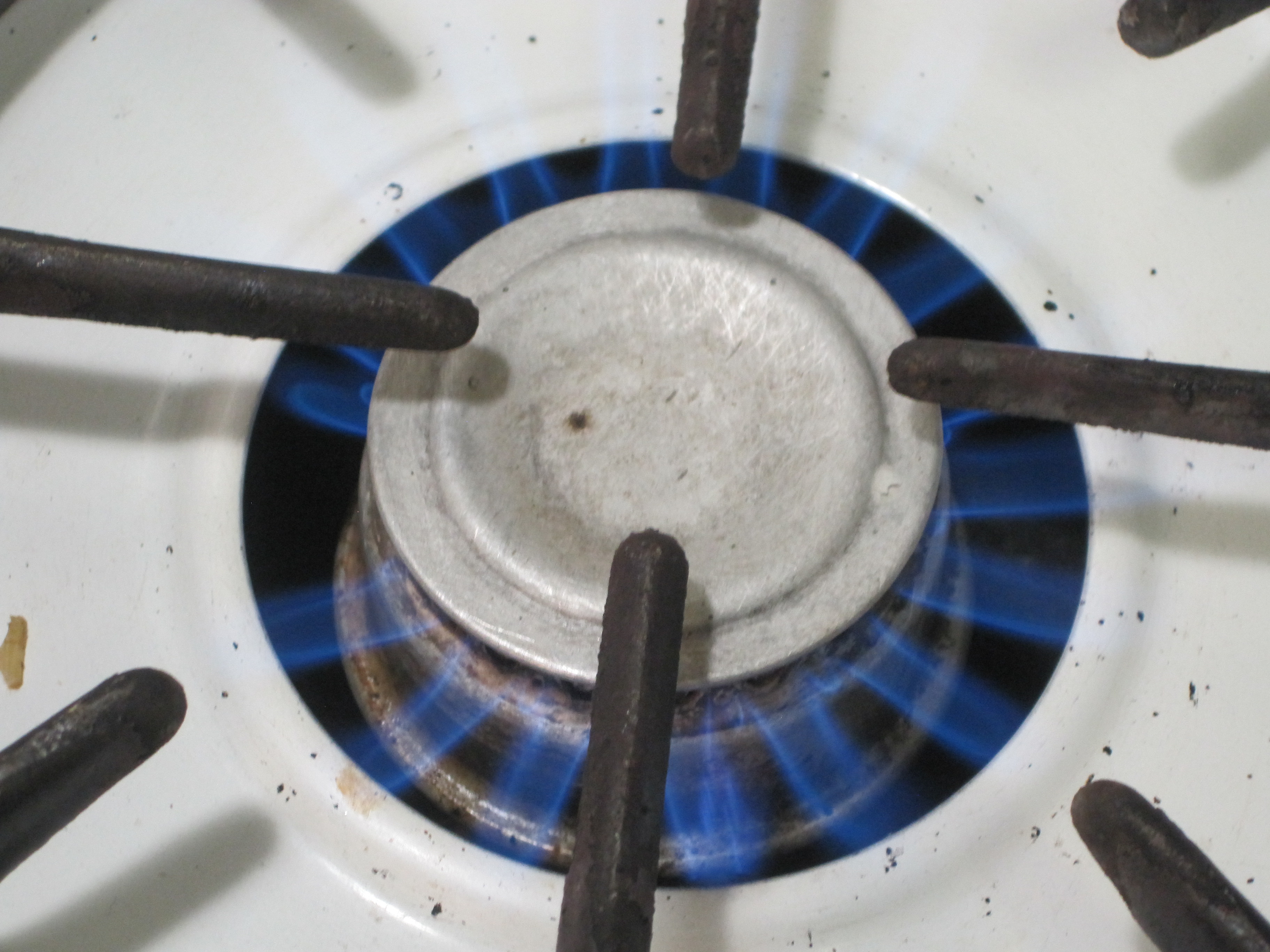
There is a reason why I usually never leave the kitchen whenever I am cooking there: I do not want to burn down the house by forgetting a pot of food on the hot cooking gas while I’m in my room reading or writing. I know myself. I think I have a very short attention span when it doesn’t have to do with something mentally stimulating. Food tops that list, and I have had to go hungry so many times because I would rather watch a movie, read an article or just stay in one spot thinking of the next mischief.

So on getting back from a long day of school yesterday, I didn’t bother to take off my back pack. I just went into the kitchen and started making pasta and soup on two of the four gas cookers there. In twenty minutes, I was done and the food was sizzling hot on the plate. But instead of sitting down in the living room to eat,  I headed into my room, but not before putting the almost empty pot back on the gas cooker, and turning the knob to be sure that I had put off the fire and the gas.

Two minutes later, while in my room, and about to settle into my comfort zone of work, I became uncomfortable because I wasn’t sure whether or not I had refilled the water bottle in the fridge, so I dropped my food and the laptop, and went there just to be sure, only to find that the half empty pot of pasta was still on a burning hot cooker, almost burning itself out from excessive heat. What? I thought I switched this off. Apparently, I had turned it the wrong way, and instead of shutting off the fire, had only turned it up. Sigh. I then switched it off for good, refilled my water bottle, and went back indoors to enjoy my meal and work. It would have been a very fiery day in Cougar Village, and I can already imagine the headline: “Curious Foreign Language SKolar Roasts Self in Building Fire.”

That didn’t happen, and thus my testimony. Praise the Lord! Halleluyah! Amen!.

Offering time…!
The Year of the Tiger

I’m beginning to consider the possibility that I might have been Chinese in my former life. The more I think about it, the more I remember instances in which the Chinese people, or the Chinese language has revolved around me. One of my favourite FLTAs at our orientation in Providence, Rhode Island was Chinese, and she taught me to write my name and my country in Chinese, and I’d given up of ever having such a chance again.

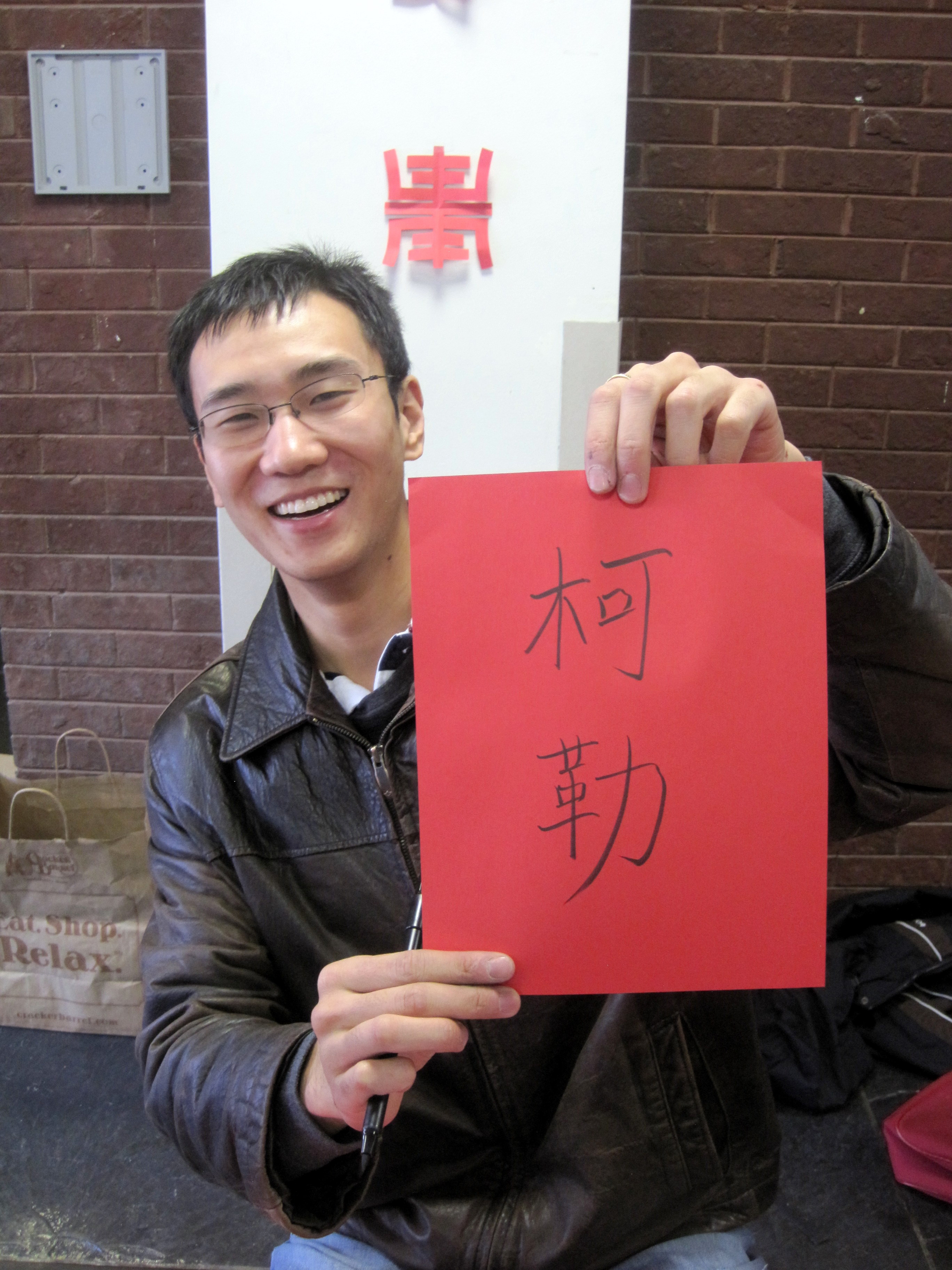
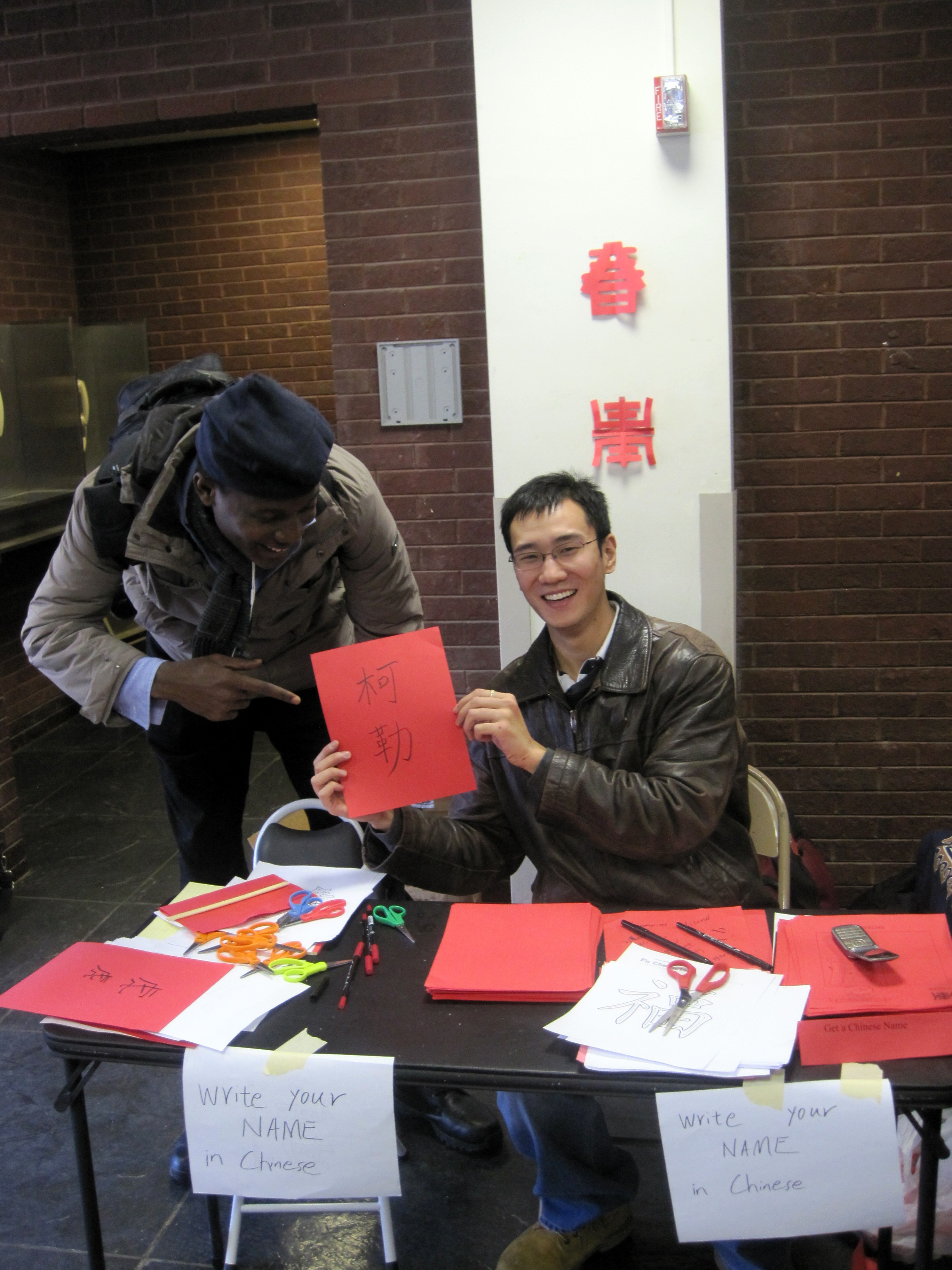
But today, I had another chance or reunion with my adopted spiritual home in the continuation of the events marking the “Discover Languages Month”. Last week was Yoruba. this week is the celebration of the Chinese new year, called The Year of the Tiger, and the student of Chinese had come out to exhibit their skills and knowledge of the language. Supervising the event was none other than Professor Lavalle, the teacher of Chinese language and literature whom I’d blogged about a few days ago. As special attraction, there were marshmallows and chopsticks, and interested competitors can win one of several Chinese toys and artifacts if they could only hold the chopsticks right and move the marshmallows from one bowl into another.

"My name is Chinese Kola"

I had never had marshmallows before, so it was nice that I showed up. Afterwards, after devouring them all, with my hands – of course, I began to wonder why it was sooo sweet in the mouth. I also had dates, which were nice, and then a fortune cookie which predicted that I was about to become $8 poorer. Tell me what kind of a “fortune” cookie is that? Later, I walked up to the stand where calligraphy was being exhibited, and I had my name written, again, in Chinese. I can’t read it now, but I believe the Chinese guy who wrote it. And Prof Lavalle was there. I believe that he would have told me if it was wrong. More than that, I also confirmed that I had not forgotten the few words of Chinese that I know: Ni hau for “hello” and Shi-shi for “thank you. When next I get free time, I think I will be making a trip to Beijing.

If it helps, Chinese is a tonal language, just like Yoruba. Professor Lavalle had also told me on our first meeting that what he read of my poems reminded him of Chinese poetry, as opposed to the prosy and “confessive” nature of American poems. It is supposed to make me feel better, I guess, that my peripatetic spirit has now has more links to the Orients than I like to acknowledge?

Maybe this is why I like Jackie Chan so much. Blood is so thicker than water. 🙂

Culture Shock

This is a guest-post by my cool and brilliant colleague Professor of Spanish language and literature who also blogs as Clarissa on issues of feminism, literature, journalism , immigration, politics, and her love for the Kindle. 🙂 Originally from Ukraine, she migrated to Canada, and she got her PhD at Yale University in the United States. She has recently taught at Cornell University before coming over to our prestigious SI University. Hers is the first in a series of guest blogposts coming on this blog in the coming weeks. Thank you Clarissa for the post. Find her blog here.

____________________________________________________________________

When I was 22, I emigrated from Ukraine to Canada. I was fully prepared to experience a massive culture shock but none came. Sure, it took some time to get used to the idea of a credit card and a check-book, realize that a bus driver doesn’t give out change and there is no need to negotiate the price of a ride with the cab-driver before getting into the cab, and figure out why maple syrup can be poured on bacon and eggs. The process of learning these small things was really fun and caused me no shock whatsoever.
Five years later I decided to go to graduate school in the United States. Having lived in North America for a while, watching American TV and reading American books and newspapers, I expected even less of a culture shock on this change of residence. I was only moving to Connecticut, where the climate and the way of life were supposed to be pretty similar to what I had gotten used to in Canada.

Boy, was I ever wrong. A massive culture shock hit me immediately after crossing the US border and remained with me for years to come. It took time and effort to understand this new reality, learn to like, and eventually even love it.

I the US I discovered a deeply divided society. Glaring class inequalities, the likes of which I never saw back in Canada, racism, religious fanaticism, gender inequalities, economically devastated areas with the kind of poverty I never saw even back in Ukraine, crime, violence, inept governmental strcutures. All this was very different from the US I had seen in movies and TV shows.

But soon I also discovered that yet another US exists. The country of intellectuals, thinkers, artists. The country of hard-working, kind, generous people, who have not abandoned the struggle for the perfect society they inherited from their founders. The country of intellectually curious people. The country of people who hate injustice and inequality. The country that deserves better than the corrupt structures governing them.

When people read the very critical things I write about the US on my blog, they sometimes ask me, “Why do you live in this country if you dislike it so much?”. But I ask, does hating injustice and inequality mean hating America? Or is it just the opposite?

______________________________

I love Clarissa’s blog because of the way she looks at the world. Even though she hasn’t called it that, her blog is a travelogue of sorts as well – a response to the American society from the viewpoint of an immigrant. And as expected of someone of her level of brilliance, she doesn’t suffer fools gladly, and she says what’s in her mind no matter whose ox is gored. I particularly like the way she responds to the people who make foolish or hateful comments on her blog. I wish I could be that quick-witted sometimes. 🙂

Guest Bloggers Welcome

Over the coming weeks, and perhaps for a longer while to come, I will be featuring Guest-Bloggers on this blog. I’ve had the idea for a while now of inviting my favourite bloggers, commenters, or just plain readers to make blog posts here about what concerns them. I like the idea of such interaction of ideas and opinions, and I hope that it will also open up new audiences both for ktravula.com and those bloggers and writers whose writing gets featured. If you are interested in being a guest-blogger on ktravula.com, let me know, send me a mail at kt@ktravula.com and surprise me with your subject of choice. There are no boundaries, I think. 🙂

On the flip side, I am guest-writing for a few blogs I like as well, so all invitations are in order. I would like to write one blogpost for any blogger who asks me to, and the topic would be any of my choice, but mostly along the ideas that I believe the readers of that blog would likely appreciate or respond to. Yesterday was my first guest-writing post, and it is was published on Clarissa’s Blog, entitled “Barking in a Foreign Language”.

The Yoruba Talking Drum

I made this video during the cultural awareness week on the campus of the University of Ibadan in May 2009. The talking drum is a uniquely Yoruba percussion instrument that is peculiar because of its ability to mimic tonal patterns of actual human speech. In this video, I tried to engage the drummer in a little competition of abilities; he on the skill of drumming, and I on the skill of discerning. Enjoy.

I showed it to students in class today, along with some music videos of Lagbaja, once again to illustrate the blend of tradition and modernity in Nigerian contemporary music. I had a reaction to his appearance almost in a similar form to the one I had the first time I showed him in class. My students are supposedly aware of the concept of the masquerade, but apparently, not in this particular shape and form. Let me get back to you after the Mardi Gras, and I’ll let you know what I learn about how American masquerades really look like. I’m guessing that they are not as elaborate, or as “scary”. We also learnt about the concept of Abiku, how different it is from the scientifically verifiable child mortality, and how many children often used it as a weapon against abusive parents.