Browsing the archives for the Academic category.

Schwartzfahrer

This 10-min short video by Pepe Danquart won an Oscar in 1994 for its portrayal of a particular aspect of everyday Germany. I caught Yvonne, my colleague at the office and German professor, watching it last week and I joined her. I enjoyed it, laughing my head off at the end. You should too. The dialogue is in German, but it is subtitled.

The title Schwartzfahrer in German means “Black Rider”, which originally referred to those who board public transportation without tickets, particularly the foreigners.

Short Observations from Class

  • Most students tended to make hasty generalizations from what they read. The book A Mouth Sweeter Than Salt had very many interesting stories from the perspective of the then young and uneducated Toyin Falola and his upbringing, but most who read it tended to think that his story was true for everyone else, e.g. people not remembering their date of birth. This happened last semester as well. Maybe we should bring Chimamanda back.
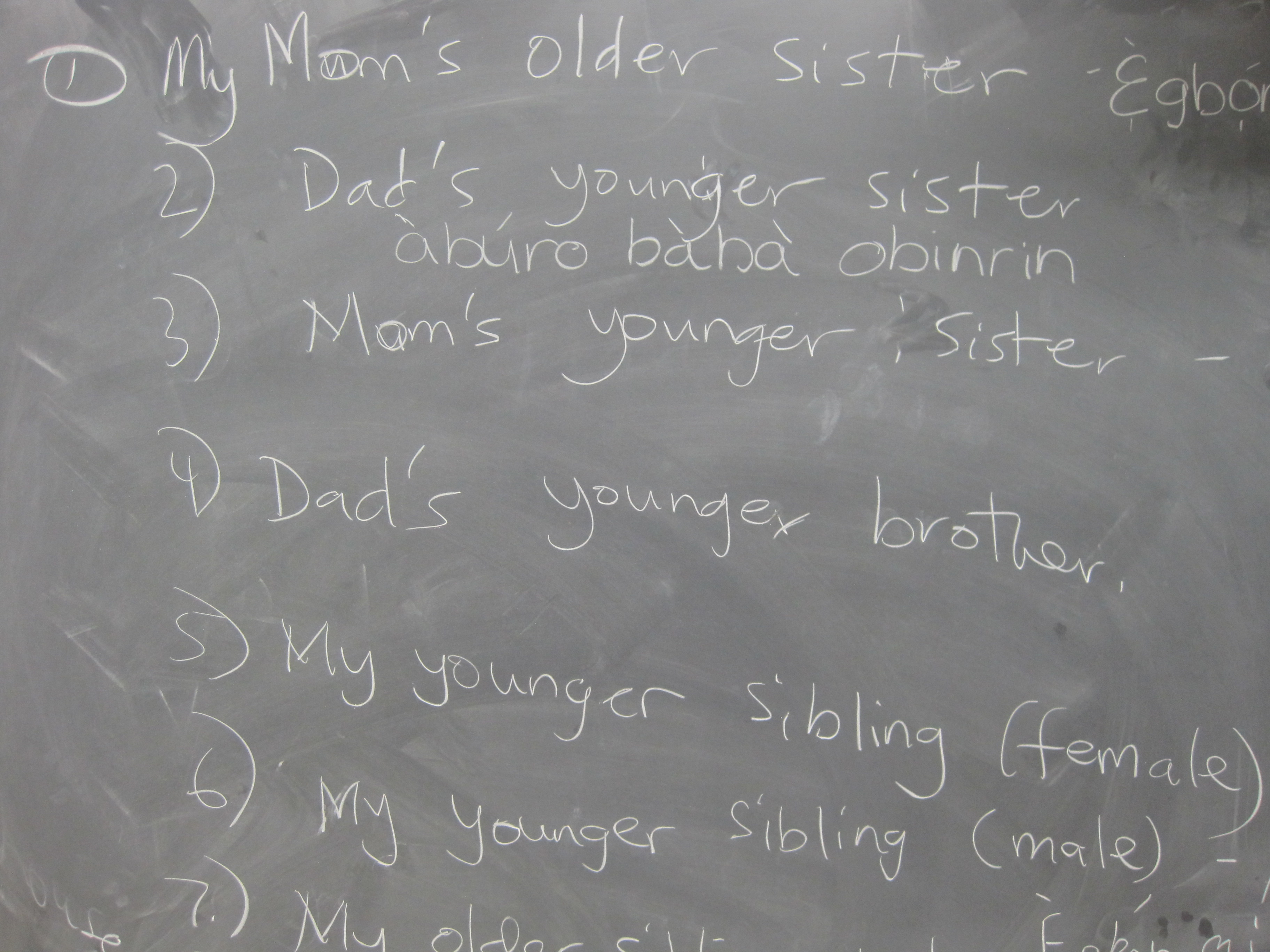
  • Americans wrote the shortened form of the English word for mother as “Mom” instead of “Mum” as I have been used to. I didn’t know this before. I’ve always written it as Mum, until someone from class gently corrected me after I wrote it on the blackboard. Then I gently corrected her too, and voiced my reluctance to ever adapt to American English. They found it amusing.
  • One of my students said on Monday after submitting an assignment to write a summary of the life of Wole Soyinka that his mother had met the Nigerian Nobel Laureatte once before, and found him to be brilliant. “Cool,” I said.
  • Many students used Yoruban whenever they used Yoruba as an adjective in an English sentence, rather than the usual Yoruba, e.g Yoruban boy, Yoruban culture, instead of Yoruba culture. Yoruba boy etc. I noticed this in the scripts of my Fall semester students last year as well. Do British English people make this generalization as well?

For All You Pandorans

What impressed me most about the blockbuster movie Avatar is, surprisingly, not the amazing 3D animation, which nevertheless blew my mind as it did everyone else. After a while though, my eyes got used to the 3D effect; the novelty didn’t last long. It was not even the utterly patronizing storyline featuring a White Messiah coming from an advanced civilization to save a tribe of nature-oriented locals by undergoing a change and becoming one of them. How could that have impressed anyone? The storyline was predictable after a while as just another typical action movie with love thrown in, except with the twist of a White Messiah which we have seen in a few other movies like “A Man Called Horse,” (which is said to have started the pattern), and “At Play in the Fields of the Lord.” What about “Dances With Wolves” or “The Last Samurai”, “Pocahontas” and “FernGully.”?

No, what I was most impressed with was the Na’vi language of the movie, which I’ve now discovered was totally made up. Now that’s creativity. Of course, from the time I saw the movie last week, I knew that I was watching a totally made up language, and this is not a slight on the movie but common sense. It would be foolhardy to expect a White director to put a real world language in the mouth of a made up tribe of “primitive” aliens, especially in the age of political correctness. But I wasn’t reallysure until I confirmed today on Wikipedia. Here’s what it had to say:

From January to April 2006, Cameron worked on the script and developed a culture for the Na’vi. Their language was created by Dr. Paul Frommer, a linguist at USC. The Na’vi language has a vocabulary of about 1000 words, with some 30 added by Cameron. The tongue’s phonemes include ejective consonants (such as the “kx” in “skxawng”) that are found in the Amharic language of Ethiopia, and the initial “ng” that Cameron may have taken from New Zealand Māori.

As a linguist, this fact tickled me to no end, and it should tickle you too. Click on the Na’vi language link on Wikipedia to see the form and phonology of the Na’vi language, developed solely for a movie. This is how to make a movie. This is one of the qualities of great artworks – the attention to detail, and the lengths to which artists go to make their work authentic. All the actors in the movie had to spend quality time learning to speak this totally made-up language, and master its nuances of speech – at least, its accepted speech patterns. The last time I was this impressed with movie language was after seeing Mel Gibson’s Passion of the Christ in which the actors spoke old Aramaic and Latin, two altogether dead languages that are no longer spoken by any group of living people (except the Catholic church, and scientists, for Latin, and a very small group of people, for Aramaic). So this is what makes Avatar great, and not the patronizing earth-saving story of the renegade crippled-White-Marine-who-falls-in-love-with-native sentimental crap. And the movie is darn too long!

What Else Is New?

Q: How do I prepare for teaching class, usually?

A: I don’t.
Well, that’s not true, technically. It’s just a short response. I spend all waking hours, especially at weekends usually mentally mapping the format of the next class that by the time it’s Saturday evening, I’m in an almost panic mode, worrying whether I’ve done enough even though I’ve been noting things down and recalling examples that could help pass the messages across better. But I don’t study much just for the class. I follow relevant links that I find online or offline, and I follow up on new and old leads. Yesterday I looked through the first chapters of Je Ká Ka Yoruba, the text for the language teaching again, and tried to see if there was something there that I hadn’t seen before or taught before. I needed to cover much of the weekly syllabus because of the Martin Luther King holiday that fell on Monday, effectively reducing my week by half.

Before I went to bed at 3am on Sunday night, I managed to read the first chapter of A Mouth Sweeter Than Salt for the very first time in one sitting. Last semester, I had only just glanced through that chapter because I had too much to read then. I got much of the ideas of it from the students’ summaries and what we discussed in class. Lazy, I know. But after reading it yesterday, I understood why anyone could be forgiven for trying to avoid reading it. For an avid reader, each sentence is a treasure of lore. It tells of some thing or the other that the author has either not talked about before earlier, or that he wants to say again in another way. I agree, the chapter could have been a little shorter, but you should read it. You should read it. It brings memories of things parents talk about. Reading it, I felt like I was listening to a seasoned elder speak of his childhood in a closely knit extended Yoruba family. If I could meet the writer, I would ask him too many questions. Or I would just sit at his feet, just listening to him talk. He is a good writer. He’s a good story teller too. Why is this book not read in Nigerian schools? Oh, I forgot, Wole Soyinka’s Ake has already taken control of that spot in autobiographical narratives in colonial and pre-colonial Nigeria. Their experiences are not the same, but they are similar, as I pointed out in class, lest they get the idea that everyone of us in Nigeria – just like this writer – do not know our exact date of birth. Alright, go and get the book, and read.

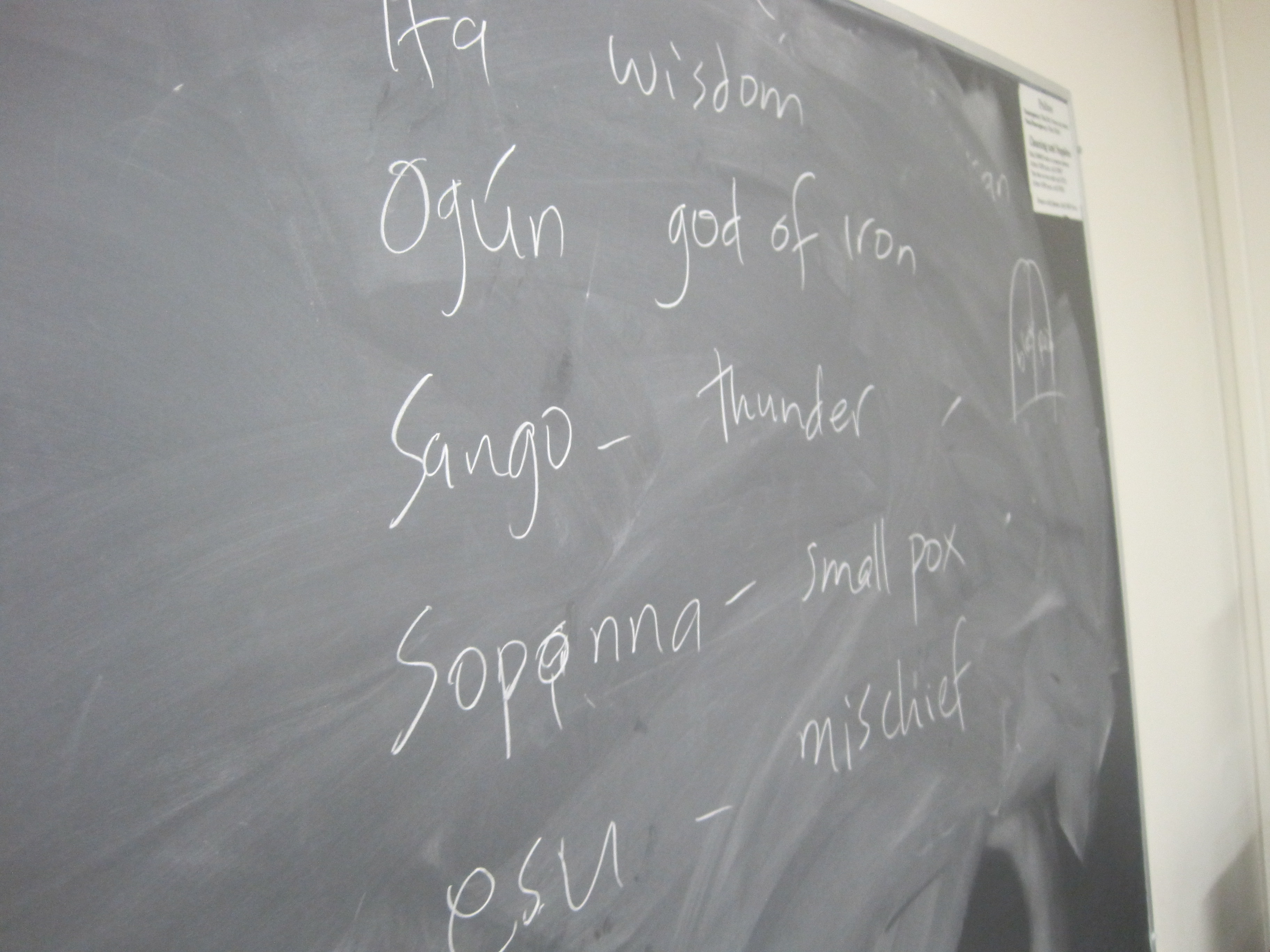
There is nothing new I want to tell you about today’s class. It stated on time and it ended on time. No other student has dropped off beside Gretchen who had dropped out after a first class. She left us for a class in Finance, so we’re nineteen now. Still, the textbooks are not sufficient. Many will have to share. We can’t complain. Now we can greet, introduce ourselves, respond in Yoruba and ask few introductory questions in Yoruba as well. It’s a start. These students are more agile, a little faster to learn than the last ones. I think. I could be wrong. They got the “kp” and “gb” far easily, for sure. Maybe it is because of the size of the class that gives this positive feeling and active participation. It is turning out to be a blessing after all. We may not be able to joke around as much as we did last semester, but we will try. I may find it harder to learn everyone’s names on time as I want to. It will take a while, but I’ll get there. Today we met esu, ifa, Obatala, and Sango. Next week, we’re meeting Wole Soyinka, and maybe later Suzanne Wenger. Maybe it’s not a bad idea to have such a large class. It feels warm enough. I love it.

I think that the most memorable thing I have found as a pattern is that I usually wake up early whenever I have to teach a class, notwithstanding when I go to bed. It’s a good thing. Maybe that’s why I’m tired on Thursdays…

Pete-Pete

It was inevitable that I would eventually blog about (my love for) this song. As at the last count on my iTunes, I have listened to it for a total 293 number of times in less than three days, after songs by Chris de burgh, Fela Kuti and Michael Jackson. That is no mean feat. I usually begin playing it in the morning, and keep it on reply throughout my work on the laptop till evening when I sleep, and then leave it on to lull me to sleep as well. This is only surprising if you take into account that I did not like the song at all the first time I heard it. I thought it was too slow. In hindsight, I now think that I it was who was too slow.

The song by two unique Nigerian singers 9ice and Asa is a classic. It is a solemn lamentation of the state of things. But where the song derives its greatness is not even in its political preoccupation but in its artistic triumph. Poetry of words and the rhythm of proverbs in the Yoruba culture is already a given. But merging it with the art of rhyming, which I believe is a fairly Western art concept, and coming out with a tune which is both melodious and deep is a great endeavour indeed. I will not even try to play this in class to my students because the poetry it contains is above them. (Heck, it’s above many of the people I know.) The real beauty of the track however is in the words, the message, the proverbs, and not in the perhaps equally moving rhythm of the instruments. For non-Yoruba speakers, I give you only the music. 🙂 Enjoy.

NOTE: The title pete-pete is taken from a Yoruba proverb that says that “As soon as pete-pete (a muddy water/liquid dirt) is beaten deliberately with a rod, you can never control whose clothes it soils.”