I believe in development.
 But many times, if you would ask me to tell you what exactly would be my indices of development, I might not immediately be able to point at much. (It would depend on where I am, won’t it?) But if you asked me about Nigeria, the first would definitely be a 24 hour power supply and a fast, reliable internet access. Then a repair of local fabric industries in Kaduna, a return of groundnut pyramids in Kano, cocoa farms in Ibadan and coal in Enugu.
But then if we had all of that, plus a higher life expectancy, healthy food for (almost) all, good healthcare and good social services, I’m pretty sure that we’ll still find something to complain about if we wanted it badly enough. Won’t we? There seems to be an inherent cynicism that never seems to go anywhere. We may start complaining that the neighbouring country seemed to be getting more action in the international scene and we want some of the action too. I bet that one of the reason why the first democratic dispensation was scuttled was that people still weren’t satisfied with the situation of the time even though they had better food, better education and better healthcare. This is not a Nigerian problem. It’s humanity’s.
However, I believe so much in the potential for development in Nigeria especially, and the tendency for things to get better if we talk about them often, commit ourselves into making them work, and helping to maintain current structures that already serve us well. But some times it seems pretty much like a futile effort with no light at the end of the tunnel. In the end, every drop of contribution will go a long way into producing a flood of results.
 I’m sounding like a politician or someone hoping to run for public office, right? I hope not, because behind the hope and optimism is a nagging skepticism. I’d just read the preface to George Carlin’s Brain Droppings again. George is an amazingly creative thinker whose ideas sometimes frighten me within the folds of their allure. Here we do not completely agree, but I’ve read the words very many times over and I find them interesting. Listen to him though:
“My interest in ‘issues’ is merely to point out how badly we’re doing, not to suggest a way we might do better. Don’t confuse me with those who cling to hope. I enjoy describing how things are, I have no interest in how the ‘ought to be.’ And I certainly have no interest in fixing them. I sincerely believe that if you think there’s a solution, you’re part of the problem. My motto: Fuck Hope…” He continues “I view my species with a combination of wonder and pity, and I root for its destruction. And please don’t confuse my point of view with cynicism; the real cynics are the ones who tell you everything’s gonna be all right…”
Could he be right? I sometimes wish I could say all that. And then I remember that my name isn’t George, I’m not Irish American, and I don’t occupy the same societal milieu as the comedian who died at 71 in 2008. In this day of terrorist threats, fear of the apocalypse, global warming/climate change, handguns infiltrations, gun-totting robbers, unsafe cars, non-universal healthcare, unsafe drugs, and underpaid airplane pilots among others, we’ll be lucky to even make it to 50. It certainly requires more than just a few shots of illegal drugs in one’s veins to adopt such a confident stance in the preface to a best-selling work. Personal confidence with a large shot of daredevilry is much needed. With all that however, perhaps a nagging inability to look into the eye of day, yell “Fuck Hope” and really mean it, and move on with life has kept me from the really funner roles.
___________________
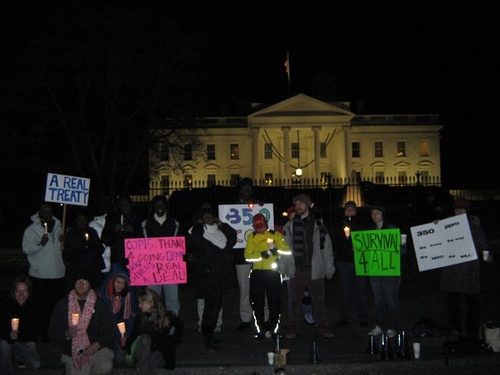
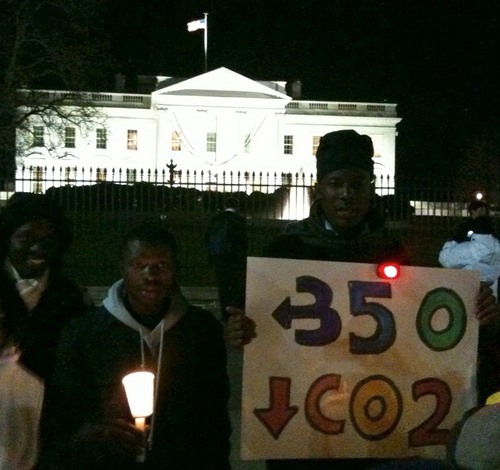
Pictures taken at the 350 vigil in front of the White House on December 13th 2009 organized to pressure the government to take (its commitment on) Climate Change more seriously.
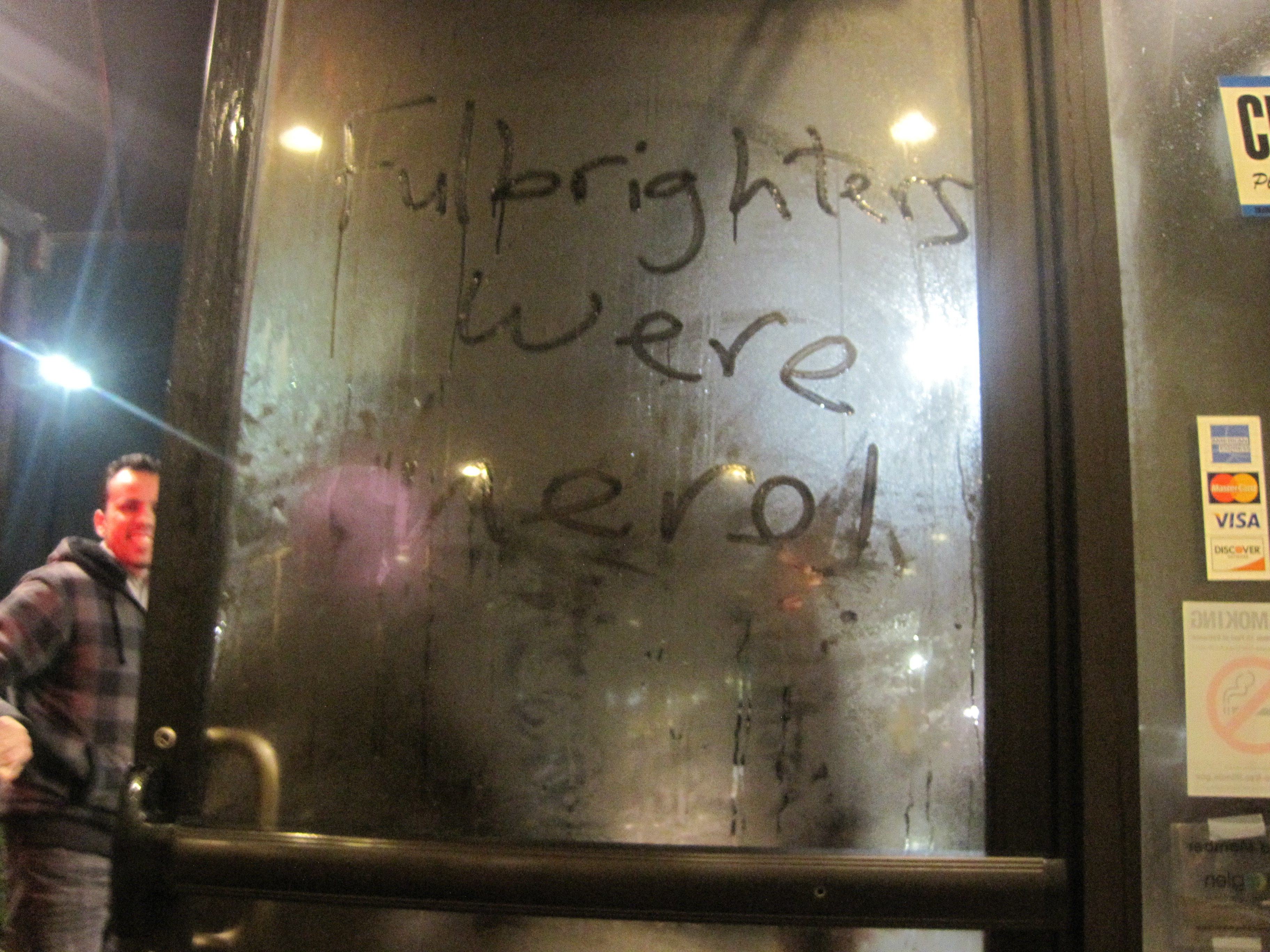 “By this time next year, if the current two return here, we’d be almost ten,” another person said, “and it would be interesting to gather around again for a discussion like this.”