Food, For Clarissa.

My initial plan was to not only put up pictures of food, but to write a recipe of making them as well. Now, the temptation is just to give you the pictures, and send the recipes later. Or how about I just tell you their names first, and we deal with the making them later?

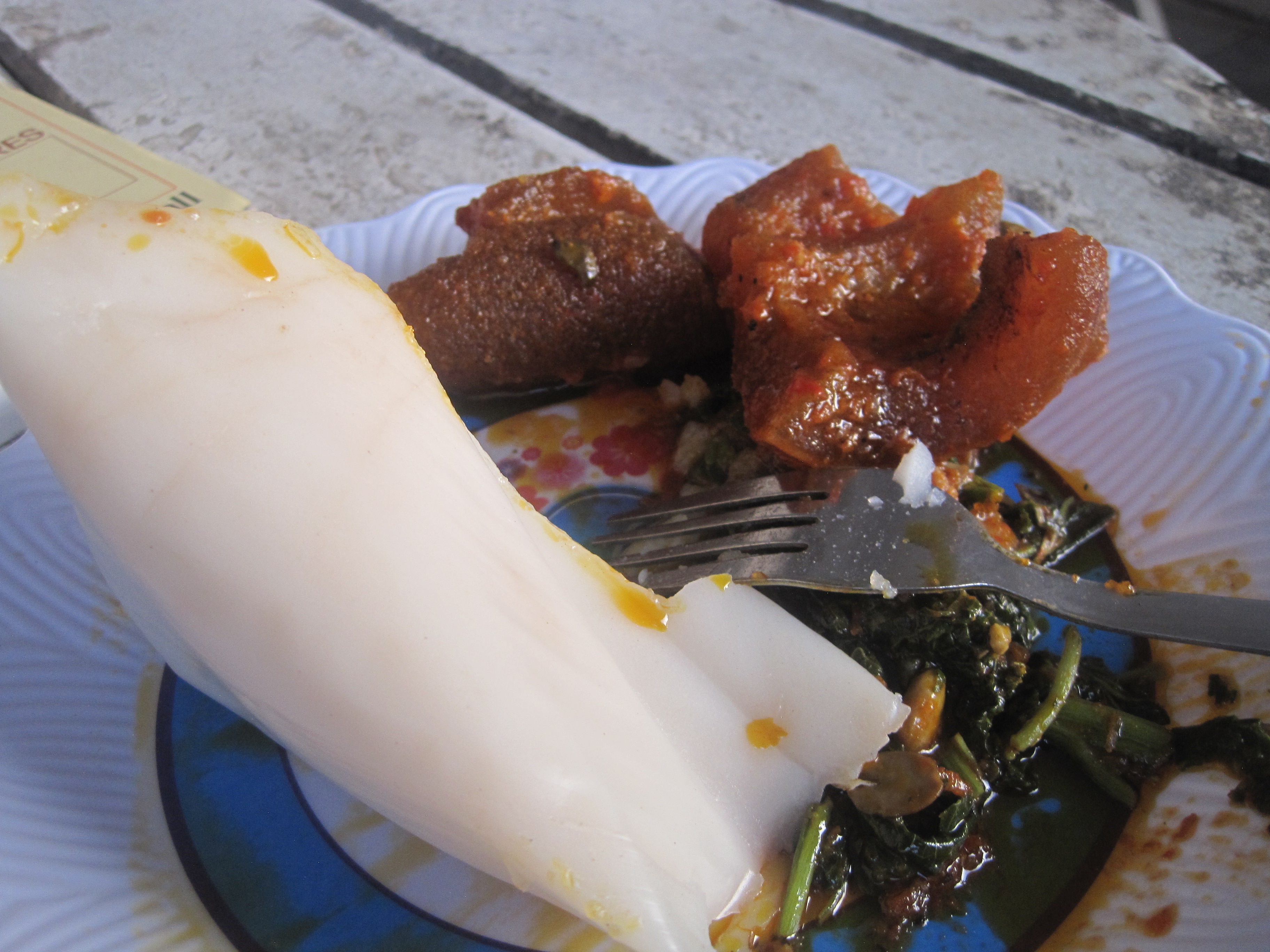
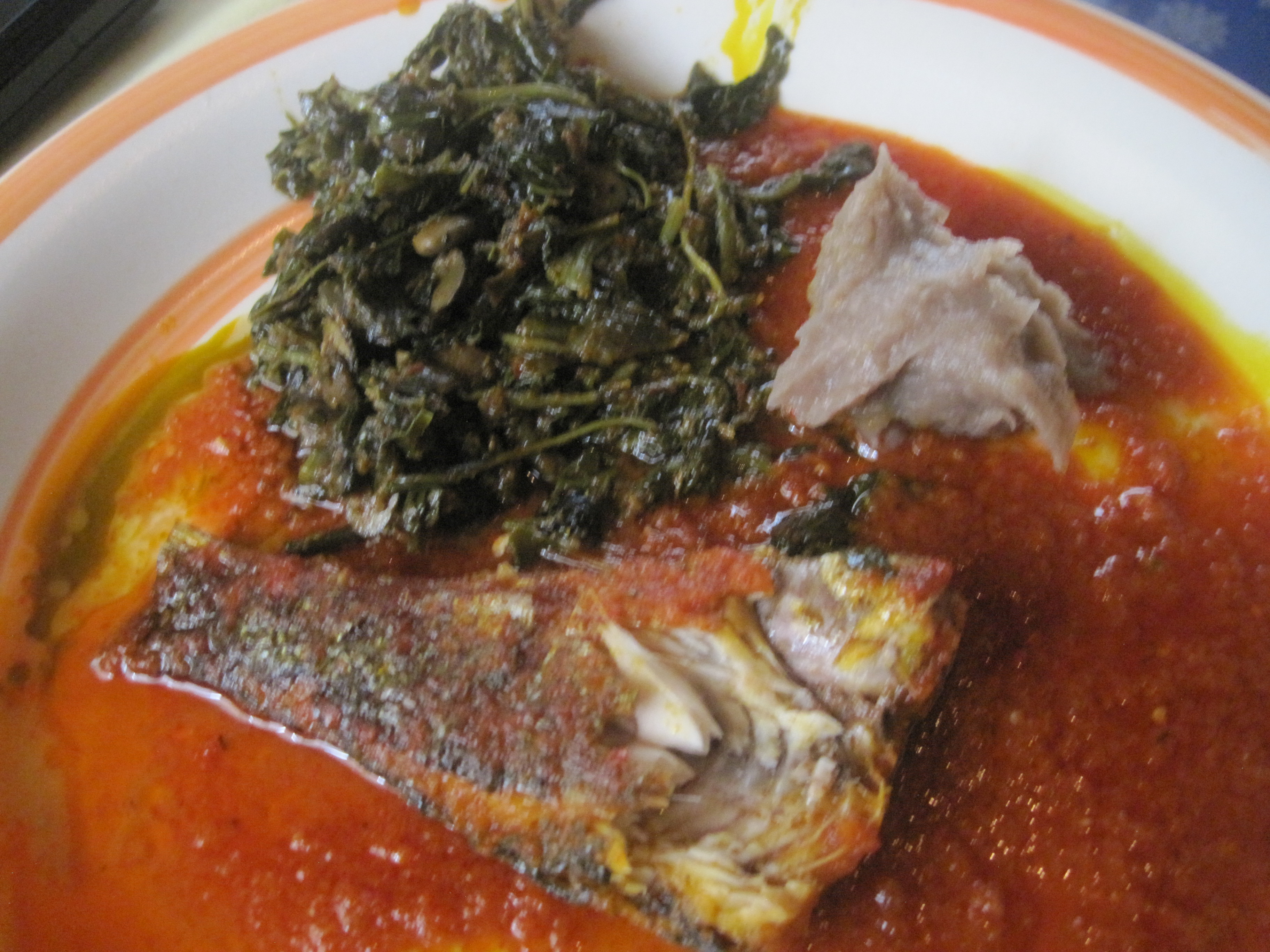
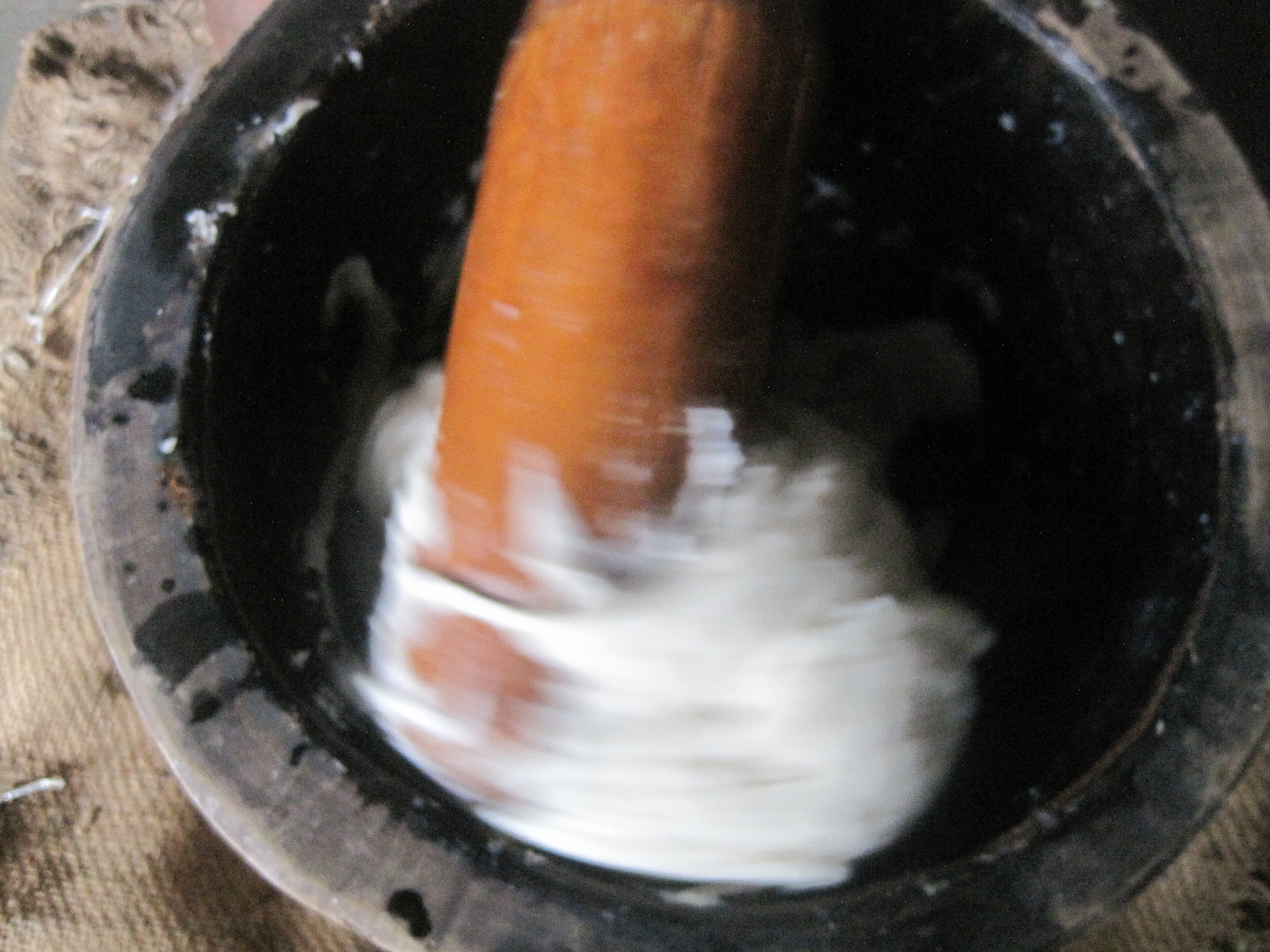
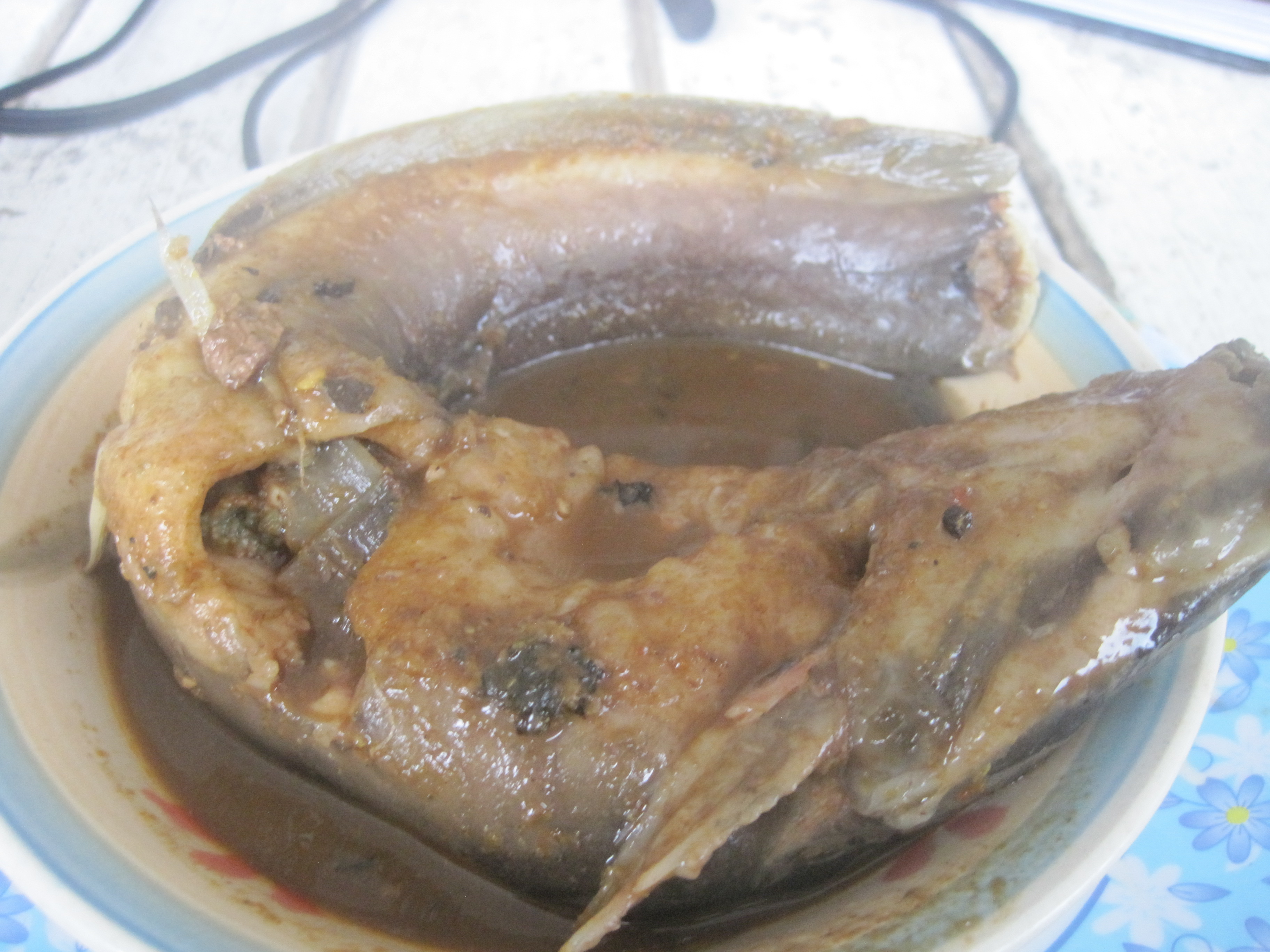
From the top, clockwise, we have:

1. Fried fish, with cooked (salted) spinach and locust beans, and a morsel of amala. This kind of amala is made from yam powder.

2. Eko (the white solid paste) made from corn, ponmo (from cow skin), and some more cooked spinach.

3. Catfish in peppersoup.

4. Pounded yam in the making. (You peel the yam, cook it without salt, and pound it until fine and doughy, then eat with any soup or vegetable of choice.)

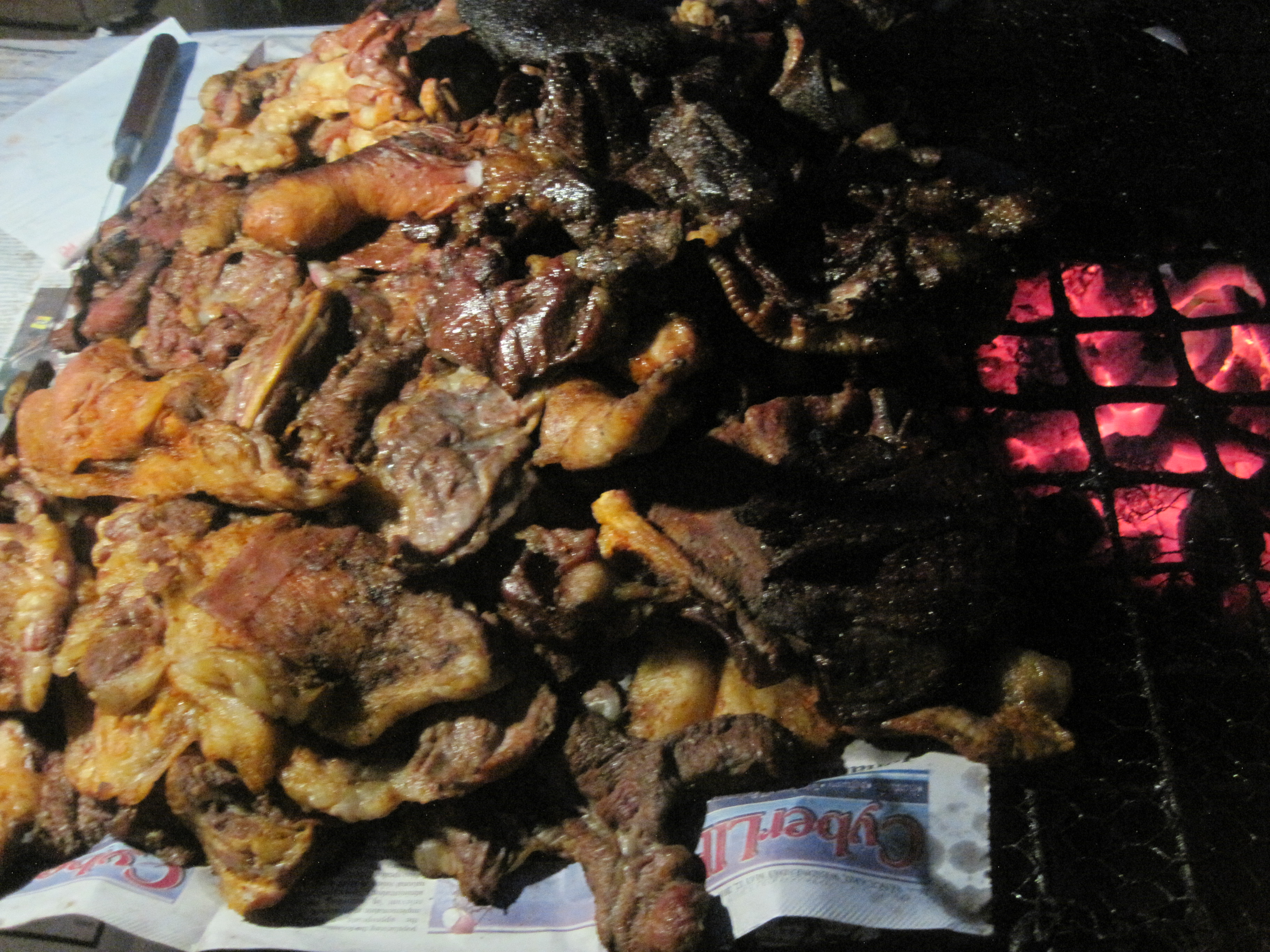
5. Suya. This is a typically Nigerian delicacy. It is cow meat roasted on an open fire with plenty spices, and eaten with cabbages, onions and some more spices.

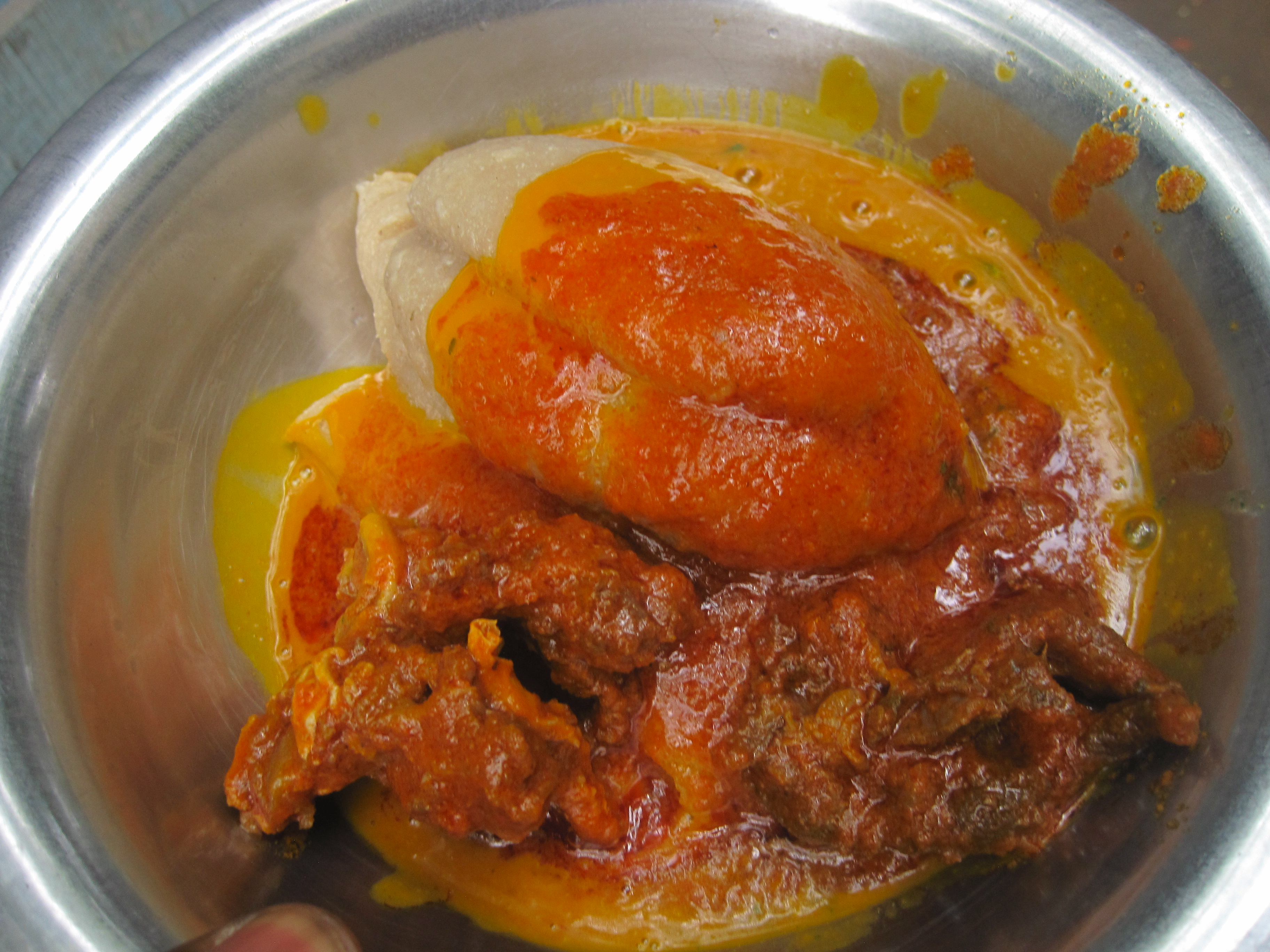
6. White amala (made from cassava flour) in black-eyed peas soup (also called gbegiri), pepper sauce, and some beef.

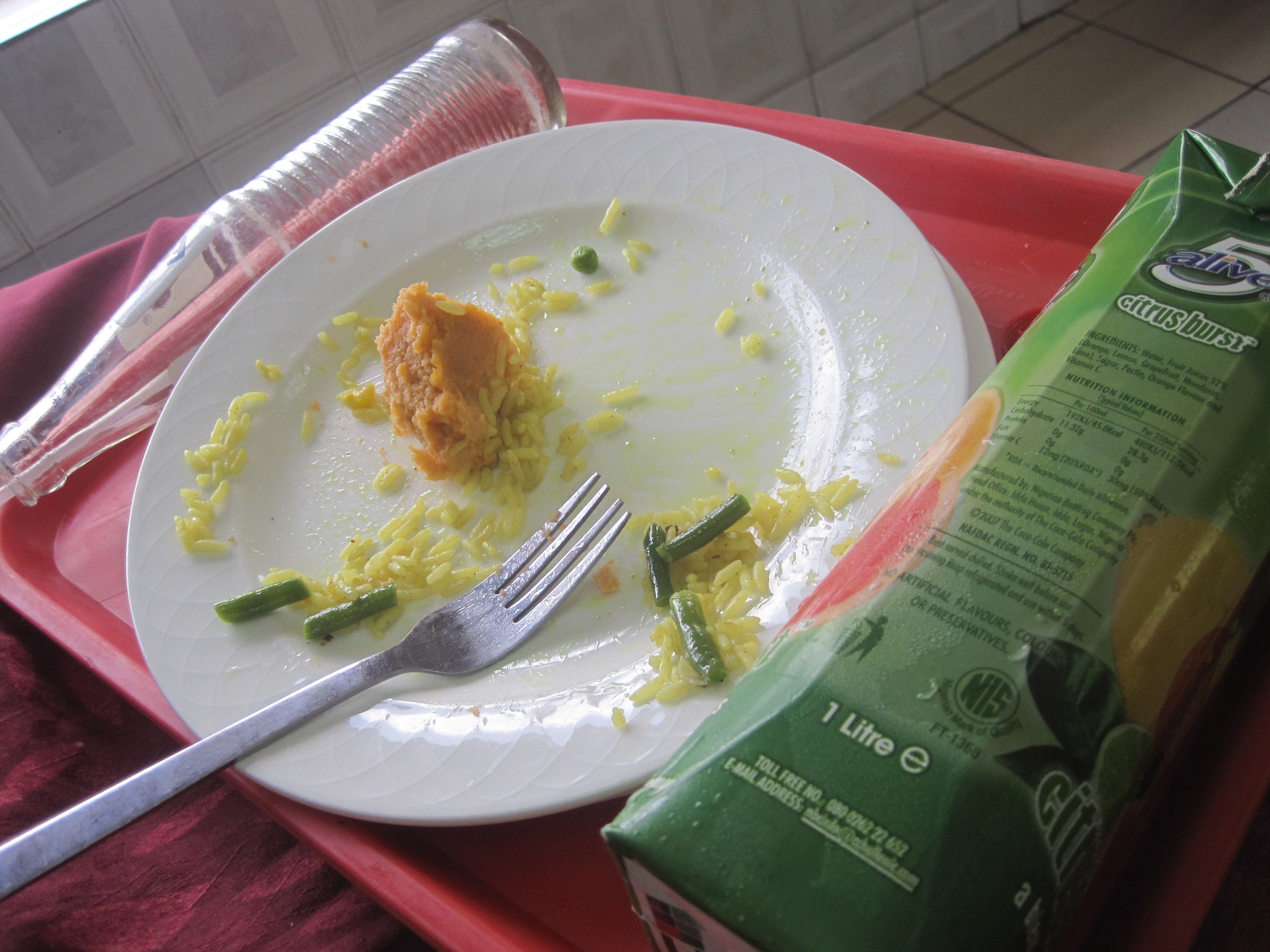
7. No comments. This is an almost empty plate of fried rice and moinmoin. Moinmoin is made from blending black-eyed peas (we actually call it beans) together with pepper, and other spices, and cooking it with crayfish or shrimps until solid.

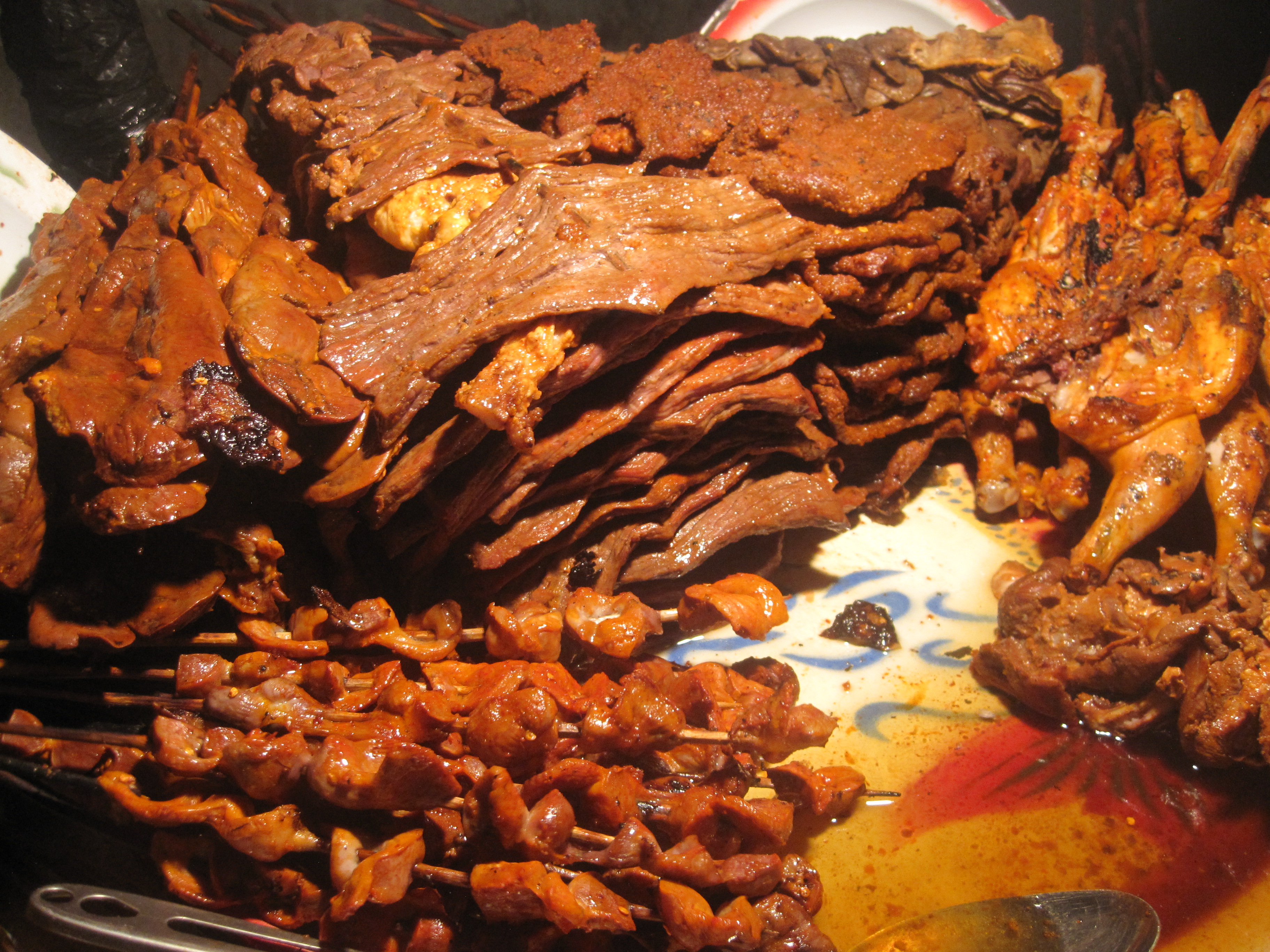
8. More suya. This one is cooked slightly differently from the one in #5. This is stacked on sticks and placed on the fire with the spices. In this picture are three different kinds: chicken, beef and chicken gizzards, all on sticks.

Alright, I’m done here. Ikhide Ikheloa, let me now formally invite you back to Nigeria. 🙂

Onion-Sage Stuffed Goose Recipe

As culled (or stolen) from Clarissa’s blog, by Paul C. I wonder why I didn’t think of this since a long time ago. Better late than never, right?


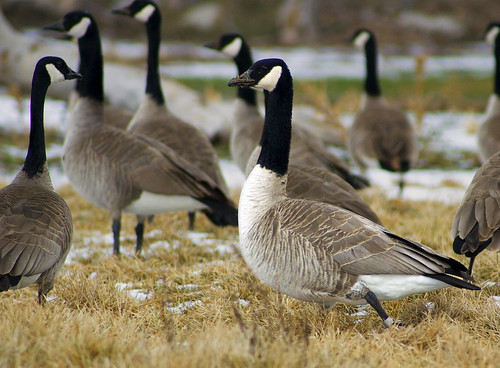
Before

Ingredients:

3 lbs of onions.
½ cup of butter.
½ cup of celery, chopped with leaves.
6 cups of soft breadcrumbs.
1 tablespoon of salt.
½ tablespoon of freshly ground black pepper.
1 tablespoon of dried sage.
1 teaspoon of dried savory.
½ teaspoon of dried marjoram.
¼ teaspoon of ground nutmeg.
1 goose, about 11 lb.
1 tablespoon of fresh lemon juice.
Salt and pepper.
2 chicken bouillon cubes.
Boiling water.


Directions:

  • Peel and cut the onions into quarters, then put them in a large saucepan, and add just enough boiling water to cover, and simmer, covered, for about 15 minutes or until just tender.
  • Drain, cool, and coarsely chop the onions.
  • In a large heavy skillet, melt the butter.
  • Add the chopped celery and gently sauté for about 3 minutes, stirring frequently.

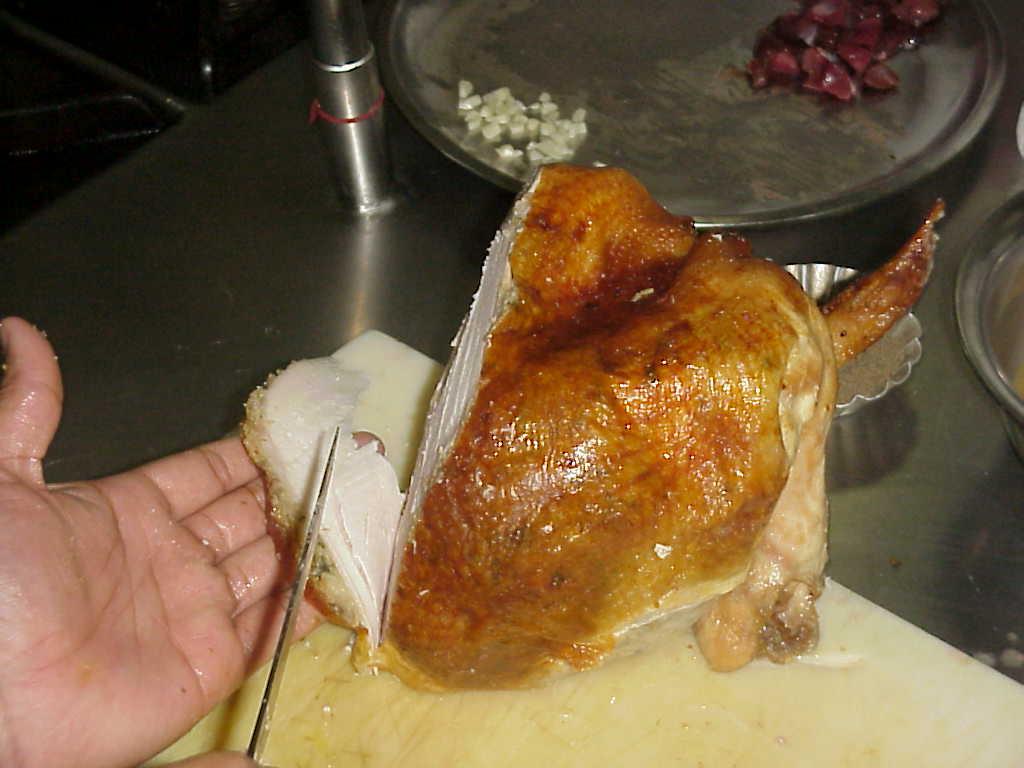
    After

  • Add half the breadcrumbs and cook gently until lightly browned, stirring frequently to combine.
  • Place the remaining breadcrumbs in a large mixing bowl.
  • Add the salt, pepper, sage, savory, marjoram and nutmeg. Toss to combine the ingredients.
  • Add the prepared onions and the sautéed celery and breadcrumb mixture to the bowl and toss again to combine.
  • Allow to cool before stuffing the goose.
  • Preheat your oven to 400°F (205°C) degrees.
  • Rub the goose inside and out with lemon juice.
  • Generously sprinkle the inside of the goose with salt and pepper.
  • Stuff the neck cavity with some of the prepared stuffing and fasten the neck skin to the body of the goose with a skewer.
  • Stuff the body of the goose with the remaining stuffing, skewering and lacing the end closed.
  • Tie the legs and the wings to the body with butcher’s twine.
  • Prick the skin of the goose all over, to let the fat escape while roasting.
  • Place the goose, breast side, down on the rack of a large roasting pan.
  • Add the chicken bouillon cubes to the two cups boiling water and stir until dissolved, then pour the mixture over the goose.
  • Roast for 60 minutes, uncovered.
  • Pour off half the drippings and discard.
  • Turn the goose over and pour two cups of boiling water over the bird.
  • Continue roasting for another 60 minutes.
  • Pour off the drippings from the pan, again.
  • Prick the skin of the goose all over and continue roasting for about 90 minutes more, or until tender.
  • To serve, place the goose on a large platter; remove the twine and skewers to carve.

_________________

Pictures from:

http://farm1.static.flickr.com/35/92769658_1f6fab7580.jpg

http://www.ifood.tv/recipe/roasted_turkey_stuffed_with_sage_and_onion

Happy Birthday Clarissa!

A birdie told me that it was your birthday so I got you these songs. One in Spanish by a cute baby boy

And one in Ukrainian by a bunch of University folks somewhere.

Happy birthday Clarissa. May your dreams come true, and thanks for being a cool professor, brilliant colleague, and supporter of this blog. 🙂

Ukraine’s Got Talent!

In response to my 10 Reasons post about Nigeria, I have got this guest-post from Clarissa as well as a video from Jacqueline Mackay. The video shows one of the amazing talents from Ukraine where a young woman makes amazing art with sand live on stage to tell a story. I do not know much about the history of Ukraine to decode the story, but I’m sure that Clarissa will be here soon enough to enlighten us. Meanwhile, enjoy these facts about Ukraine by Clarissa, and the video courtesy of Jackie.

Did You Know That Ukraine…

• Is the second largest country in Europe? (If we don’t count Russia, which is located in Asia for the most part, anyways.) Even among my blog visitors, I have had people who refer to Ukraine as “a tiny country in Eastern Europe.” One look at the map, however, is enough to demonstrate that Ukraine’s territory is large and its population is 1,5 times larger than the population of Canada.
• Has the most fertile soils in Europe? Ukrainian soil is so fertile that people have been known to remove the top level of soil and sell it to other countries simply because everything grows and flourishes on it.
• Has a tradition of democracy that dates back to the XVI century? This makes Ukraine a country with the most longstanding tradition of democracy in Europe.
• Started a sexual revolution around 1910? While people in the US and Western Europe had to wait until the mid-sixties for their sexual revolution, a famous Ukrainian writer and the future prime-minister of the first independent Ukrainian Republic Volodimir Vinnychenko dedicated his career as a writer to promoting the ideas of sexual liberation, free love, and the rights of women. His books were hugely popular all over Europe in the first half of the XXth century.
• Has a strong anti-imperialist tradition? In spite of being surrounded by fiercely imperialist countries, Ukraine never followed their example and absorbed the imperialist way of thinking. Even when Ukrainian troops would repel the invaders and enter the territory of the invading country, they would turn back and leave without trying to retain foreign territories.
• Had slavery until 1861? Under the name “serfdom”, the tradition of slavery existed and was very wide-spread in Ukraine until 1861.
• Was the site of one of the greatest modern genocides? In 1932-3, over 10 million Ukrainians were exterminated by the Soviet government in an attempt to wipe out any resistance to the imperial subjection of Ukraine by the Soviet Union. Today, the government of Russia is engaged in endless propaganda that denies that Ukrainian Holocaust ever took place.
• Has recently elected a convicted criminal to be its president? Viktor Yanukovich, a recently elected president of Ukraine, was incarcerated for robbery and assault in 1967 and for assault in 1970. It is said that his second crime was a rape that was eventually pleaded down to assault.
• Does not require a definite article before its name? Many people still say “the Ukraine” instead of “Ukraine.” Not only is this grammatically incorrect, it is also kind of annoying.
• Has one of the most melodic languages in the world? According to a study by the French Academy of Fine Arts, Ukraine has the world’s second most melodic language after Italian. I’m not sure that I agree about the entire world, but it’s definitely one of the most beautiful sounding languages in Europe. Sadly, the language is disappearing because centuries of colonial domination and propaganda cause many Ukrainians to be deeply ashamed of their cultural and linguistic heritage.

Culture Shock

This is a guest-post by my cool and brilliant colleague Professor of Spanish language and literature who also blogs as Clarissa on issues of feminism, literature, journalism , immigration, politics, and her love for the Kindle. 🙂 Originally from Ukraine, she migrated to Canada, and she got her PhD at Yale University in the United States. She has recently taught at Cornell University before coming over to our prestigious SI University. Hers is the first in a series of guest blogposts coming on this blog in the coming weeks. Thank you Clarissa for the post. Find her blog here.

____________________________________________________________________
When I was 22, I emigrated from Ukraine to Canada. I was fully prepared to experience a massive culture shock but none came. Sure, it took some time to get used to the idea of a credit card and a check-book, realize that a bus driver doesn’t give out change and there is no need to negotiate the price of a ride with the cab-driver before getting into the cab, and figure out why maple syrup can be poured on bacon and eggs. The process of learning these small things was really fun and caused me no shock whatsoever.
Five years later I decided to go to graduate school in the United States. Having lived in North America for a while, watching American TV and reading American books and newspapers, I expected even less of a culture shock on this change of residence. I was only moving to Connecticut, where the climate and the way of life were supposed to be pretty similar to what I had gotten used to in Canada.

Boy, was I ever wrong. A massive culture shock hit me immediately after crossing the US border and remained with me for years to come. It took time and effort to understand this new reality, learn to like, and eventually even love it.

I the US I discovered a deeply divided society. Glaring class inequalities, the likes of which I never saw back in Canada, racism, religious fanaticism, gender inequalities, economically devastated areas with the kind of poverty I never saw even back in Ukraine, crime, violence, inept governmental strcutures. All this was very different from the US I had seen in movies and TV shows.

But soon I also discovered that yet another US exists. The country of intellectuals, thinkers, artists. The country of hard-working, kind, generous people, who have not abandoned the struggle for the perfect society they inherited from their founders. The country of intellectually curious people. The country of people who hate injustice and inequality. The country that deserves better than the corrupt structures governing them.

When people read the very critical things I write about the US on my blog, they sometimes ask me, “Why do you live in this country if you dislike it so much?”. But I ask, does hating injustice and inequality mean hating America? Or is it just the opposite?

______________________________

I love Clarissa’s blog because of the way she looks at the world. Even though she hasn’t called it that, her blog is a travelogue of sorts as well – a response to the American society from the viewpoint of an immigrant. And as expected of someone of her level of brilliance, she doesn’t suffer fools gladly, and she says what’s in her mind no matter whose ox is gored. I particularly like the way she responds to the people who make foolish or hateful comments on her blog. I wish I could be that quick-witted sometimes. 🙂