Browsing ktravula – a travelogue! blog archives for August, 2011.

Reviewing “The Help”

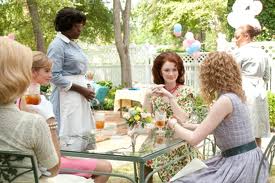
A group of young southern housewives (all brought up by black maids working for meagre payment) gathered around to play bridge every week in each other’s house drinking wine and having fun. Beneath this facade is a series of complex relationships which included jealousy, in-fighting, pretense, hate, and compassion, courage, inferiority, humour, discrimination, ignorance, among very many others. The time was early to late 60s, and the place was Mississippi. The movie is an adaptation of “The Help” a best-selling novel written by 40 year old Kathryn Stockett.

I saw the movie today and it was a moving experience. (I have written a short review on Nigerianstalk.org.) My attention was first called to the movie in May at a house party at a professor’s house. She’s a 70 year old history professor here who occupies a vivid memory span of some of the event recalled in the book. I recommend the movie to everyone who is interested in a few more nuances of the race relations in the South of the 60s and their implications for today’s society. It is an important story.
 

Reading in Lagos

Join the Jalaa Writers Collective this weekend for a day of reading by some of Nigeria’s most promising writers. Join them as they address questions about publishing in Nigeria and what a Writers’ Collective may offer, what Jalaa Writers Collective offers. The event is FREE!

Date: August 13, 2011

Venue: Freedom Park, Broad Street, Opposite. General Hospital. Lagos.

Readings by:

A. Igoni Barrett, one-time editor of Farafina Magazine is the recipient of a Chinua Achebe Center Fellowship, a Norman Mailer Center Fellowship and a Rockefeller Foundation Bellagio Center Residency. His first book, the story collection “From Caves of Rotten Teeth”, was published in 2005 in Nigeria. His second story collection is forthcoming from Graywolf Press in 2013.

Akachi Adimora-Ezeigbo is a lecturer, writer, novelist, critic, essayist, journalist, and administrator. She has written over twenty books. Her latest work “Roses and Bullets”, published by Jalaa Writers’ Collective is about the Nigerian Civil War. The former winner of the NLNG Prize for Literature, the biggest prize for literature in Nigeria, heads the Prize’s panel of judges this year.

Jude Dibia is the author of “Walking With Shadows”,” Unbridled” (winner of the 2007 NDDC/ANA sponsored Ken Saro-Wiwa Prize for Prose and finalist in the 2007 NLNG Nigeria Prize for Literature) and the newest, “Blackbird”.

Odili Ujubuonu is the award winning author of Pregnancy of the Gods (Winner, 2006 ANA/Jacaranda Prize for Prose), Treasure in the Winds (winner, 2008 ANA/Chevron Prize on Environmental Issues) and the newest, “Pride of the Spider Clan.”

Uche Peter Umez is one of the 24 winners of the 2006 and 2008 Commonwealth Short Story Competition. No, he is not the actor. He is the winner of the 2006 ANA/Funtime Prize for Children Literature for his unpublished novel,” Sam and the Wallet, and 2008 ANA/Funtime Prize for Children Literature . He is the author of Dark through the Delta (poems), Tears in Her Eyes” (short stories) and “Aridity of Feelings” (poems). His latest work “The Runaway Hero” is on the NLNG Prize shortlist for 2011.

More information on Facebook.

Re: Spotting Nigerians

I got this mail from Nick about another personal peculiarity in English pronunciation in response to my recent post. Enjoy.

_______________________

I enjoyed your post about spotting Nigerian accents by the pronunciation of “man/men”

(https://www.ktravula.com/2011/08/spotting-nigerians/).

This doesn’t have anything to do with Nigerian English, but I know you like American English accents, so I thought I’d write.  I ran into something similar to the “man/men” issue when I moved from my home town of Portland, Oregon to Pittsburgh, Pennsylvania (you should visit both cities if you get a chance).  Having lived in Pittsburgh for ten
years I still find myself having to consciously use more of a “aa” sound, particularly with the word “bag”, which my wife tells me I pronounce too much like “beg”.  I do it pretty automatically now, but I actually find myself exaggerating it to prevent comments.  I think I sound like a sheep, going “baaaaaa-g”.  The vowel sounds more open and I hold my tongue farther back in my throat than I would naturally.

This might not be exactly the same as the “men/man” thing, but it seems similar.

This is just my experience and not evidence of a regional accent issue, but at least one of my friends reported something similar after moving from Portland to the east coast.  Other significant factors are that I may have picked up a bit of my mom’s New England accent, and also that Pittsburgh is home to a slight local accent and some cool local vocabulary like “yinz” instead of “y’all”.

Thanks for your always-interesting blog,

Sincerely,

Nick.

_____________________

Notes

This mail reminds me of one other distinct pronunciation difference in Nigerian and Ghanaian English. Growing up in the early to late eighties, I remember a common assumption that Ghanaian English sounded closer to the British standard than Nigerian English, and Nigerian parents paid more to send their children to private schools that had Ghanaian teachers rather than ones that didn’t. And though they paid so much for the “privilege” for us, we never understood much of the obsession beyond the fact that our teachers insisted on pronouncing “Church” as “cherch” (as it rhymes with “perch”), the as “the” (as rhyming with the “e” in “wet”, hamburger as “hamberger”, luck as “lack”, and but as “bat” rather than the Nigerian “bot” among very many others that I can list if I get the time. We students also didn’t gain much from the hubris that the teacher brought with them either. It however provided plenty moments of comic relief in classroom sessions when it didn’t come along with punishments for deviation. We had some good laughs as I am sure did Ghanaians who had listen to us speak English as well.  I have been to East African and I think that the English there – along with its own amusing peculiarities that knocked Nigerian and Ghanaian versions to a corner – comes the closest to British English pronunciation standard in all of the Englishes I’ve heard on the continent. But then, I’ve never been everywhere.

Thank you Nick.

Sincerely,

KT

Pen for Chickens

The smell is familiar. Almost every family at one time or the other in South-Western Nigeria has kept a chicken farm. And a farm is usually too serious a name for it. Free range chicken running around the house cackling and providing needed amusement for little children with idle hands. There is a rooster that crows unfailingly at five in the morning, and then there is the hen which lays cute little white eggs and then sits on them for about twenty-one days before little chicks come out looking like tiny little dolls. Get close to them while they waddle around their feisty mother around the large compound of the house and see the wrath of a woman (bird) scorned. An angry mother bird is not a pleasant sight to see.

Grandmother had a theory about predating hawks who found these little chicks a delicious specimen and preyed on them regularly for lunch. Paint them in bright red colours and the hawks and kestrels thought they were dangerous aliens and stayed away. I don’t know how well the theory worked but it was usually funner to see the motherbird walking around with a set of red coloured little chicks hand painted with red ink obtained from a certain leaf… The sight of a hawk swooping to pick up its favourite dinner of little chicks from behind the nursing motherbird is usually a sight too, but it happens usually really fast. One moment you have a piece of boiled yam on the way to the mouth. The other, you are staring at a noisy little battle that lasts just a second. A bigger bird has swooped down and made away with its living lunch and the angry mother is out there in the sun wailing in loud chicken cackles. Some times, the other little chicks are still too frightened to come out of where they had gone to hide at the prompting of the mother.

My first other conscious memory of chicken pens comes from the brown, sometimes black, imported “agric” type ones in fancy cages, fancy feeds and fancy golden eggs. Those lay eggs without mating, get large in no time and usually get slaughtered for Christmas “because they taste good”. But they are never usually allowed to range around the house, staying confined to a specially made pen with saw dust all over its ground which is changed after a few days. Too much work, if only mother cared about that. She was always already too busy worrying about raising us to bother with how much time and effort it took to change dirty saw dust layers on the floor of a large poultry. That, of course, unless we had to do it ourselves. Thinking back to this specific time, it always made it necessary to hope that one didn’t grow old fast enough to be able to take up the responsibility of cleaning a whole room full of chicken dung. It was a hope that never manifested.

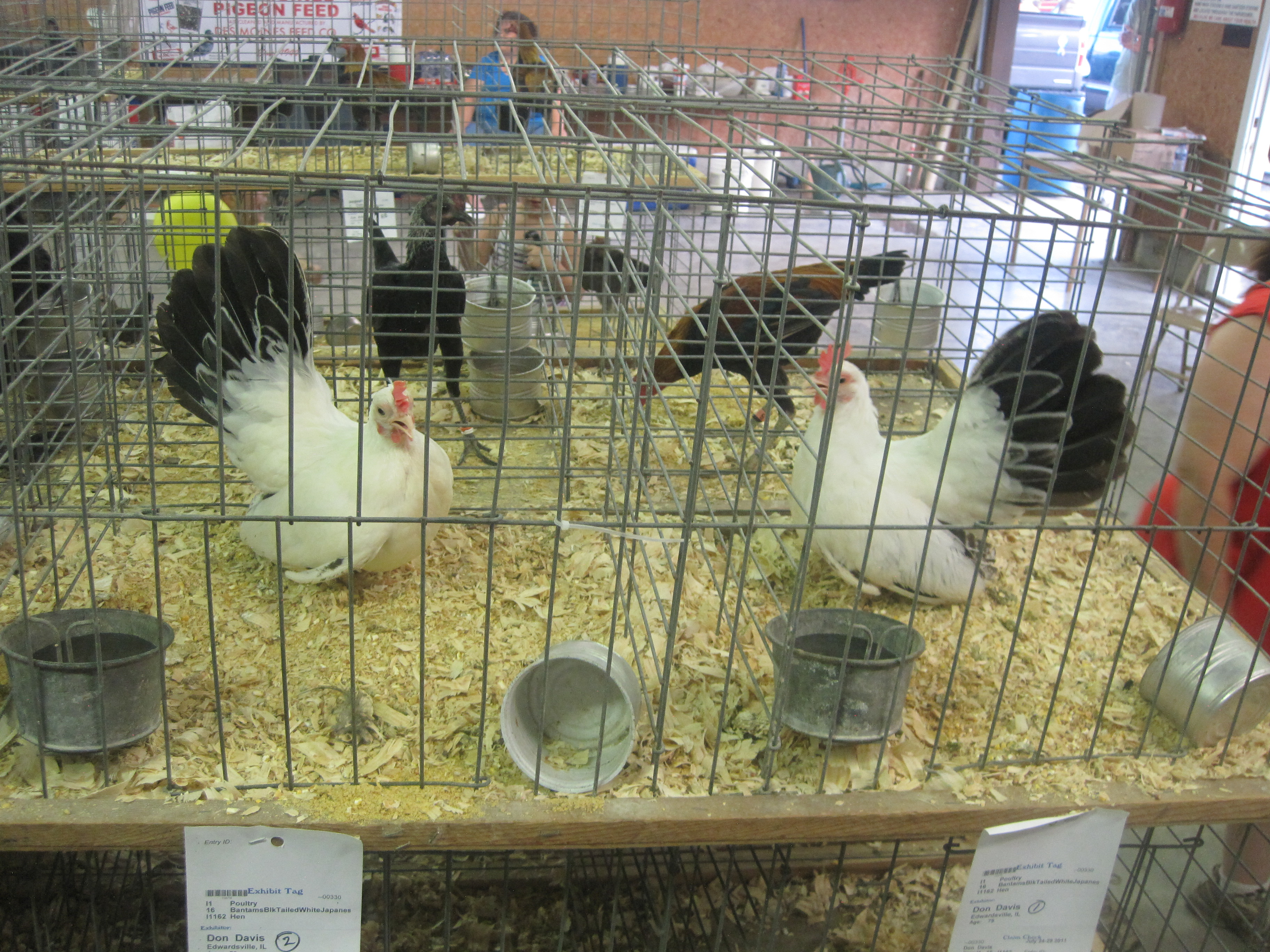
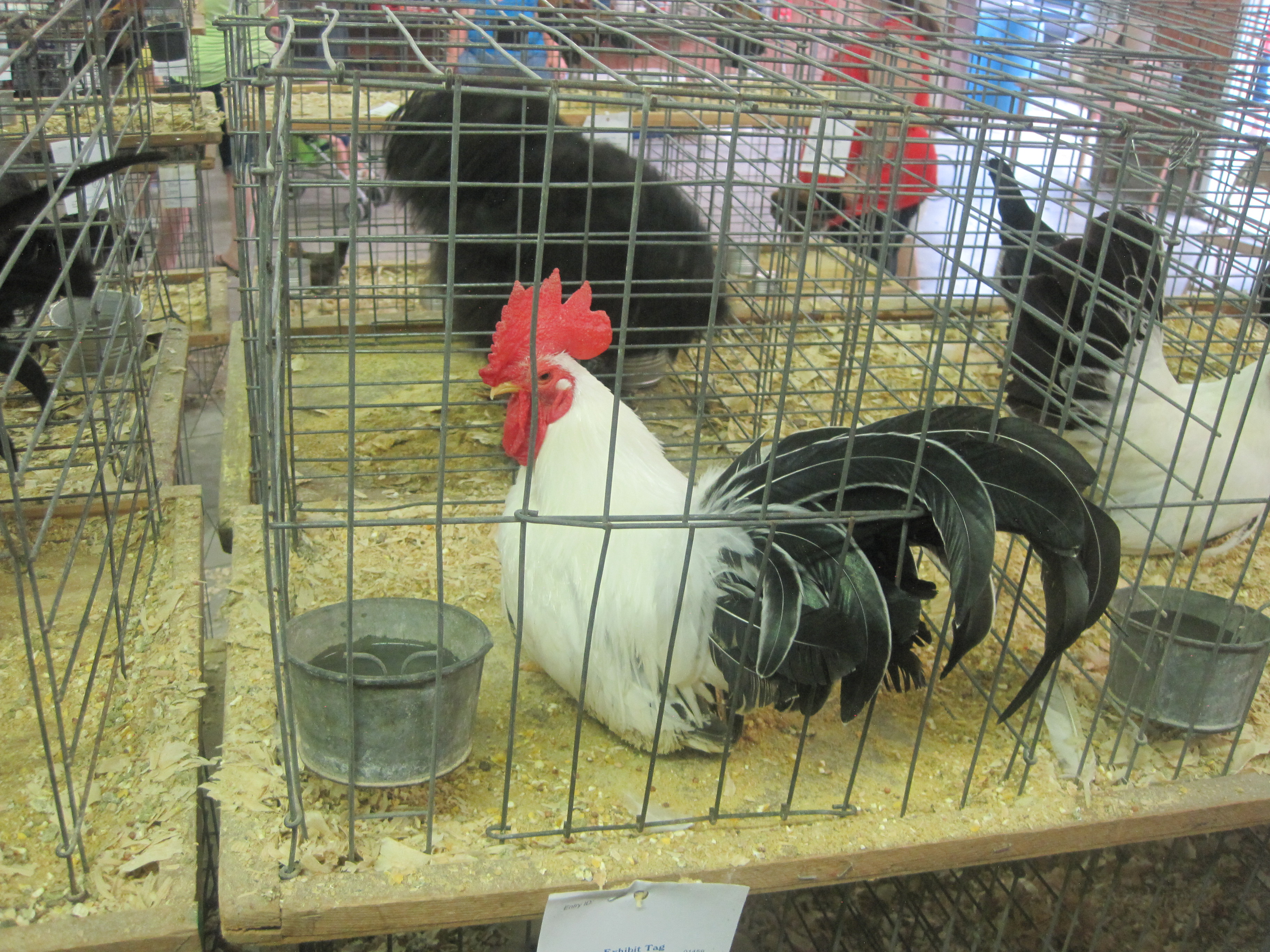
Back to the large smelly room of the county fair in Highland last week was that moment where all that sounded, smelled and surrounded the traveller was a sight from a very distant past. He wasn’t a graduate student travelling with an equally adventurous colleague to check out the “country” side of America in form of a hundred cackling roosters of different shapes and sizes in familiar cages, he was a little boy by his grandmother’s side smelling chicken poo all over the house, discovering the delight in a boiled white egg of a local breeding chicken, crying over the death of one run over by a careless driver, watching her paint little chicks with locally-made crimson dye, running scared of the little white covering around the chicken’s eye whenever it blinks, and wondering with a thousand unanswered questions how chickens always found their way home to roost after such long wanderings around the neighbourhood.

The smell in that room came with a little more than just memories.

Spotting Nigerians

Watching a cover of Rihanna’s “Man Down” yesterday, I noticed something curious: one of the girls in the video pronounced the word “man” with a familiar consistency. I became intrigued and went to see other videos by the young ladies. Eventually I found one in which they answered questions from their fans, and I got what I was looking for. They were born to Nigerian parents, raised partly in Nigeria and in the United States. It’s unmistakable. That pronunciation of “man” in the video is of someone who has lived in Nigeria at one point or the other in their life. Watch the song cover here.

The last time something like this happened to me was four weeks ago on the streets of Chicago. “Are you from Nigeria?” I asked the taxi driver who had spoken just a few words to me through the window as I complained that his fares were too exorbitant. “Yes, in fact,” he responded, to the astonishment of my company. “There was something in his pronunciation,” I told her later. It turned out that the man had grown up in Nigeria but had lived in Chicago since 1979. Like her, he was also astonished to hear that I had guessed his nationality from just a few words in a big city.

There are some very distinct peculiarities in Nigerian English pronunciations observable usually only to compatriots, residents or regular visitors. This must be why all comedic imitations of African speech by American actors seem to be funnier (or sillier, depending on how you look at it) for being too inaccurately generic. (Chris Tucker does another one of those impressions at the end of this video, and Steve Havey in this one.)

PS: Here is a related video in which we played around with the perceptible difference in “man” on a Nigerian or an American tongue.