Browsing ktravula – a travelogue! blog archives for July, 2011.

Burning Up!

These two statements are very true: America is a very hot place. America is a very cold place. There is one reason however why one of the statements will raise an eyebrow anywhere else across the Atlantic. The most enduring image of this country is that of white flurry snow falling down on lighted trees at Christmas. Somehow, for some strange reason, none of the images of sweating pedestrians, smelly cowboys and dusty roads of Nevada and California survived childhood memories and a transatlantic flight.

The temperature in Edwardsville yesterday was over 100 degrees F (about 37 degrees C). In Minnesota just two days ago, the recorded temperature was 115 degrees F. (That is 46 degrees C for heaven’s sake!!!) Thirteen people have already died from heatwaves. It is very telling that this happened in Minnesota, a usually cold place that still had snow until April when everyone else had already started having sunlight. If there was ever need for anyone to see that climate change is a harrowing reality, this is it. The question is, how do/would people survive the summer here, especially people already used to cold weather for half the year?

This statement is also very true: although coming from sub-saharan Africa, I’ve never been in a hotter or colder weather anywhere else.


Secondary School Days

It was always cold and dry in November towards the end of the school year, and the season always came with a certain bubbling feeling and restless feet. School was at Agodi, a stone throw from the governor’s office, and the state prisons. It was bordered by a military housing project/barrack which had some of the best eating shacks we had ever encountered. It was also the only place where we could go have burukutu in the after hours with the little money we could save. Fufu at Barracks was the best, for some reason. It was rock solid, and filling. It was just as well since the majority of the customers of the eating joints were military people expected to be tough, filled, and healthy.

The broadcasting corporation was about two miles away. It had a very large fenced compound where at this time of the year an exhibition was held. It was called an exhibition because it was conceived as a carnival for the Christmas season. In time, it became a spot for gaming, alcohol and peppersoup and not much else. It was the ultimate taboo spot of escape from school, and we took the liberties many times daring the always looming risk of being apprehended by state law enforcements sent out to find school children loitering the streets during school hours. The best way to get to the broadcasting corporation from the school without getting caught was to walk through a winding short-cut road that went through the Officer’s Mess of the Second Mechanized Division located just across the road. I see it now, a quiet living estate with fancy houses and barking dogs. Three, and sometimes four, young school boys in blue checkered shirts trekking across the land under a sometimes scorching sun. In their pockets are a few coins each, and some roasted groundnuts tied in transparent nylons.

The excitement at the exhibition grounds never always justified its anticipation, but it almost always compensated for gloom of confinement that the walls of our school represented. Dry harmattan Novembers on the streets of Bashorun as pesky loose cannon truants from a faraway place looking for a lost piece of their precocious childhoods… were good times. They also featured really dusty feet in rubber sandals.


Me Plus

Here is a riddle: what is the best way to take over the world? Need a minute? The answer is this: make something that everybody uses. This was my first thought on encountering the now almost inevitable internet destination that is Google Plus. What it is is an aggregation of Google’s top services and much of what we use on the internet, in one place.

It has got everyone talking. Even my grammar professor want to know how it can be used to teach an online class (hint: it can’t without the glitches of privacy and copyright concerns). It can, however be used to manage a social existence without worries to privacy the kind that Facebook brought. What exactly is Google Plus? I’d say it’s Facebook, Twitter, Blogger combined with some of other services we use everyday. Who would have thought that a day will come when everything we search for on Google can now be indexed publicly for our friends to see if we want. Who needs twitter? Who needs Facebook? Who needs a blog even? With Google Plus, everything comes together, and you still get to keep your gmail address.

Here’s how someone put it in a recent shared post:

Instead of saying, “I’m going to write a blog post now,” or “I’m going to send an e-mail” or “I think I’ll tweet something” you simply say what you have to say, then decide who you’re going to say it to.

If you address it to “Public,” it’s a blog post.

If you address it to “Your Circles” it’s a tweet.

If you address it to your “My Customers” Circle it’s a business newsletter.

If you address it to a single person, it can be a letter to your mother.

Why would you pay to keep a blog online when you can have everything a blog gives you for free on such a cool platform? Oh, I know the answer: that little issue of copyright and ownership. Besides that however, Google Plus is a nice new addition. I’ve already begun considering leaving Facebook though I know it might never really happen. It’s already a while since I last logged on to twitter. I think there is something relaxing about not having to open so many windows on my (wait for it: Google) Chrome browser.

I hope to use G+ to share some of my online curiosities and discoveries, particularly those not worth writing a whole blog post about. Join my Google Plus circle here.

Poor Linguists

Bantering with a linguist friend in UK about the possibility of me coming over to the country for a visit, I told her that it would only work if I won a lottery or a major prize. “You have to buy tickets, dear,” she gently advised. “There is no Nobel Prize for Linguistics.”

Zing!

Orwell on The English People

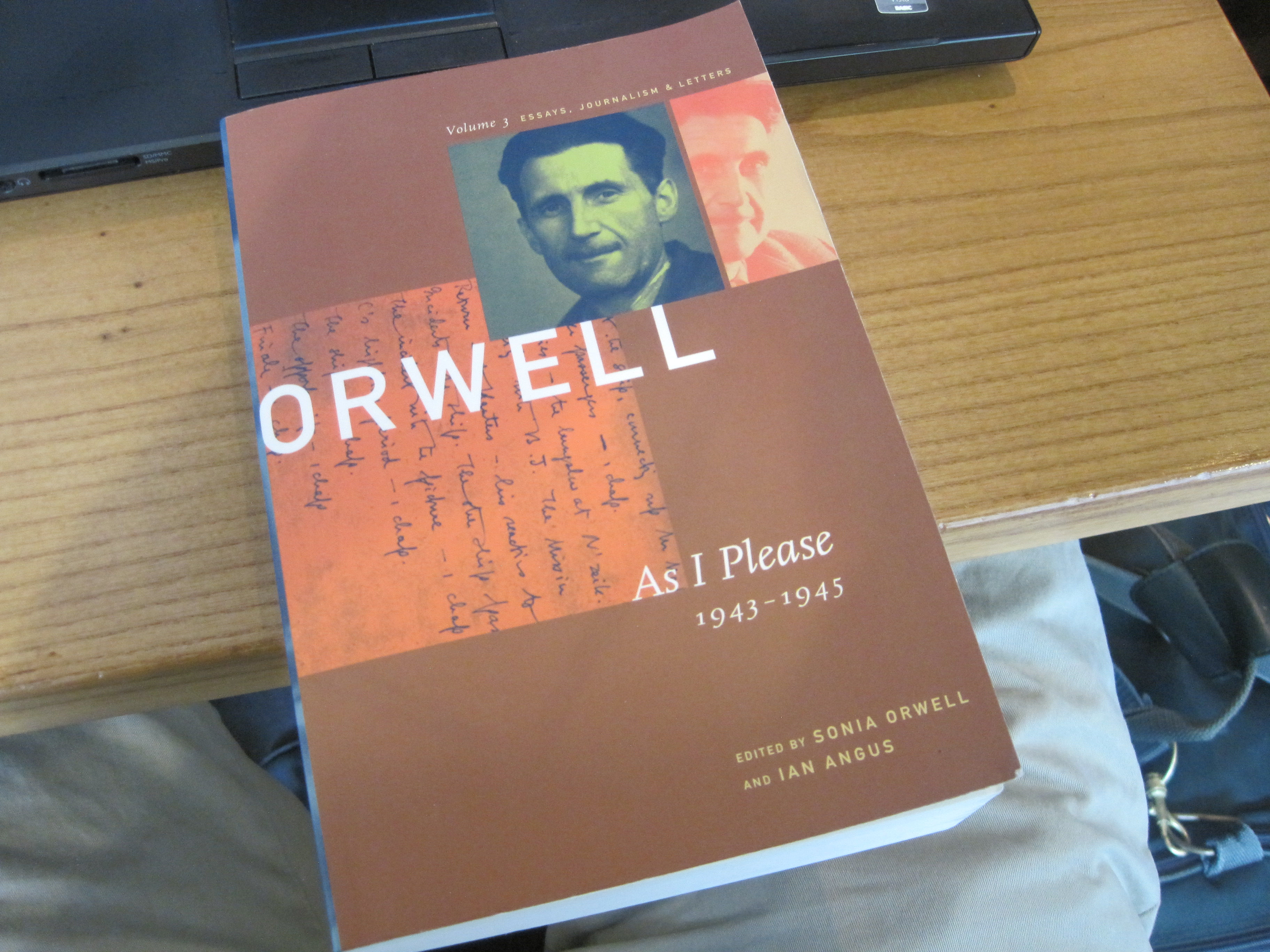
I am reading “As I Please”, a collection of essays written by George Orwell between  1943 and 1945 and edited by Sonia Orwell and Ian Angus. In the first essay titled The English People, the author explains some benefits and demerits of being an Englishman speaking English:

“But there are also great disadvantages, or at least great dangers, in speaking English as one’s native tongue. To begin with, as was pointed out earlier in this essay, the English are very poor linguists. Their own language is grammatically so simple that unless they have gone through the discipline of learning a foreign language in childhood, they are often quite unable to grasp what is meant by gender, person, and case. A completely illiterate Indian will pick up English far faster than a British soldier will pick up Hindustani.  Nearly five million Indians are literate in English and millions more speak it in a debased form. There are some tens of thousands of Indians who speak English as nearly as possible perfectly; yet the number of Englishmen speaking any Indian language perfectly would not amount to more than a few scores. But the great weakness of English is its capacity for debasement. Just because it is so easy to use, it is easy to use badly.

In the essay with parts that read like an epilogue to his earlier essay Politics and the English Language, Orwell complains about English being influenced by “American” pop culture words. Although written about six decades ago, it is fascinating how Orwell’s perception of the English life, language, and culture seems to remain as applicable now as it was then, even seeming applicable to other new post-colonial societies elsewhere.

Here is another quote:

“The temporary decadence of the English language is due, like so much else, to our anachronistic class system. “educated” English has grown anaemic because for long past it has not been reinvigorated from below. The people likeliest to use simple concrete language, and to think of metaphors that really call up a visual image, are those who are in contact with physical reality. a useful word like bottleneck, for instance, would e most likely to occur to someone used to dealing with conveyor belts: or again, the expressive military phrase to winkle out implies acquaintance both with winkles and with machine-gun nests. and the vitality of English depends on a steady supply of images of this kind. It follows that language, at any rate the english language, suffers when the educated classes lose touch with the manual workers. As things are at present, nearly every englishman, wheatever his origins, feels the working-class manner of speech, and even working-class idioms, to be inferior…”

An engaging read.