ktravula – a travelogue!

reflections on the world

Browsing ktravula – a travelogue! blog archives for December, 2011.

The Mayans Have It

I’ve been trying to find the right words to sum up this year. When I look back, there is an enormous bank of memories (some of them very personal) that I carry. There is that very first day of the year spent in the good merry company of my a friend, a Fulbright colleague, and my friend and fellow blogger Clarissa (and her husband). We had the most delicious cake, a great food, and a merry time into the night. Then there is that delightful trip to Chicago in July which changed my life in a remarkably delightful way.
It was this year when we protested against Mubarak using social media. I wrote this poem for him in January a few days before he was actually kicked out. Fun times. Little did I know that other tyrants would fall after him: Gaddafi, Osama, Laurent Gbagbo, and Kim Jong Il. Two of those dying tyrants were mentioned in the title of the poem. If I was a betting man, I could be rich by now. I also remember 2011 for The King’s Speech, one of my most favourite movies of all time.

This year, I met Ken Burns and Niel deGrasse Tyson – two brilliant writers opinion makers. I also visited Joplin in what will remain one of my year’s most enduring memory. I’ll also remember the year for losing my last surviving grandmother in January, then an aunt in March. Not very happy feelings about that. In 2011, the St. Louis Cardinals won the World Series, a surprise. I did not write as many posts this year as I did in previous years, deliberately. Academics have taken much of my attention, inevitably. Thank you for forgiving :) . Now, if we listen to the Mayans, all the remaining negatives on the world’s plate point only to one conclusion: this will be our last New Year celebration. (I haven’t seen that movie 2012, but I’m very familiar with its apocalyptic premise).
So here we are: Iran on the way to nuclear armament, the US selling new arms to Saudi Arabia, a small but skilled group of homicidal religious maniacs are blowing people up in Nigeria with the hopes of setting up an islamic government, Syria is on a murderous rampage on its protesting citizens, Egypt is unstable, and the Isreali-Palestinian conflict is not any nearer to resolution than it was fifty years ago. If the Mayans are to be believed, whatever needs to happen will begin to happen when the new president of the United States takes office in November 2012. Ron Paul? That’s a scary thought. But by then, I will be as far away from this place as possible, most likely in the arms of someone I love. Is there a shuttle service out of this planet?

So, there it is, a sum of my thought for the dying year. My favourite posts in the year was The News Paradox (and perhaps Advances in Indigenous Language Technology). Cool visits: Lewis and Clark.

May the coming year bring a smile to your face.

What were your favourite memories, posts, news?

VN:F [1.9.17_1161]
Rating: 0.0/10 (0 votes cast)
VN:F [1.9.17_1161]
Rating: +2 (from 2 votes)
Share

A Nigerian Tragedy

There comes a time when talking about the same kind of tragedy, or idiocy, over and over again becomes a futile act. Once is an aberration, twice is a trend. When it happens a third time, it has definitely settled into a most horrific pattern. I speak, of course, of the terrorist acts in Nigeria committed by a small radical Islamist group*, as well as the inability of the government to respond in a satisfactory way. It has almost become an annual Christmas idiocy.

In 2009, just around Christmas, the idiot from Katsina Abdul Mutallab got on a plane from London headed for Detroit, and almost took all the lives on an airplane. He put the country’s name on the world map for terrorism, and the outrage from citizens was unprecedented. “He doesn’t represent us”, we shouted, as the United States placed the country on a terror watch list. In December 2010, a bomb blast in Jos killed about 32 people and wounded dozens more (along with another one in October sponsored by the Movement of the Emancipation of Niger Delta, to mark the October independent celebrations). This year, bombs placed strategically in churches where faithfuls were celebrating the Christmas holiday has now claimed another number of innocent people.

However, beyond the deserved rage against the deranged people to whom violence is an acceptable way of making a point, and the gross ineptitude of a government unable to provide adequate security for the citizenry when they need it the most, I have realized that what should be most deplored is also the lack of fast and competent emergency response. A common sentence to all the news about the recent attacks is a variation of this: ”Nigeria’s Emergency services acknowledged they didn’t have enough ambulances immediately on hand to cope with the wounded.” If the government entrusted with the security of the country could not provide that security, it should at least provide emergency help whenever crises happens. This one did not, and thus the tragedy. I am outraged.

NEMA should either be made efficient, or be disbanded and its funding money given to non-governmental organisations that will provide real emergency response whenever citizens need help. It is anyone’s guess how many lives would have been saved if there was prompt emergency response by capable people on the ground rather than finger-pointing and vain tough-talking rhetoric by an incompetent government. When I’m in an accident and dying on the street, I do not want my government on television saying “(this is) a dastardly act that must attract the rebuke of all peace-loving Nigerians… These acts of violence against innocent citizens are an unwarranted affront on our collective safety and freedom” as Mr. Jonathan did last week. I want a president that directs all emergency vans to my help as soon as possible. I don’t know about you, but I would appreciate that a whole lot more.

* The crises in the country are not caused only by radical Islamists. Other radical minorities like the said Movement of the Emancipation of the Niger Delta (MEND) have also been credited with many acts of violence on innocent public structures, and killed countless innocent people. Then there are vehicular accidents, maternal mortality, and armed robbery. An undeniable fact is the decline of that country into chaos. A more heartbreaking one is the ineptitude of government response either in prevention, and in crises management.

PS: There is a new KTravula poll on the right sidebar. Please tell me what you think. —->>

VN:F [1.9.17_1161]
Rating: 10.0/10 (1 vote cast)
VN:F [1.9.17_1161]
Rating: +1 (from 1 vote)
Share

We Got Snow!

Two days late still, but, yes! Winter is here.

VN:F [1.9.17_1161]
Rating: 10.0/10 (1 vote cast)
VN:F [1.9.17_1161]
Rating: 0 (from 0 votes)
Share

Greetings.

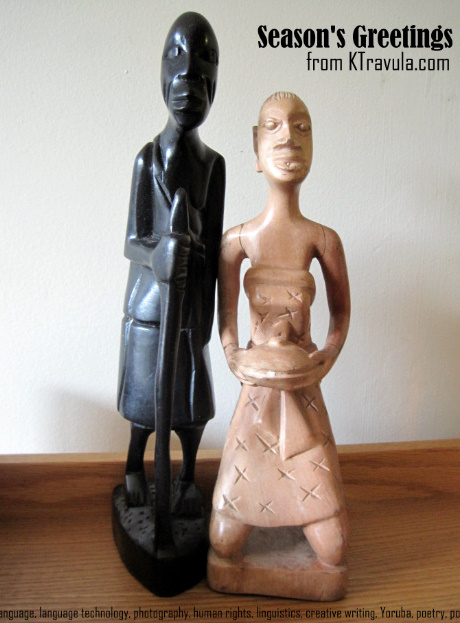
For your readership from the beginning of the year, for comments, word of mouth compliments, blog/twitter/facebook following, and support, here is wishing you a very happy holiday season, Merry Christmas, and a happy new year in advance.


The card was made from a picture of the first two carvings I brought with me to the United States in August 2009.

VN:F [1.9.17_1161]
Rating: 10.0/10 (1 vote cast)
VN:F [1.9.17_1161]
Rating: +1 (from 1 vote)
Share

The One Percent Project

Out of a need to save lives in Nigeria today comes this new idea called the One Percent Project. Nigeria, a country of over 160 million people, still gets by with a crippling healthcare system and a large portion of its population without access to adequate emergency care. 25% of maternal mortality today is due to unavailability of blood. The current blood donation and distribution system is poorly regulated and coordinated. Hospital based blood collection leads to a highly inefficient and fragmented system.

The recent UN bomb blast in Abuja is a case in point. Within minutes of the attack, the National Hospital in Abuja ran out of blood and many patients lay there, waiting to die. A bleeding trauma patient is said to need more than 100 units of blood. Blood usage today is growing at 3 times the national population growth and there is no other known substitute for human blood.  The Nigerian Ministry of Health estimates that 10% of HIV/AIDS infections in the country were caused by the use of unsafe blood. That is: 1 in 10 HIV positive people in Nigeria were infected because of unsafe blood transfusion.

The One Percent Project seeks to bridge this gap between blood donors and recipients. It is estimated that if one percent of all Nigerians (1.6 million people) will be willing to give blood when needed, much of the problem will be solved and over 13,500 lives of pregnant women and thousand others in need will be saved. With a need of about 1.5 million to 2 million pints of blood annually, the project hopes to recruit young voluntary non-remunerated blood donors. These donors will only have to sign up with One Percent, and share their location in the country. This information is then shared – as need be – with the National Blood Transfusion Service in Nigeria, and other hospitals, at their moment of need. With a database of 1.6 million people, there hopes to be at least one person near every emergency around the country who will show up when called upon to fulfil his/her pledge to donate blood when needed.

I’m involved in this project (along with a few other dedicated health professionals) and very passionate about its success. You should be too. If one percent of Nigerians to donate blood (3 times a year for women and 4 times a year for men), the problem is virtually solved. If you are reading this and you are a young Nigerian between the age of 17 and 65, or you have lived in the country for more than five years, please take a moment to complete this survey right now. It will take about five minutes. Then check out the website foronepercent.org. Follow the organization’s twitter account to get updates on the project and hear about blood drives coming near you. The organization also needs an army of volunteers to get the project working from the ground up in Nigeria. If we all will sign up to be called upon whenever a hospital near us needs blood to save lives, and we will heed that call, we can make a difference, one volunteer at a time.

(Please share this post on your networks)

VN:F [1.9.17_1161]
Rating: 0.0/10 (0 votes cast)
VN:F [1.9.17_1161]
Rating: +1 (from 1 vote)
Share

The Third Winter

Browning tar, a rote of car zoom noises around my window. The sun sets in a distance, a lot earlier than before, to a now conditioned amazement. Afternoon and night share a neighbourly block on the street of a dying year. Tick, tock, the clock hand counts the moments again in memories of times gone before. At a different time but in a similar pose, time counted down. The geese quacked. The refrigerator hummed creaky tunes in the middle of night. Ice formed into layers of sweat balls around the glass, and everything else stayed still.

The world has not changed since then, or has it? Many months of movements follow each other in steps of ease, and texts, and work, and revolts. And here we are, another winter, another dark evening at four o’ clock. It is a short remove from those quiet times, just two years ago, in the sober remove of a rustic village, but here it is. A year winds down with the last paces of its easing rote, crank and all.


VN:F [1.9.17_1161]
Rating: 0.0/10 (0 votes cast)
VN:F [1.9.17_1161]
Rating: +1 (from 1 vote)
Share

The Light in Double Equivalents

The outrage that greeted Republican front-runner Newt Gingrich’s recent comment about poor people stemmed mostly from his condescension, and not from the fact of his assertion. Speaking at a campaign in Iowa last week, two weeks after he had called the labour laws in America “truly stupid”, Mr. Gingrich said:

Really poor children in really poor neighborhoods have no habits of working and have nobody around them who works. So, they literally have no habit of showing up on Monday. They have no habit of staying all day. They have no habit of ‘I do this and you give me cash’ unless it’s illegal.

Coming from a middle-class background and growing up in Nigeria’s lousy economy of the 90s, I relate with much of what he said with regards to the habit of working. The disingenuity of the argument he makes, however, is in the way it casually omits the truth in a similar argument for the other side. Read below:

“Really rich children in really affluent neighborhoods have no habits of working and have nobody around them who works. So, they literally have no habit of showing up on Monday. They have no habit of staying all day. They have no habit of ‘I do this and you give me cash’ unless it’s for partying.”

Did you see what I did there? I substituted the words “poor” for “rich” and other “negative” equivalents for “positive” ones. Does that little trick change the truth in the assertion of Mr. Gingrich? No. The problem however is that he did not make this balanced claim. By focusing only one side and demonizing poor children, he pits himself on one side of the argument, and thus muddles the issue he was supposed to be solving. If the focus of his comment was to breed a culture of working, is there a particular reason why it should focus only on poor children?

Let me make a second example, also from Mr. Gingrich’s attempt at political commentary. While speaking with a Jewish television last week, Mr. Gingrich said that Palestinians are, after all, “an invented people” who didn’t exist as a nation until after the exit of the Ottoman empire. Of course, he was right. The people now referred to as the Palestinian people, now craving for a state of their own, are just Arab people living in the middle east. However, so are the Jewish people as well! The Jewish State of Israel (at least as we know it today) was just as well “invented” in self-determination after the Second World War. So why did Newt Gingrich not state the second equivalent truth of his assertion? Because it is not politically expedient, and – like other Republican candidates – all he wanted to do was to sound Pro-Israel than the incumbent president whose job he seeks.

Now, to my final two examples on this matter, this time on race. I found out to my chagrin that the most popular post on my earlier wordpress blog (before moving to this domain) has remained this one where I wondered if oyinbo - a Yoruba word for “white person” was a racist word. I knew it wasn’t, but I was interested in reader perspectives on the way a word conditions the way we look at the world and other people. I got feisty, energetic responses. But what struck me earlier this morning however is a fact that I had overlooked for too long: that more than half of what is considered racist – even here in the United States – were anything but. Here are two quotes, the first by Donald Trump: “I have a great relationship with the blacks,” said a few months ago to public outrage, and Ann Coulter’s “Our blacks are so much better than their blacks” – a reference to African-Americans in the Republican party as opposed to those in the Democratic party.

It is easy for me as an African to take umbrage at each of these statements (as I undoubtedly did for a few days without being able to lay my hands on why the statements seemed so jarring). A few months removed from the uttering of those words however, I finally got it. It took a short memory trip back to the sociopolitical environment of my home country. “I have a great relationship with the whites” would not have elicited such a public umbrage in Nigeria but it would have raised eyebrows of social awkwardness. There is a consensus that there is something awkward with a citizen who felt the need to associate himself with a particular race for political advantage. “Our whites are so much better than their whites” would have elicited a similar response of awkwardness, albeit with a heavy dose of scorn and derision. It definitely would take some self-loathing and inferiority complex to make such a public proclamation. Implicit in these statements however is the acceptance of the “otherness”, and thus the problem. In Nigeria, this “otherness” is accepted, considering our colonial history The “whites” are not one of us. In America, it is not, because of the country’s history of slavery and civil rights. The “blacks” are also Americans, and undeserving of such “otherization,” thus the outrage. If Mr. Trump had said “I have a great relationship with the Nigerians”, or Ann Coulter, “our Nigerians are better than their Nigerians,” no one would have taken notice.

There is something to be said for double equivalents. Some things don’t make much sense until we put them in front of a mirror of polar equivalents. Some don’t make sense at all, eventually, of course, but it sometimes helps to pare them off all their political overtones. Mister Trump and Miss Coulter get a pass from racism but not from bigotry, and Speaker Gingrich gets all the blame he very well deserves.

VN:F [1.9.17_1161]
Rating: 0.0/10 (0 votes cast)
VN:F [1.9.17_1161]
Rating: 0 (from 0 votes)
Share

End of Classes, and More

My presentation in class on Wednesday was my last in this Master’s program (baring a thesis defense, of course). It focused on a hypothetical lesson plan for second language teaching in a foreign country. One of the advantages of such assignment that allows for creativity is the chance it gives the student to make conjectures on things that may actually become future research areas. I am a teacher of English language in a high school in Kigali, Rwanda. That country emerged just a few years ago from a brutal civil war that tore the country into many ethnic parts. It has now adopted a policy of English language (over French and Kinyarwanda) in order to forge a more united country free of a colonial past, and with a view to a more globalized future.

What problem does such a job pose for both the student and the teacher, even beyond the usual problems of language acquisition? Socio-cultural attitudes of parents still hung up on ethnic and cultural identities and resistant to change? Government bureaucracy and a typical political gamesmanship that might deny funding for much of the initial experimentation that could amount in success? A problem of communication between teacher and student? (It’s hard enough for students to be learning a new language. If the teacher offering guidance for such teaching does not even share the linguistic identity of the students, the baggage of his “otherness” might be a little hard to overcome). What else? There are actually far more positives to the experiment, one of which is the delight of sharing cultural similarities and differences while at the same time sharing the knowledge of a connecting international language. Cultural exchange is after all always an learning stimulant.

I have good memories of my first major teaching experiences in the Nigerian middlebelt as a Youth Corper. Students delighted in their ability to communicate in Hausa and Berom even in our English classes. It was a battle that I struggled with all through the year, frustrated that the purpose of English education is defeated when students choose instead to resort to local codes at every moment of convenience. Other linguists working in the area of Second Language Acquisition have argued that there are positives in this model of acquisition where the pressure to always be right is taken off the shoulder of students and they are allowed to subconsciously acquire the second language. The problem in the application was the reluctance of the students themselves to even try since their mother tongues provided an easy alternative. (But then, a prominent educational research in Nigeria, particularly the Ife Six-Year Primary Project of 1989, showed that students taught in their mother tongues performed better in learning other subjects).

I find Second Language Acquisition extremely fascinating, and the prospect of teaching English in another country equally enticing. Rwanda presents a fascinating example of such intervention because it combines education with social work. A country willing to ditch a dividing legacy of multilingualism for a second foreign language presents a fascinating study. One of the best rewards for teaching – as I have realized from my years of involvement – is not just in the knowledge that the teacher brings into the class, but the ones he takes out of his interactions with his students. I believe that in the next century, the language of the world will not be this English language as we know it, of course, but something richer, encompassing the form and world-view of all the peoples through which it has passed. There is something to enjoy in the process of bringing that to existence.

VN:F [1.9.17_1161]
Rating: 0.0/10 (0 votes cast)
VN:F [1.9.17_1161]
Rating: 0 (from 0 votes)
Share
.