My most-recent recollection of self-consciousness about my hair must have been less than three weeks ago, even if it had always been in my subconscious one way or the other long before then. I do like my hair, and I’ve never had any problems with it except when it becomes too much to carry around, and I have dealt with that by cutting it down at the right time, getting a good comb, or wearing a nice-fitting cap. But a friend had looked at my hair during a minor discussion about interracial marriage and said “Whooo! I’d never ever want my child to have your kind of hair. It’s looks like jute! I would cry if I had to look at something like this on my child’s head every morning. How will I live with myself?” It would have been funny if she was only joking, but in the expressions of her hair preference for an unborn child, I found a certain seriousness that has kept the relevance of the issue around my head (no pun intended) for a while.
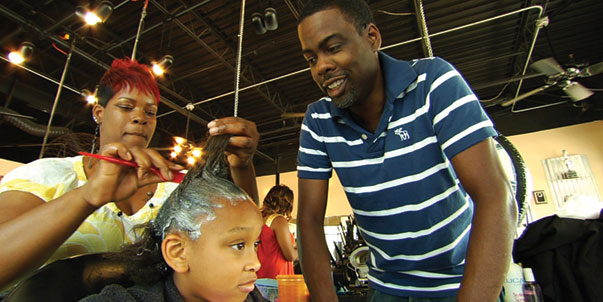 So when I finally sat down on Saturday to watch Chris Rock’s comedy/documentary called Good Hair to the end, I was prepared for a journey of discovery, pleased that someone was taking a journalistic trip into the politics, the culture and the world of hair, and I was there to witness it with him. Chris Rock has been one of my favourite comedians and thinkers, and I had heard good things about the movie. But all through the theatre run of Good Hair in the theatre, it just never showed up in Edwardsville, so I have had to wait for the DVD. Now that I am finally through with it, I can tell you without a doubt that it is one of the best documentaries I’ve seen in a long while. Ever.
The documentary according to Rock was inspired by his three year old daughter’s question to him about whether her hair was “good hair”. The pursuit of the answer to the question took the comedian around the world from his base in the United States to India where young religious women in the country volunteer to have their heads shaven in temples every time, to Los Angeles and Atlanta in the United States where said hair are eventually used as beauty enhancements after having been sold by the priests in whose temples the hairs were acquired, to the dealer who would later process them into a presentable and usable form. Apparently, as the movie shows, India is the biggest source of hair weaves and attachments to the developed world, especially black women. What Chris Rock very vividly portrays is not just a kind of displeasure of (black) women with their own hair types for a foreign one, but also their sometimes unexplainable nonchalance as to the implication of economic enslavement that comes with it. I grew up in a household of so many women so the idea of weaves is not strange to me, yet over the years of interaction with women either as family, friends, lovers or just plain acquaintances, I still haven’t got myself around the motivations that must fuel such an addiction to straightening, weaves, and a different kind of look than permitted by the hair’s natural characteristics.
So in putting the movie/documentary together, Chris Rock interviewed the Reverend Al Sharpton, the civil rights activist and a former James Brown fan whose physical identity is defined by his straightened all-back hairstyle; the poet and writer Maya Angelou who revealed to much surprise that she never used the “relaxer” until she was seventy years old; Nia Long, a hollywood actor with a fondness for weaves; Ice-T, who once confessed to have had a mug shot while wearing one of the hair rollers used after a relaxer; Eve, Salt N Pepa, and very many others ordinary Americans as regards their motivations, drawbacks and challenges of wearing weaves, as well as their dos and don’ts.
Dos:
(I can’t remember)
Don’ts:
Never touch a black woman’s hair (except you’re friends)
Never touch your girlfriend’s hair. (What? Yes, you heard right. Don’t do it, even while in bed together. Alright! I’d never heard this one before.)
(For women) Never immerse your hair in water, not even in the pool…
Don’t ask a (black) woman whether her hair is real or fake.
among many others.
The movie has however been criticized for failing to provide answers to the question of motivation of the women who go through extreme pain to look “good” with Sodium Hydroxide relaxers or imported Indian hair obtained mostly by some kind of exploitation, or whether the percentage of African and African-American women who prefer straightened or weaved hair fall into a majority. In my opinion, it wasn’t really the comedian’s place to provide such answers. From it’s very nature, the movie/documentary was made to be eye-opening through questions and queries rather than through answers through the actor’s mouth. And this format worked very well to take the viewer into the very many dimensions of the politics of hair.
From the despair in my Indian friend’s mind about the possibility of ever having a child with “jute” African hair, to the not favourable (or at least understandably condescending) perception that educated Indians must now have of Hollywood stars and ordinary African folks from all over the world who spend a fortune every year to acquire their kind of human hair, to the criminality of such religion that must brainwash young women to give up their hair for free as sacrifice to God while such is immediately sold for huge sums of money to the highest bidder, to the very many dynamics that makes the business of hair a multi-billion dollar industry in the world (with the black community occupying only on the paying – and not the earning – side), and the finickiness of all my female friends about how their hair looks whenever I whip out my camera for a quick shot, I have definitely found a renewed interest – thanks to Good Hair – in the phenomenon of women’s hair, and the cultural/economic/political dimensions of their shade, colour, length and style. And I’m not always pleased.
What I should add here is that the movie/documentary is VERY hilarious. What else would you expect from Chris Rock? Every family should watch it. Find the trailer here.