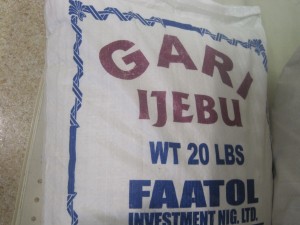
 It was just as well a case of serendipity, because when I went out to cut my hair on Friday, I didn’t have it in mind to run into another Nigerian restaurant at Edwardsville. For all I knew, the closest one to me was the one at St. Louis, forty minutes away by car. But I did run into an African market/stall run by a Nigerian, right beside the Barber’s shop. The woman who attended warmly to me was Igbo, from Abia state of Nigeria who also spoke fluent Yoruba and knew just what I would be wanting to buy: Ijebu Garri, Yam tubers, cans of sardine, frozen chicken, ewedu, sugarcane, and a whole lot of Nigerian-themed food items that I couldn’t find anywhere else. Ah yes, and plantain, which was the only thing I eventually bought since I wasn’t in the mood for any of the others at the moment of sudden discovery. She also found me quite amusing a tourist when I brought out my camera and started taking pictures. In any case, it was another very warm home experience. I drank malt, spoke Yoruba – and the little Igbo I could remember – and had a little political discussion about Nigeria, while showing off my new twenty naira notes which they hadn’t seen before. (Note: Nnenna from the shop has already left one comment on my Barber’s Shop post, which goes to shows that she kept her promise to check out my blog. Thanks again Nnenna for the hospitality.)
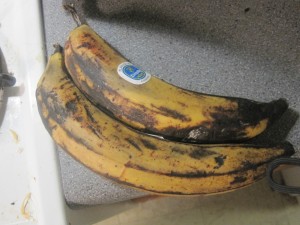 It was serendipity because just last week, the class consensus was an almost riotous but endearing request for Nigerian food before the end of the course. And as much as I tried to dodge the issue citing inability to get the foodstuff as well as the problem of conveying it to class in hot condition, I still wanted to give them an experience of the taste of Nigerian food and I despaired in me about how impossible it was going to be, especially since I feared a possible lawsuit from anyone that might find discomfort after a meal, and hold the teacher – me – responsible. But they made it clear that they wanted it too, so I spoke with Tola – a former FLTA (now a graduate student in the University) who said that we could work something out only if I could find the foodstuffs, and perhaps obtain a written consent from them absolving us of liability. It would prove not to be necessary in the end, as I luckily got sufficient plantain from the African shop, and woke up early enough today to prepare it to the best of ktravula‘s kitchen standards.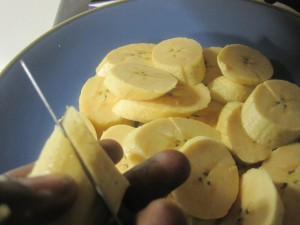
- Wash your hands
- Put a little vegetable/peanut/corn oil on the frying pan
- Open up plantains
- Slice them to the right sizes
- Add a little salt
- Put them in the now hot frying oil
- Wait until it’s golden brown
- Get them out of the oil into a clean plate
- Wait until it cools down a bit, and then put them all into a ziploc plastic bag.
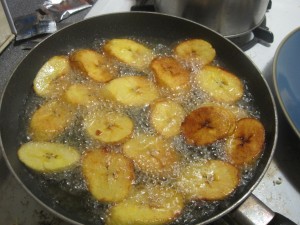
So it was probably a surprise to them today – the last class – for them to find that we were going to eat something after all. It was not the most quintessential Yoruba food, but it was representative of something that we eat and they did not, until today. Many of them hadn’t even seen the plantain before. Of course, the feeding was preceded with a little slide show of the production process, just in case they want to try it out at home as well, but mostly so that they know that it wasn’t such a complicated cooking process. I was glad that everyone had a taste, said they liked it, and showed sufficient curiosity about how we eat it at home. One person wanted to know with which sauce and which other food we would usually eat it with. It was learning in a new way. I also showed them sugarcane, which everyone seemed to be seeing for the very first time, ever. (Thanks again to Nnenna for the sugarcanes.) I was definitely new to me that most of the people I showed the sugarcane to, even before I came to class, didn’t know what it was. Most said it was “bamboo”. Apparently, having eaten sugar is not always a guarantee that one knew just from what it came. Maybe the sugarcane is a tropical plant after all, native to Africa, Asia and some warm parts of South America.
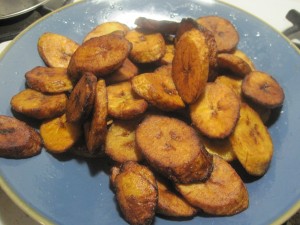 With this, my teaching class for this semester has now come to an end. The class that began with a memorable encounter over thirteen weeks ago seemed to have gone by so fast. And just before an emotional group photo and final dispersal, we shared a few jokes, revisions, small talks (which included my blog information and experiences), and a shared wonder at how fast the time had gone, and how much we have learnt from one another. The individual class essays from student about their class experience are now with me, for grading, and the contents are enlightening. We were dispersing in the flesh, but the shared community of our collective experiences would live with me for a long time to come, surely longer than the taste of dodo in my mouth – the plantain snacks from Yorubaland that was really our first, and last, communal supper.