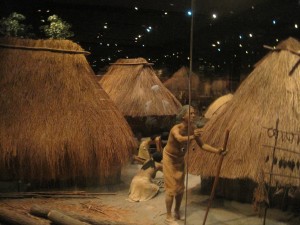
 Occupying over 2,200 acres of land space near Collinsville, Illinois, is an old Native-American settlement called Cahokia. It was so named after a tribe of indigenous and ingenuous native people who occupied the spot thousands of years ago and built a city that was at a time bigger than the city of London. Today, due to a reason not yet fully discovered and reconstructed, the city of Cahokia is non-existent, except for its various landmarks of man-made mounds, numbering between 80 and 120, left by the people as they either moved away to other parts of the country, or died off from the face of the earth. The space on which they lived and prospered as a city has now been made into a National Historic Landmark/Museum, and a World Heritage Site of the United Nations. It is a reconstructed replica of the components of the old Native-American city when it was still fully functional, and it is called the Cahokia Mounds. According to Wikipedia, it is “the largest archaeological site related to the Mississippian culture, which developed advanced societies in eastern North America centuries before the arrival of Europeans. I was there today, and it was enlightening.
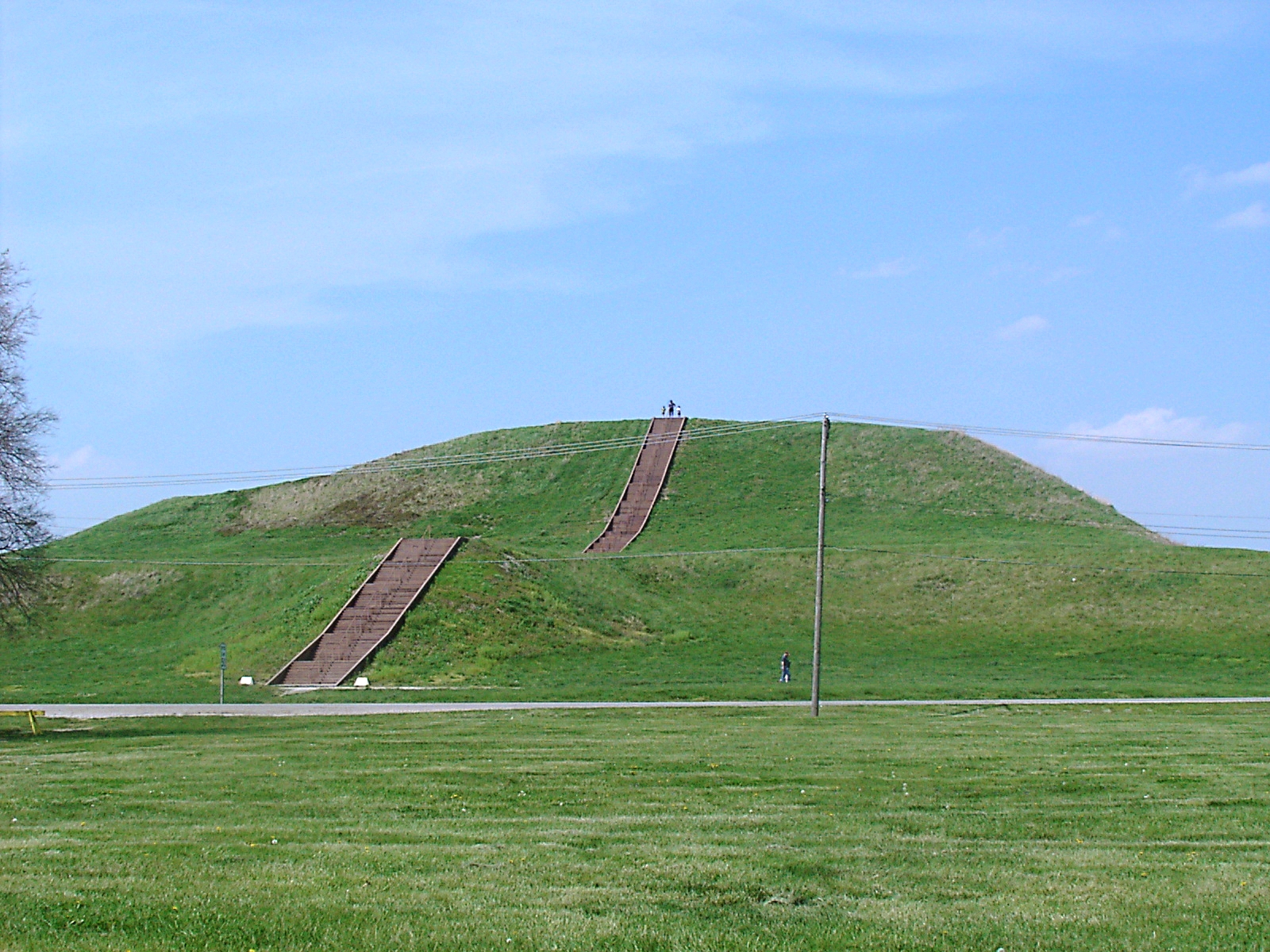
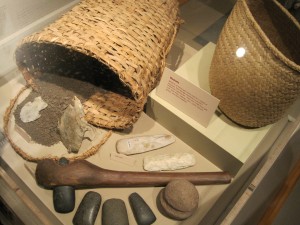 The site is basically an expanse of land with many mounds – or let’s say man-made hills. Excavations done there over the years have produced evidence that archeologists have used to learn all they now know about the place, their tools, their clothings, their burial practices and their system of government.
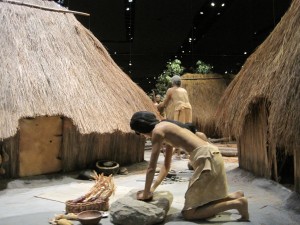
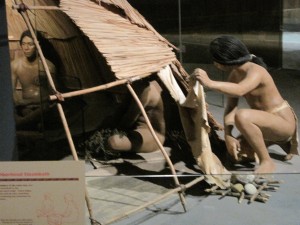
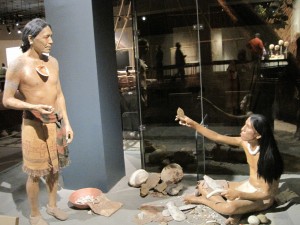
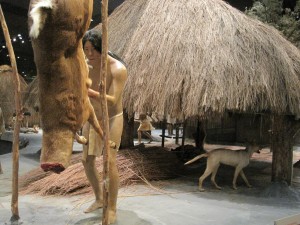
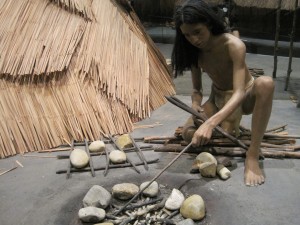
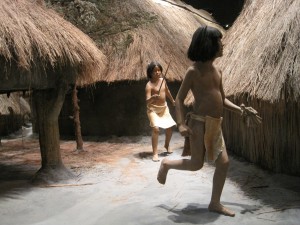
Walking through the on-site museum which features real-size wax/clay forms of Cahokia’s people and animals, the most memorable thing that struck me throughout was how similar the culture of this community of dark-skinned people that occupied the city was to those of old African villages that I know. The museum has exhibits of the excavations as well as pictures, signs and statistics on the wall, along with real-life wax reconstructions of people in their natural environment, their habitat and their habits (pictured). They ground food with stones on the floor, they wore minimal clothing (presumably only in the summer, because I know how cold it can get around here), they lived in huts made of soft grass, and they hunted with spears and stone tools. It was also memorable that the city had thrived during the same time of the great kingdoms of West Africa before the coming of the Europeans. How they were eventually decimated has not been explained, but one of the picture exhibits of bone samples excavated over the years tell of signs of “urban stress” which included infection, diseases and dietary deficiencies. Each of the mounds around the site are supposedly representative of spots in the plan of the city where particularly memorable events and festivals took place. The largest of the mounds, with its original wooden staircase was said to house the head chief and his court. It was from there that he administered the expanse that is Cahokia, and from there, he could see almost to the end of his kingdom.
 Another most thrilling discovery I made was this: a spinning toy belonging to old Cahokia which was made of a little round wheel and a short thread that runs through it. It worked like this: with a little spin by one of the two hands that hold the thread on each side, the wheel rolled on for a while, and when the user pulled the thread apart, the wheel spins by itself clockwise, anti-clockwise, and then clockwise again in perpetuity as long as the user kept pulling the thread apart in either directions. Those who grew up in rural, or at least fun and playful neighbourhoods, in Western Nigeria would remember the same replica which was fashioned with the cap of soda bottles made flat and punctured with two holes. Check out the picture to the right and tell me if you see a difference. Holding it in my hand today brought back a cold thrill of an almost forgotten past. And yet, here I was Cahokia, and not in Akobò.
The facility also included a theatre where we saw a video show about Cahokia itself. It has a gift shop also, and a picture art gallery. The event was paid for by the Fulbright Midwest Association, and I went along with Reham and a Geography Professor from SIUE who’s originally from Nigeria. I had a nice time, and I was informed. And from there, we went up the St. Louis Arch. Wait for it… it was magical. The Cahokia story is one that is quite famous around Illinois, and no visit to the state should be complete without a visit to the site that shows not only the ingenuity of a native people with dark skin that lived thousands of years before the coming of the Europeans, but also the gains of archeology in preserving, documenting and interpreting history.
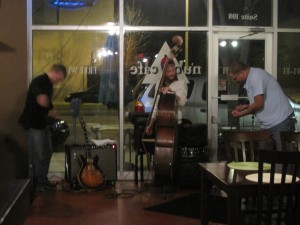
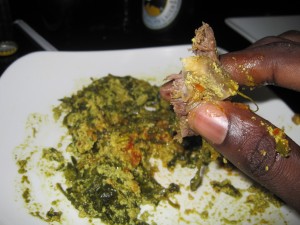
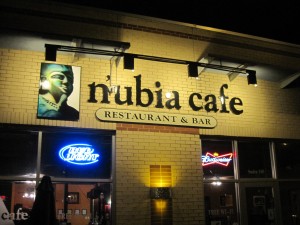 And so tonight after a drought of three months and more, I arrived home, and in heaven, with all but the seventy welcoming virgins, of course. It started as a jest and mild daring that we would drive down to St. Louis to check out the “African” restaurants. I had had a few apples and was just hoping to go to bed but the trip proved a little too tempting to pass, so we – Mafoya the Beninoise, Ben the American and I the traveller hopped in the car and drove to St. Louis, seeking a place called “Nubia Cafe.” The name did not suggest anything other than African so believed that I was going to at least find something to my taste, just like I did in the Indian restaurant in Chicago. At least it was peppery (read spicy) enough to my African tongue.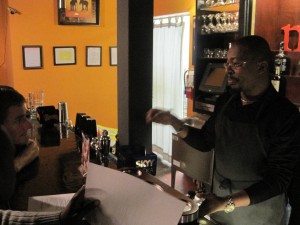
 HOW LONG HAVE YOU BEEN HERE?
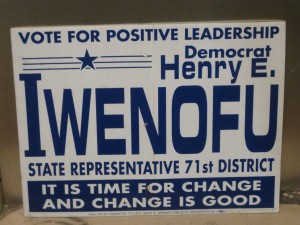
 There is a little board sign beside the counter bearing his name. “I contested in the last election for a council seat.” He said. “I didn’t win, but I got some votes.”
 DO YOU SERVE PALM WINE?
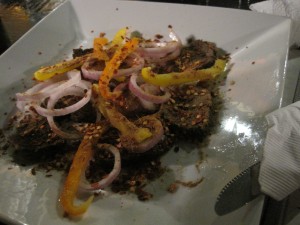
 Drinks: Tusker beer from Kenya (Comments: none)
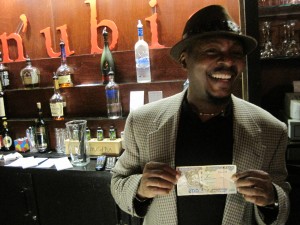
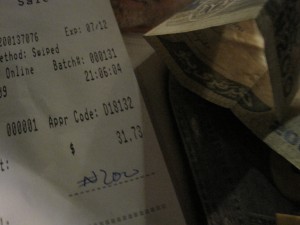 The other woman who had welcomed us in with a smile turned out to be from Tennessee, and she found the whole show we had put up to be very amusing. She was going to find it a lot more amusing when, as it was time for us to pay and head back to Edwardsville, I looked at the bill and had a very bright idea. Since I’ve been in the US, I’ve been gradually initiated into the tipping culture and found a certain joy in leaving little change for the people who had made effort (don’t tell me it’s their job) to provide good quality service. So to show my appreciation tonight, I looked into my purse and brought out the crispiest – well, not necessarily the crispiest – of my Nigerian currency notes. It was a two hundred. I had brought the Nigerian currency notes along to the States only to show my students (and some of them have actually “won” a few of them for keeps while answering questions in class), and for other unexplainable reasons, but as I looked at the space for tips on the bill, I could think of nothing more appropriate to give back to this long range traveller like me than a small piece of home.